
John Bligh
Royal Navy officer during the American War of Independence and the French Revolutionary and Napoleonic Wars.
About John Bligh
Lived 1770 – 1831 (aged 60). John Bligh was a British naval officer.
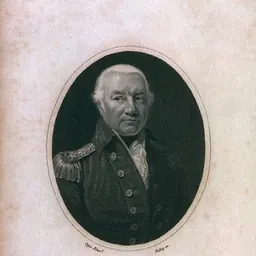
Rear-Admiral John Bligh CB (August 1770 – 19 January 1831) was an officer in the Royal Navy who served during the American War of Independence and the French Revolutionary and Napoleonic Wars.
Bligh was born into a naval family and served on a variety of ships from a young age, moving up through the ranks to lieutenant prior to the outbreak of the wars with France. He was in the East Indies when war broke out, but returning to Britain he saw action in the Mediterranean during the early attacks on Corsica, the Siege of Toulon and the Battle of Cape St Vincent. Promoted to his own commands in 1797, he was the victim of a mutiny on his ship, when his crew joined the larger mutinies at Spithead, and was sent ashore. He returned after it had ended and went on to serve at Newfoundland, before beginning a long period of distinguished service in the Caribbean. He was active in the Blockade of Saint-Domingue after the outbreak of the Napoleonic Wars, and arranged the surrender and evacuation of several French-held positions. He then took charge of an expedition to Curaçao, but withdrew his forces in the face of heavy opposition. His final actions there involved several successes against enemy privateers and merchant shipping.
Returning to Britain in 1806, Bligh went out with the fleet to the Baltic and was present at the Battle of Copenhagen. He then sailed to the Portuguese coast, where he was active landing troops and supporting the army's operations there. He was involved in the Battle of the Basque Roads in 1809, directing efforts to destroy several grounded French ships. While cruising off Belle Île in 1810 he had the good fortune to intercept a French vessel carrying the wealth of the merchants of Île de France back to France. Suddenly wealthy from the prize money and in weakening health after his long service in the tropics, Bligh retired ashore. He settled on the south coast, receiving an appointment as a Companion of the Bath, and a promotion to rear-admiral before his death in 1831.
Family and early life Bligh was born in Guildford in August 1770, the son of the naval officer Commander John Bligh, and his wife Elizabeth, née Titcher. He attended the Royal Grammar School, Guildford until joining the Navy on 22 January 1780, becoming a captain's servant aboard the 28-gun . Nemesis was at this time commanded by John's uncle, Richard Rodney Bligh. After service here he was rated midshipman and moved to the 74-gun on 28 August 1782. Waldegrave took her out to the Mediterranean and Bligh served aboard her during operations there under Commodore Robert Linzee against the Corsican town of St Fiorenzo. Bligh was present in this post at the Battle of Cape St Vincent on 14 February 1797, and having acquitted himself well in action, was promoted to commander on 8 March 1797 and given the sloop for service on the Portuguese coast. Latona then went out to Newfoundland as Waldegrave's flagship after his appointment as Commodore Governor there. Bligh then took command of Waldegrave's new flagship, the 64-gun , in January 1798 and commanded her until the expiration of Waldegrave's tenure at Newfoundland, in 1800.
Napoleonic Wars
Blockade of Cap-Français
Bligh initially blockaded Cap-Français but was unable to prevent it from being resupplied by small vessels operating from Saint-Domingue's northern ports. He decided to launch an attack on Fort-Dauphin, intending on capturing it along with taking or destroying the 28-gun frigate Sagesse that lay in its harbour. Bligh accepted their surrender and evacuated the garrison to Cap-Français after having the fort's guns spiked and its ammunition destroyed.
Attack on Curaçao Having performed these duties Bligh sailed to Jamaica and was given command of a squadron of three ships of the line and two frigates by Sir John Duckworth with orders to attack the Dutch-held island of Curaçao. Duckworth had received intelligence that the Dutch had not been able to reinforce the island and consequently it was only lightly defended. Bligh sailed to the island with his squadron, expecting to face only 160 men and a frigate, and with the garrison apparently having been further reduced by disease. After arriving off the island, Bligh sent an officer to negotiate with the island's governor. The Dutch refused to surrender and Bligh began to blockade the island and begin preparations to force a landing. Having secured a landing site, Bligh sent 600 men ashore and landed some cannon, which he placed so as to be able to bombard Fort Republique and the town of St Anne. Contrary to reports, the Dutch had received significant reinforcements and though Bligh was able to set part of the town on fire, he was forced to constantly skirmish with Dutch forces, which numbered around 500 men. Though the Dutch were continually repulsed, British losses mounted, exacerbated by outbreaks of dysentery. Though the British force had failed to capture the island, Duckworth was sympathetic, and felt that Bligh could have succeeded had the men and guns of HMS Vanguard been at his disposal. He made a night-time landing on the Spanish island of Saint Andreas, capturing the garrison and the governor, and taking them away as prisoners of war. Bligh also oversaw the landing of various divisions as the army advanced, landing 3,500 men under General Robert Anstruther on 18 August and 6,500 men under General Wroth Palmer Acland on 20 August.
Capture of Confiance Bligh then resumed his station with the Channel Fleet, patrolling off the French ports. On 3 February 1810 he came across the French ship Confiance, a former frigate that had been purchased by the merchants of the Île de France to transport their goods back to France. Her cargo was valued at £800,000, of which Bligh received £14,041.
Later life and family By now extremely wealthy from prize money, Bligh remained captain of Valiant until May 1810, when ill health forced his resignation.
Don’t just read it —
keep it.
Full-length biographies made to live with: read them, listen on the way to work, watch them tonight.
- E-book
- Audio
- Video
Instant download · yours to keep · every purchase keeps this site free
Important facts
People in John Bligh's life
Named in this biography and alive at the same time


Related people
Same field, nearest in time



Contemporaries
People whose lives overlapped John Bligh's





Frequently asked questions
Who was John Bligh?
Royal Navy officer during the American War of Independence and the French Revolutionary and Napoleonic Wars.
When was John Bligh born?
John Bligh was born on 1 August 1770 in Guildford.
When did John Bligh die?
John Bligh died on 19 January 1831 in Hambledon.
What was John Bligh's occupation?
John Bligh was a naval officer.
What nationality was John Bligh?
John Bligh was British.
Sources & further reading
· DBpedia: John Bligh (Royal Navy officer)
Cite this page
APA: Biography.guide. (2026). John Bligh. https://biography.guide/john-bligh/
MLA: "John Bligh." Biography.guide, https://biography.guide/john-bligh/.
Chicago: "John Bligh." Biography.guide. https://biography.guide/john-bligh/.
Data last updated: 2026-09-20 · Spot an error? Report a correction.
Page generated 2026-09-27 05:13 UTC