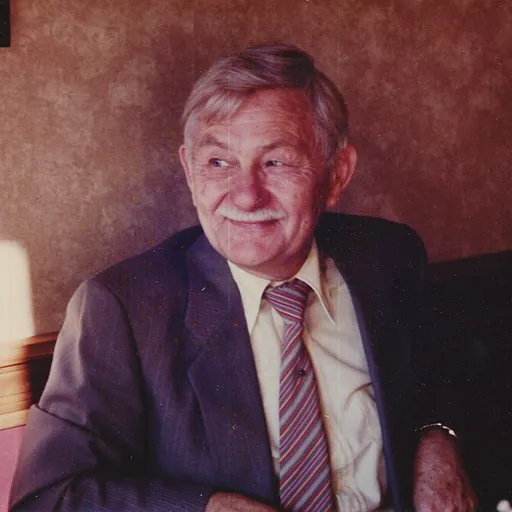
About John B. Calhoun
Lived 1917 – 1995 (aged 78). John B. Calhoun was an American psychologist and ethologist.
John Bumpass Calhoun (; May 11, 1917 – September 7, 1995) was an American ethologist and behavioral researcher noted for his studies of population density and its effects on behavior. He claimed that his observations of the bleak effects of overpopulation on rodents were a grim preview for the future of the human race. During his studies, Calhoun coined the terms "behavioral sink" to describe aberrant behaviors in overcrowded situations, and "beautiful ones" to characterize passive individuals who withdraw from all social interaction under extreme population density.
Calhoun's work gained worldwide recognition. He spoke at international conferences and his opinion was sought by groups as diverse as NASA and the District of Columbia's panel on overcrowding in local jails. His rat and mouse studies were a basis for the development of Edward T. Hall's ideas on proxemics. Calhoun's seminal 1962 Scientific American article on "Population Density and Social Pathology" fueled fears of the dystopian effects of human overpopulation, which Paul Ehrlich predicted in his 1968 bestseller The Population Bomb.
Early life and education John Calhoun was born May 11, 1917, in the tiny rural town of Elkton, Tennessee. His parents were James Calhoun, a high school principal who rose through the ranks of the Tennessee Department of Education; and Fern Madole Calhoun, a kindergarten teacher. John had three siblings: an older sister, Polly; and two younger brothers, Billy and Dan. When John was still an infant, the Calhouns moved from Elkton to Winchester, Tennessee. After he completed kindergarten (taught by his mother), the family moved to the small rural town of Brownsboro, Tennessee. John would later refer to himself as a "Tennessee country boy".
In 1930, when John was 13, his father was promoted to the Tennessee school board, and the family relocated to Nashville. Shortly after, John began attending meetings of the Tennessee Ornithological Society. Amelia Laskey, distinguished for her work in bird banding and in the study of the chimney swift, was a pivotal influence on his developing interest in birds and bird habits. John spent much of his junior and senior high school years banding birds and observing their behavior.
Despite his father's refusal to help him attend an out-of-state university, John made his way to the University of Virginia where he obtained a bachelor's degree in biology in 1939. In his third year in 1938, he published his first scientific paper, titled "Swift Banding at Nashville and Clarksville"; it appeared in The Migrant, the journal of the Tennessee Ornithological Society. Over the summer, he worked for Alexander Wetmore, head of the Smithsonian Institution in Washington, D.C., doing ornithology research. Calhoun attended graduate school at Northwestern University where he earned an M.S. in biology, and a Ph.D. in ethology in 1943. His dissertation was on the activity rhythms of two rodents, prairie voles and Hispid cotton rats.
While at Northwestern University, Calhoun met Edith Gressley, an undergraduate biology major. They married in 1942. They had two daughters together and remained married until the end of Calhoun's life.
Career Early rat studies After graduating from Northwestern, Calhoun taught at Emory University and Ohio State University. In 1946, he and Edith moved to Towson, Maryland, a suburb of Baltimore. Calhoun worked on the Rodent Ecology Project at Johns Hopkins University. The project was testing a new poison that would kill rats in downtown Baltimore. Moreover, the rats were not randomly scattered throughout the pen area, but had organized themselves into twelve or thirteen local colonies of a dozen rats each. He noted that twelve rats seemed to be the optimal number that can live harmoniously in a natural group, beyond which stress and psychological effects function as group break-up forces.
In Calhoun's next posting, at Jackson Laboratory in Bar Harbor, Maine, in 1951, he once more studied a colony of Norway rats. During this period, his first daughter, Catherine "Cat" Calhoun, was born. The family was living at the time in the guesthouse on the Luquer estate.
In late 1951, the Calhouns moved back to Silver Spring, Maryland. He worked for Walter Reed Army Medical Center in the neuropsychiatry division before gaining a position in 1954 at the National Institutes of Health, where he would be employed for the next 32 years. 1954 was also when his second daughter, Cheshire Calhoun, was born.
Norway rat experiments Calhoun pursued his experiments in rodent behavior, using domesticated Norway rats, at his lab on the second floor of a huge barn on the Casey farm outside Rockville, Maryland. The area is now a suburban center but the barn still stands, renovated for suburban usage. In the days of Calhoun's occupancy, there was a small, cluttered office area at the top of the stairs. The rodent odor was said to be overpowering, and it took some time before one could breathe normally.
The research area was divided into three parts. In the center section, a box-like room was built. There was a hallway all the way around the box, and stairs that led to the top of it. The box was divided into four rooms, or habitats. Each room had a door for a researcher or caretaker to enter by, and in the ceiling of each room was a glass window. The activity in each room could be observed through these windows. Each room was divided into quarters by partitions. V-shaped ramps connected pens I and II, II and III, and III and IV. Pens I and IV were not connected. Mounted on the wall in the corner of each quarter was an artificial burrow, which could be accessed via a spiral staircase. In two of the quarters, the "burrows" were from the floor, and in the other two the "burrows" were from the floor. Each quarter also contained a drinking station and a feeding station. These variations in environment led to differences in behavior patterns and ultimately to the concept of "behavioral sinks".
The research carried on in this lab (labeled the "Casey Barn") began in 1958 and lasted until 1962. In that year, he published a monograph, The Ecology and Sociology of Norway Rats. It was unusual then to associate the word "sociology"—normally reserved for the study of humans—with animal subjects, but it indicated Calhoun's growing belief that his rodent colonies could shed light on the social problems of humans. For more than a decade, the Space Cadets met two or three days each year, and the lively exchange of ideas stimulated Calhoun's thinking. It prompted him to question the existing literature on population growth in animals and humans. With help from his mathematician colleagues, Calhoun constructed a new statistical model to predict the level of "social welfare" in a rodent colony. The model's three key variables were: "the number of animals interacting with one another, the time between when an animal ended one social interaction and when it began another (the 'refractory' period), and the size of the space in which social interactions took place."
Mouse experiments
In the early 1960s, NIMH acquired rural property outside Poolesville, Maryland. The facility that was built on the property housed several research projects, including those headed by Calhoun. It was here that he conducted his landmark experiments with mouse universes , the most famous of which was called "Universe 25". In July 1968, four pairs of mice were introduced into the habitat, which was a square metal pen with sides. Each side had four groups of four vertical, wire mesh "tunnels". The "tunnels" gave access to nesting boxes, food hoppers, and water dispensers. There was no shortage of food or water or nesting material. There were no predators. The only adversity was the limit on space.
The conclusions drawn from this experiment were that when all available space is taken and all social roles filled, competition and the stresses experienced by the individuals will result in a total breakdown in complex social behaviors, ultimately leading to the demise of the population. Calhoun summarized his findings in a paper, "Death Squared: The Explosive Growth and Demise of a Mouse Population", which he delivered as a speech in 1972 before an audience at the Royal Society of Medicine in London:
Calhoun saw the fate of the mouse population as an omen for the fate of an overcrowded human population.
Later research
In the 1970s and early 1980s, Calhoun operated Universe 33 for mice, and Universe 34 for rats, and extended the experiments which had brought him renown. He observed more evidence of behavioral sink as the rodent populations grew.
He continued to speak and write about an idea he first proposed at a 1968 American Association for the Advancement of Science (AAAS) symposium. He believed that the human brain had reached its "maximum functional potential" and must be augmented by "thinking prostheses" which would connect individuals in a common communication network. He researched the idea in the 1970s and, at the 1982 annual AAAS meeting, he delivered a paper on the topic, "The Transitional Phase in Knowledge Evolution", in which he stated: "The next phase shift in evolution should utilize computer-like devices and interlinked systems of them to simulate biological brain function to manipulate more effectively thought products of the human brain and process them for return use in human reflection." His supporters later claimed he was anticipating the development of the World Wide Web. His papers were donated to the National Library of Medicine by Edith Calhoun and by the American Heritage Center.
Influence and legacy Calhoun's mouse experiments have been cited by writers such as Bill Perkins as a warning of the dangers of living in an "increasingly crowded and impersonal world". Others took different lessons; medical historian Edmund Ramsden hypothesized that the mouse society collapsed from excessive social interaction, rather than density per se. A writer in io9 stated, "Instead of a population problem, one could argue that (the mouse universe) had a fair distribution problem."
In the mid-1960s, Steve Suomi was a research assistant to Professor Paul Ehrlich, a population ecologist at Stanford University. Having been deeply fascinated by Calhoun's 1962 Scientific American article, "Population Density and Social Pathology", Suomi presented Ehrlich with a synopsis of the article, which was then alluded to in Ehrlich's 1968 bestseller The Population Bomb: However, Ehrlich quickly added a caveat: "But extrapolating from the behavior of rats to the behavior of human beings is much more risky than extrapolating from the physiology of rats to the physiology of human beings. Man's physical characteristics are much more ratlike than are his social systems."
Mrs. Frisby and the Rats of NIMH (1973), by Robert C. O'Brien and published in 1971, was inspired by Calhoun's work;
Calhoun's "behavioral sink" phrase has been used in reference to perceived urban moral degradation. In 1966, author Tom Wolfe popularized the phrase when he published an essay, "O Rotten GothamSliding Down into the Behavioral Sink", in the New York World Journal Tribune after learning about Calhoun's rat experiments.
Calhoun's scientific legacy has been subject to debate, with some scientists questioning the methodologies he used. Jon Day writes:
Don’t just read it —
keep it.
Full-length biographies made to live with: read them, listen on the way to work, watch them tonight.
- E-book
- Audio
- Video
Instant download · yours to keep · every purchase keeps this site free
Important facts
People in John B. Calhoun's life
Named in this biography and alive at the same time






Related people
Same field, nearest in time


Contemporaries
People whose lives overlapped John B. Calhoun's

Frequently asked questions
Who was John B. Calhoun?
American ethologist and behavioral researcher (1917–1995)
When was John B. Calhoun born?
John B. Calhoun was born on 11 May 1917 in Elkton.
When did John B. Calhoun die?
John B. Calhoun died on 7 September 1995 in Tennessee.
What was John B. Calhoun's occupation?
John B. Calhoun was a psychologist and ethologist.
What nationality was John B. Calhoun?
John B. Calhoun was American.
Sources & further reading
Cite this page
APA: Biography.guide. (2026). John B. Calhoun. https://biography.guide/john-b-calhoun/
MLA: "John B. Calhoun." Biography.guide, https://biography.guide/john-b-calhoun/.
Chicago: "John B. Calhoun." Biography.guide. https://biography.guide/john-b-calhoun/.
Data last updated: 2026-09-22 · Spot an error? Report a correction.
Page generated 2026-09-27 05:10 UTC