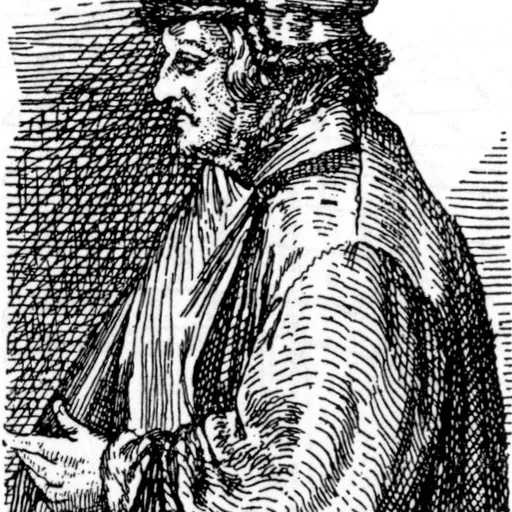
About Johannes Werner
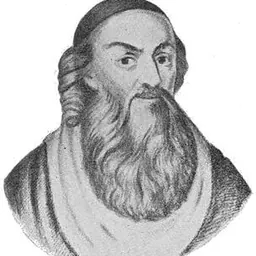
Lived 1468 – 1522 (aged 53–54). Johannes Werner was a mathematician, astronomer, cartographer, astrologer and cleric.
Johann(es) Werner (; February 14, 1468 – May 1522) was a German mathematician. He was born in Nuremberg, Germany, where he became a parish priest. His primary work was in astronomy, mathematics, and geography, although he was also considered a skilled instrument maker.
Mathematics His mathematical works were in the areas of spherical trigonometry, as well as conic sections. He published an original work on conic sections in 1522 and is one of several mathematicians sometimes credited with the invention of prosthaphaeresis, which simplifies tedious computations by the use of trigonometric formulas, sometimes called Werner's formulas.
Astronomy In 1500 he observed a comet, and kept observations of its movements from June 1 until the 24th.
Geography He is most noted for his work, , published in Nuremberg in 1514, a translation of Claudius Ptolemy's Geography. In it, he refined and promoted the Werner map projection, a cordiform (heart-shape) projection map that had been developed by Johannes Stabius (Stab) of Vienna around 1500. This projection would be used for world maps and some continental maps through the 16th century and into the 17th century. It was used by Mercator, Oronce Fine, and Ortelius in the late 16th century for maps of Asia and Africa. By the 18th century, it was replaced by the Bonne projection for continental maps. The Werner projection is only used today for instructional purposes and as a novelty.
In this work, Werner also proposed an astronomical method to determine longitude, by measuring the position of the moon relative to the background stars. The idea was later discussed in detail by Petrus Apianus in his (Landshut 1524) and became known as the lunar distance method.
Meteorology Many consider Werner as a pioneer of modern meteorology and weather forecasting. Between 1513 and 1520, Johann Werner made the first regular observations of the weather conditions in Germany.
Notable publications , Nürnberg 1514 , Nürnberg, Petrejus 1522 , Leibzig, B.G. Teubner 1907 [written early 16th century]. , 1546
Honours
The crater Werner on the Moon is named after him.
Some of the trigonometric identities used in prosthaphaeresis, an early method for rapid computation of products, were named Werner formulas in honor of Werner's role in development of the algorithm.
Don’t just read it —
keep it.
Full-length biographies made to live with: read them, listen on the way to work, watch them tonight.
- E-book
- Audio
- Video
Instant download · yours to keep · every purchase keeps this site free
Important facts
People in Johannes Werner's life
Named in this biography and alive at the same time


Related people
Same field, nearest in time
Contemporaries
People whose lives overlapped Johannes Werner's





Frequently asked questions
Who was Johannes Werner?
German mathematician
When was Johannes Werner born?
Johannes Werner was born on 14 February 1468 in Nuremberg.
When did Johannes Werner die?
Johannes Werner died in 1522 in Nuremberg.
What was Johannes Werner's occupation?
Johannes Werner was a mathematician, astronomer, cartographer, astrologer and cleric.
What nationality was Johannes Werner?
Johannes Werner's recorded nationality: Bavaria-Munich.
Sources & further reading
Cite this page
APA: Biography.guide. (2026). Johannes Werner. https://biography.guide/johannes-werner/
MLA: "Johannes Werner." Biography.guide, https://biography.guide/johannes-werner/.
Chicago: "Johannes Werner." Biography.guide. https://biography.guide/johannes-werner/.
Data last updated: 2026-09-21 · Spot an error? Report a correction.
Portrait: Wikimedia Commons · author & licence
Page generated 2026-09-27 05:00 UTC