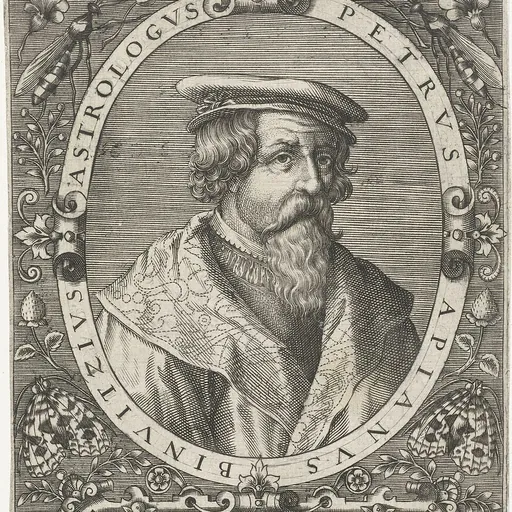
Petrus Apianus
German astronomer, mathematician and cartographer
About Petrus Apianus
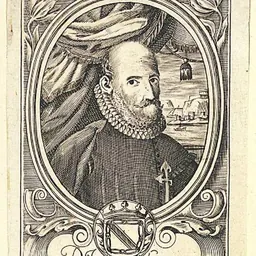
Lived 1495 – 1552 (aged 57). Petrus Apianus was a German mathematician, astronomer, cartographer, university teacher, cosmographer and publisher.
Petrus Apianus (April 16, 1495 – April 21, 1552), also known as Peter Apian, Peter Bennewitz, and Peter Bienewitz, was a German humanist, known for his works in mathematics, astronomy and cartography. and asteroid 19139 Apian are named in his honour. Later editions were produced by Gemma Frisius.
In 1527, Apianus was called to the University of Ingolstadt as a mathematician and printer. His print shop started small. Among the first books he printed were the writings of Johann Eck, Martin Luther's antagonist. This print shop was active between 1543 and 1540 and became well known for its high-quality editions of geographic and cartographic works. It is thought that he used stereotype printing techniques on woodblocks. The printer's logo included the motto Industria superat vires in Greek, Hebrew, and Latin around the figure of a boy.
Through his work, Apianus became a favourite of emperor Charles V, who had praised Cosmographicus liber at the Imperial Diet of 1530 and granted him a printing monopoly in 1532 and 1534. In 1535, the emperor made Apianus an armiger, i.e. granted him the right to display a coat of arms. In 1540, Apianus printed the Astronomicum Caesareum, dedicated to Charles V. Charles promised him a truly royal sum (3,000 golden guilders), appointed him his court mathematician, and made him a Reichsritter (a free imperial knight) and in 1544 even an Imperial Count Palatine. All this furthered Apianus's reputation as an eminent scientist. Astronomicum Caesareum is noted for its visual appeal. Printed and bound decoratively, with about 100 known copies, it included several Volvelles that allowed users to calculate dates, the positions of constellations and so on. Apianus noted that it took a month to produce some of the plates. Thirty-five octagonal paper cut instruments were included with woodcuts that are thought to have been made by Hans Brosamer who may have trained under Lucas Cranach, Sr. in Wittemberg. It also incorporated star and constellation names from the work of the Arab astronomer Azophi (Abd al-Rahman al-Sufi Apianus is also remembered for publishing the only known depiction of the Bedouin constellations in 1533. On this map Ursa Minor is an old woman and three maidens, Draco is four camels, and Cepheus was illustrated as a shepherd with sheep and a dog.
Despite many calls from other universities, including Leipzig, Padua, Tübingen, and Vienna, Apianus remained in Ingolstadt until his death. He neglected his teaching duties. Apianus's work included in mathematics – in 1527 he published a variation of Pascal's triangle, and in 1534 a table of sines – as well as astronomy. In 1531, he observed Halley's Comet and noted that a comet's tail always point away from the sun. Girolamo Fracastoro also detected this in 1531, but Apianus's publication was the first to also include graphics. He designed sundials, published manuals for astronomical instruments and crafted volvelles ("Apian wheels"), measuring instruments useful for calculating time and distance for astronomical and astrological applications.
Apianus married Katharina Mosner, the daughter of a councilman of Landshut, in 1526. They had fourteen children together – five daughters and nine sons. One of their children was Philipp Apian (1531–1589), who preserved the legacy of his father, in addition to his own research.
Works
(also called Cosmographia)
Ein newe und wolgegründete underweisung aller Kauffmanns Rechnung in dreyen Büchern, mit schönen Regeln und fragstücken begriffen, Ingolstadt 1527. A handbook of commercial arithmetic; depicted in the painting The Ambassadors by Hans Holbein the Younger. Cosmographiae introductio, cum quibusdam Geometriae ac Astronomiae principiis ad eam rem necessariis, Ingolstadt 1529. Ein kurtzer bericht der Observation unnd urtels des jüngst erschinnen Cometen..., Ingolstadt 1532. On his comet observations. Quadrans Apiani astronomicus, Ingolstadt 1532. On quadrants.
Don’t just read it —
keep it.
Full-length biographies made to live with: read them, listen on the way to work, watch them tonight.
- E-book
- Audio
- Video
Instant download · yours to keep · every purchase keeps this site free
Important facts
People in Petrus Apianus's life
Named in this biography and alive at the same time


Related people
Same field, nearest in time


Contemporaries
People whose lives overlapped Petrus Apianus's

Frequently asked questions
Who was Petrus Apianus?
German astronomer, mathematician and cartographer (1495-1552)
When was Petrus Apianus born?
Petrus Apianus was born on 16 April 1495 in Leisnig.
When did Petrus Apianus die?
Petrus Apianus died on 21 April 1552 in Ingolstadt.
What was Petrus Apianus's occupation?
Petrus Apianus was a mathematician, astronomer, cartographer, university teacher, cosmographer and publisher.
What nationality was Petrus Apianus?
Petrus Apianus was German.
Sources & further reading
Cite this page
APA: Biography.guide. (2026). Petrus Apianus. https://biography.guide/petrus-apianus/
MLA: "Petrus Apianus." Biography.guide, https://biography.guide/petrus-apianus/.
Chicago: "Petrus Apianus." Biography.guide. https://biography.guide/petrus-apianus/.
Data last updated: 2026-09-24 · Spot an error? Report a correction.
Portrait: Wikimedia Commons · author & licence
Page generated 2026-09-27 05:09 UTC