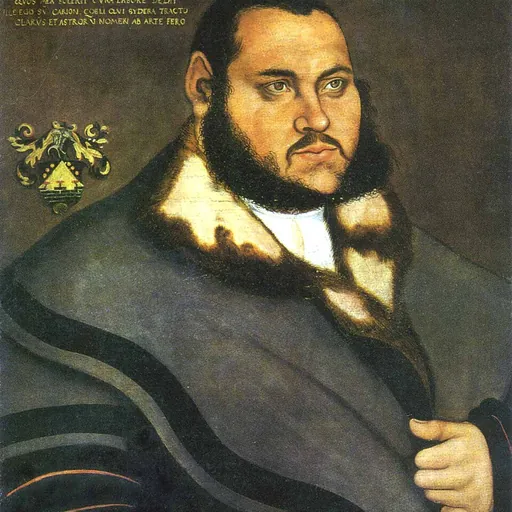
About Johann Carion
Lived 1499 – 1537 (aged 37). Johann Carion was a mathematician, historian and astrologer.
Johann Carion (22 March 1499, Bietigheim – 2 February 1537) was a German astrologer, known also for historical writings. Life He was court astrologer to Elector Joachim I Nestor of Brandenburg. A prognostication he published in 1521 gained him a later reputation of having predicted the Protestant Reformation, as well as a major flood in 1525 and some apocalyptic dates. For 15 July 1524 he predicted another flood so that Joachim I Nestor and his entourage fled to the Runder Berg, then the highest of the Tempelhofer Berge range south of the residential city of Cölln. At about 16:00 h, after spending much of the day on the hill in vain, Electress Elizabeth of Denmark urged her husband to return. They returned to town, where a thunderstorm started and a lightning killed four horses and the coachmen. With Joachim Camerarius, Melanchthon and other Lutheran humanist scholars the work changed from a traditional chronicle into a Reformation narrative of the Middle Ages. After Melanchthon's death, Caspar Peucer continued to edit it. Major features were the scheme of four monarchies taken from the Book of Daniel, extended by the medieval idea of translatio imperii; further there is a second Three Eras schematic, the third period of which will be co-extensive with the Roman Empire extended by the Holy Roman Empire (the fourth monarchy) which will last to 2000 AD. A part of the work today attributed to Melanchthon contained the first evidence for the Lotharian legend. A disproven theory which purported to explain why Roman law (as expounded in the ) was the law of the Holy Roman Empire.
Initially, Carion published a short universal history in German, at Wittenberg (1532). It was then translated into Latin by Herman Bonnus (Halle, 1537); there were numerous subsequent editions and translations.
In England there were translations by Walter Lynne, and also by Thomas Lanquet (unfinished) which was completed by Thomas Cooper (with Robert Crowley) and became known as Cooper's Chronicle.
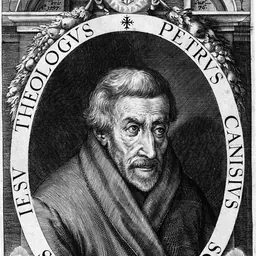
In 1567, Peter Canisius, the most important Jesuit in Germany, wrote to the Catholic historian Onofrio Panvinio to inquire about the chronicle he was preparing. The work was intended to counter Carion's Chronicles. The Jesuits hoped to use the book in Germany, but despite Canisius's high expectations, Panvinio's work remained only a manuscript. As a result, it was not until the end of the sixteenth century that Orazio Torsellino's Epitome Historiarum (1598) gave the Jesuits a Catholic counterpart to Carion's Chronicles.
Don’t just read it —
keep it.
Full-length biographies made to live with: read them, listen on the way to work, watch them tonight.
- E-book
- Audio
- Video
Instant download · yours to keep · every purchase keeps this site free
Important facts
People in Johann Carion's life
Named in this biography and alive at the same time



Related people
Same field, nearest in time



Contemporaries
People whose lives overlapped Johann Carion's



Frequently asked questions
Who was Johann Carion?
German astrologer and historical writer
When was Johann Carion born?
Johann Carion was born on 31 March 1499 in Bietigheim-Bissingen.
When did Johann Carion die?
Johann Carion died on 12 February 1537 in Magdeburg.
What was Johann Carion's occupation?
Johann Carion was a mathematician, historian and astrologer.
Sources & further reading
Cite this page
APA: Biography.guide. (2026). Johann Carion. https://biography.guide/johann-carion/
MLA: "Johann Carion." Biography.guide, https://biography.guide/johann-carion/.
Chicago: "Johann Carion." Biography.guide. https://biography.guide/johann-carion/.
Data last updated: 2026-09-22 · Spot an error? Report a correction.
Portrait: Wikimedia Commons · author & licence
Page generated 2026-09-27 05:04 UTC