
Johann Friedrich Overbeck
German painter, a member of the Nazarene movement
About Johann Friedrich Overbeck
Lived 1789 – 1869 (aged 80). Johann Friedrich Overbeck was a German and Italian painter, illustrator, writer, poet, draftsperson and artist.
Johann Friedrich Overbeck (3 July 1789 – 12 November 1869) was a German painter and a founder of the Nazarene art movement.
Early life and education Overbeck was born in Lübeck in 1789. His family had been Protestant pastors for three generations; his father Christian Adolph Overbeck (1755–1821) was doctor of law, poet, mystic pietist and burgomaster of Lübeck. Near the family mansion in the Konigstrasse stood the Gymnasium, where his uncle, a doctor of theology and a voluminous writer, was the master; there Johann became a classic scholar and received instruction in art.
Artistry
Art studies Overbeck left Lübeck in March 1806, and studied at the academy of Vienna, then under the direction of Heinrich Friedrich Füger. While he gained some of the polished technical aspects of the neoclassic painters, he was alienated by lack of religious spirituality in the themes chosen by his masters. He wrote to a friend that he had fallen among a vulgar set, that every noble thought was suppressed within the academy and that losing all faith in humanity, he had turned inward to his faith for inspiration.
In Overbeck's view, the nature of earlier European art had been corrupted throughout contemporary Europe, starting centuries before the French Revolution, and the process of discarding its Christian orientation was proceeding further now. He sought to express Christian art before the corrupting influence of the late Renaissance, casting aside his contemporary influences, and taking as a guide early Italian Renaissance painters, up to and including Raphael. The training methods at the academy of Vienna were at an international level; however Overbeck wrote to his father around 1808, was it lacked "heart, soul, sensation!" Instead of technical skills and slavish studies ("sklavisches Studium") exercising and working "with a pure heart" ("in einem reinen Herzen") would aim to a renewal of art. Together with other disaffected young artists at the academy, he started a group named the Lukasbund, dedicated to exploring his alternative vision for art. After four years, the differences between his group and others in the academy had grown so irreconcilable, that Overbeck and his followers were expelled.
Career
He left for Rome, where he arrived in 1810, carrying his half-finished canvas of Christ's Entry into Jerusalem. Rome became the centre of his labor for 59 years. He was joined by a company of like-minded artists, including Peter von Cornelius, Friedrich Wilhelm Schadow and Philipp Veit, who jointly housed in the old Franciscan convent of Sant'Isidoro, and became known among friends and enemies by the descriptive epithet of Nazarenes. Their precept was hard and honest work and holy living; they eschewed the antique as pagan, the Renaissance as false, and built up a severe revival on simple nature and on the serious art of Perugino, Pinturicchio, Francesco Francia and the young Raphael. The characteristics of the style thus educed were nobility of idea, precision and even hardness of outline, scholastic composition, with the addition of light, shade and colour, not for allurement, but chiefly for perspicuity and completion of motive. Overbeck in 1813 joined the Roman Catholic Church, and thereby he believed that his art received Christian baptism. It has been suggested that the Nazarenes should be considered a special branch of German Romanticism.
Honours Overbeck was elected a Foreign Honorary Member of the American Academy of Arts and Sciences in 1864.
Family His nephew Johannes Overbeck, a professor of archaeology at the University of Leipzig, was noted for his work in art history.
Followers In 1843 the Church of St. John the Baptist, Penymynydd, North Wales was built by the Glynne Family of Hawarden, Flintshire. The first vicar, Rev. John Ellis Troughton spent the first 20 years of the life of the church painting the interior with Overbeck murals, including the Palm Sunday one - of which the original was destroyed in an Allied Bombing raid in 1942, overnight into Palm Sunday.
Works
Early Christians were punished, young Agnes family stood for Christ. She was killed and became a martyr.
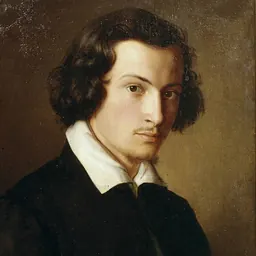
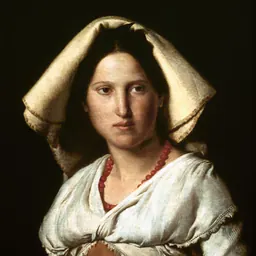
Portrait of the Painter Franz Pforra (1810) Vittoria Caldoni (1821) Christ's Entry into Jerusalem (1824), in the Marienkirche (destroyed through Allied bombing, Palm Sunday 1942). Christus am Ölberg (1827–1833) Italy and Germany (1828) Christ's Agony in the Garden (1835), in the great hospital, Hamburg. Lo Sposalizio (1836), Muzeum Narodowe, Poznań, Poland. The Triumph of Religion in the Arts (1840), in the Städel Institute, Frankfurt. The Banishment of Hagar (1841) Pietà (1846), in the Marienkirche, Lübeck. Lamentation of Christ (1846) The Incredulity of St. Thomas (1851), first in the possession of Beresford Hope, London, now in the Schäfer collection, Schweinfurt, Germany. The Assumption of the Madonna (1855), in Cologne Cathedral. The Ascension of the Virgin Mary (1857) Christ Delivered from the Jews (1858), tempera, originally on a ceiling in the Quirinal Palace. It is a commission from Pius IX, and a direct attack on the Italian temporal government, therefore later covered by a canvas adorned with Cupids, and now hanging in front of the Aula delle Benedizione in the Vatican. The Seven Sacraments (sketches are kept in the cathedral of Orvieto) (1861) Baptism 1862-64, Neue Pinakothek, Munich Drawings for the frescoes for the Cathedral of St. Peter and St. Paul in Đakovo (1867–1869).
Don’t just read it —
keep it.
Full-length biographies made to live with: read them, listen on the way to work, watch them tonight.
- E-book
- Audio
- Video
Instant download · yours to keep · every purchase keeps this site free
Important facts
more
fritz overbeck, fr. overbeck, J. F. Overbeck, Overbeck, Friedrich ÖverbeckPeople in Johann Friedrich Overbeck's life
Named in this biography and alive at the same time


Related people
Same field, nearest in time
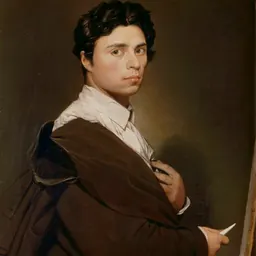


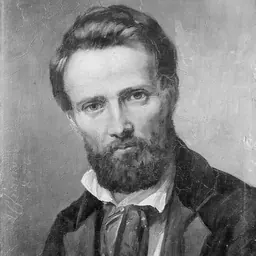
Contemporaries
People whose lives overlapped Johann Friedrich Overbeck's


Frequently asked questions
Who was Johann Friedrich Overbeck?
German painter, a member of the Nazarene movement (1789–1869)
When was Johann Friedrich Overbeck born?
Johann Friedrich Overbeck was born on 3 July 1789 in Lübeck.
When did Johann Friedrich Overbeck die?
Johann Friedrich Overbeck died on 12 November 1869 in Rome.
What was Johann Friedrich Overbeck's occupation?
Johann Friedrich Overbeck was a painter, illustrator, writer, poet, draftsperson and artist.
What nationality was Johann Friedrich Overbeck?
Johann Friedrich Overbeck was German and Italian.
Sources & further reading
· Wikipedia: Johann Friedrich Overbeck
· DBpedia: Johann Friedrich Overbeck
Cite this page
APA: Biography.guide. (2026). Johann Friedrich Overbeck. https://biography.guide/johann-friedrich-overbeck/
MLA: "Johann Friedrich Overbeck." Biography.guide, https://biography.guide/johann-friedrich-overbeck/.
Chicago: "Johann Friedrich Overbeck." Biography.guide. https://biography.guide/johann-friedrich-overbeck/.
Data last updated: 2026-09-20 · Spot an error? Report a correction.
Page generated 2026-09-27 05:18 UTC