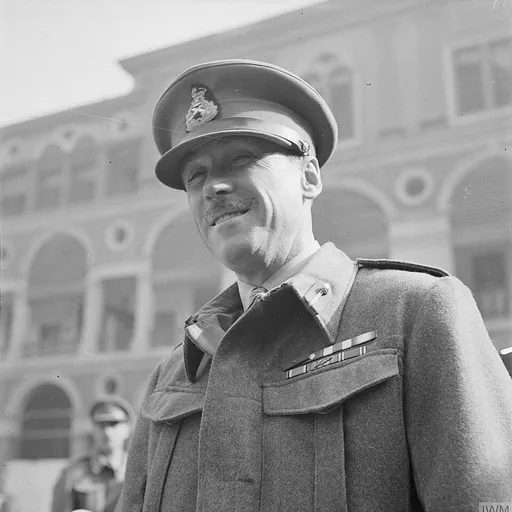
Jock Campbell
British army officer and recipient of the Victoria Cross
About Jock Campbell
Lived 1894 – 1942 (aged 48). Jock Campbell was a British military personnel.
Major-General John Charles Campbell, (10 January 1894 – 26 February 1942), known as Jock Campbell, was a British Army officer and recipient of the Victoria Cross, the highest award for gallantry in the face of the enemy that can be awarded to British and Commonwealth forces.
Early life and career Campbell was born in Thurso and educated at Sedbergh School. At the beginning of the First World War in August 1914 he joined the Honourable Artillery Company, and, after graduating from the Royal Military Academy, Woolwich, was commissioned into the Royal Field Artillery in July 1915. Serving in France, he was wounded twice and ended the war as a captain, having earned the Military Cross (MC).
Between the wars (see the interwar period) he became a first class horseman (in the top flight at both polo and hunting), while continuing to serve as an artillery officer.
Second World War Brigadier Jock Campbell of the 7th Armoured Division driving his commanding officer, Major-General William Gott, pictured here between 1940 and 1942.
When the Second World War broke out Campbell was 45 years old and a major commanding a battery in the 4th Regiment Royal Horse Artillery in Egypt. When Italy declared war in June 1940, Campbell, by then a lieutenant colonel, was commanding the artillery component of 7th Armoured Division's Support Group under Brigadier William Gott. The British Army was heavily outnumbered by the Italians, so General Archibald Wavell formulated a plan with his senior commanders to retain the initiative by harassing the enemy using mobile all-arms flying columns. Campbell's brilliant command of one of these columns led to their being given the generic name "Jock columns" (although it is unclear if the idea originated with Campbell or not).
During Operation Compass Campbell's guns played an important role in 7th Support Group's involvement in the decisive battle at Beda Fomm in February 1941 which led to the surrender of the Italian Tenth Army. In April 1941 Campbell was awarded the Distinguished Service Order (DSO), receiving a second award clasp shortly afterwards.
In September 1941 Gott was promoted to command 7th Armoured Division and Campbell took over command 7th Support Group as an acting brigadier. In November 1941 during Operation Crusader, 7th Support Group was occupying the airfield at Sidi Rezegh, south of Tobruk, together with 7th Armoured Brigade. On 21 November 1941 they were attacked by the two armoured divisions of the Afrika Korps. The British tanks suffered heavy losses but prevented the Germans taking the airfield. Brigadier Campbell's small force, holding important ground, was repeatedly attacked and wherever the fighting was hardest he was to be seen either on foot, in his open car or astride a tank. According to Alan Moorehead,
Campbell and Commander in Chief Auchinleck in the Western Desert.
The following day he was again at the forefront, encouraging his troops through continued enemy attacks. He personally directed the fire of his batteries, and twice manned a gun himself to replace casualties. Though wounded, he refused to be evacuated during the final German attack. His leadership did much to maintain the fighting spirit of his men, and resulted in heavy casualties being inflicted upon the enemy. The fighting continued on 23 November, but with 7th Armoured Brigade destroyed and the 5th South African Infantry Brigade being decimated, Campbell withdrew the remains of his support group to the south. For his actions during the battle, Campbell was awarded the Victoria Cross.
Campbell and Auchinleck watch for fall of shot from atop a newly arrived Grant tank.
He purportedly received a letter of congratulation from General Johann von Ravenstein, commander of the 21st Panzer Division, one of the armoured formations which Campbell had faced at Sidi Rezegh. When interviewed later as a prisoner of war, Ravenstein freely expressed his "greatest admiration" for Campbell's skill on "those hot days" and recalled "all the many iron that flew near the aerodrome around our ears".
In February 1942 Campbell was promoted Major-General and given command of 7th Armoured Division, while Gott was promoted from the 7th to lead XIII Corps.
Three weeks after his promotion Campbell was killed when his jeep overturned on a newly laid clay road. The driver of the jeep, Major Roy Farran, and the other passengers were thrown clear from the wreck and knocked unconscious. Farran had been Campbell's aide-de-camp, and later admitted considering suicide while waiting for medical help. During the Western Desert campaign Campbell was considered one of the finest commanders in the Eighth Army, an old desert hand who had been in North Africa from the start of the war. His loss was deeply felt. Alan Moorehead, a war correspondent who served throughout the war in the desert, described the impact that both Gott and Campbell had when visiting a hospital in Benghazi:'
Victoria Cross His Victoria Cross is displayed at the Royal Artillery Museum, Woolwich, England. The citation for the award was published in the London Gazette on 30 January 1942, reading:
Further information A memorial to Campbell stands in his old school, Sedbergh, commemorating his brave deeds.
There is a plaque and bench on a seaside walk in his home town in his honour. Major-General Campbell is also recorded on the War memorial in the village of Flore, 7 miles West of Northampton.
Don’t just read it —
keep it.
Full-length biographies made to live with: read them, listen on the way to work, watch them tonight.
- E-book
- Audio
- Video
Instant download · yours to keep · every purchase keeps this site free
Important facts
People in Jock Campbell's life
Named in this biography and alive at the same time


Related people
Same field, nearest in time





Contemporaries
People whose lives overlapped Jock Campbell's

Frequently asked questions
Who was Jock Campbell?
British army officer and recipient of the Victoria Cross
When was Jock Campbell born?
Jock Campbell was born on 10 January 1894 in Thurso.
When did Jock Campbell die?
Jock Campbell died on 26 February 1942 in Halfaya Pass.
What was Jock Campbell's occupation?
Jock Campbell was a military personnel.
What nationality was Jock Campbell?
Jock Campbell was British.
Sources & further reading
· DBpedia: Jock Campbell (British Army officer)
Cite this page
APA: Biography.guide. (2026). Jock Campbell. https://biography.guide/jock-campbell-military-personnel/
MLA: "Jock Campbell." Biography.guide, https://biography.guide/jock-campbell-military-personnel/.
Chicago: "Jock Campbell." Biography.guide. https://biography.guide/jock-campbell-military-personnel/.
Data last updated: 2026-09-22 · Spot an error? Report a correction.
Portrait: Wikimedia Commons · author & licence
Page generated 2026-09-27 05:04 UTC