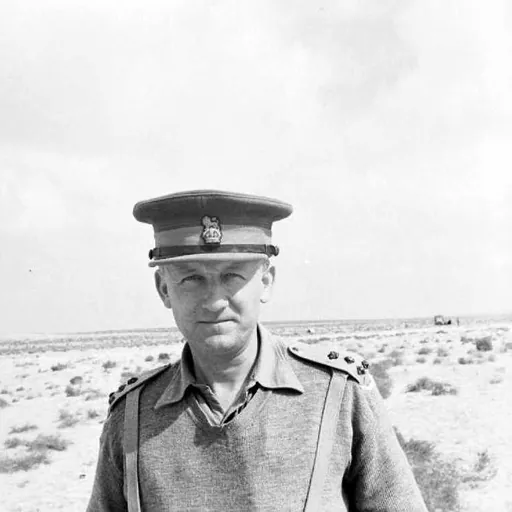
About William Gott
Lived 1897 – 1942 (aged 44). William Gott was a British military officer and military personnel.
Lieutenant-General William Henry Ewart Gott, (13 August 1897 – 7 August 1942), nicknamed "Strafer", was a senior British Army officer who fought during both the First and the Second World Wars, reaching the rank of lieutenant-general while serving with the British Eighth Army in the Western Desert and North Africa from 1940 to 1942. In August 1942, he was appointed as successor to General Claude Auchinleck as commander of the Eighth Army, but on the way to take up his command, his plane was shot down and he was killed. His death led to the appointment of Lieutenant-General Bernard Montgomery in his place.
Military career Educated at Harrow School, he was commissioned as a second lieutenant into the King's Royal Rifle Corps (KRRC) in February 1915, and served with distinction with the British Expeditionary Force (BEF) in France during the First World War. His nickname "Strafer" was a pun on the German war slogan Gott strafe England (God punish England). He was promoted to the rank of captain in January 1921, and attended the Staff College, Camberley from January 1930 until December 1931. He was promoted major in July 1934, having been made a brevet major earlier in January. His service during the interwar period included a posting as adjutant to a territorial battalion, and a period of postings in India as a general staff officer (GSO2) and Deputy Assistant Quartermaster General.
North African campaigns Brigadier Jock Campbell of the 7th Armoured Division driving his commanding officer, Major-General William Gott, pictured here between 1940 and 1942.
Having been promoted lieutenant-colonel in October 1938 to command the 1st Battalion, KRRC on its transfer from Burma to Egypt to become part of the Mobile Division (later to become 7th Armoured Division, the "Desert Rats"), Gott held a succession of posts in the division; he was successively chief staff officer of the division (General Staff Officer, Grade I, ranked lieutenant-colonel) commander of the Support Group as acting brigadier, and General Officer Commanding acting major-general of the 7th Armoured Division.
While under Gott's command the Support Group performed well from the beginning of the campaign; skirmishing along the frontier from June 1940; conducting a planned withdrawal in September during the Italian invasion of Egypt, and during Operation Compass in December which saw the conquest of Cyrenaica and the destruction of the Italian Tenth Army the following February.
Following the arrival of the German Afrika Korps under the command of Erwin Rommel, the Axis counter-attacked in April and 7th Support Group, which had been refitting in the Delta, was called upon to stabilise the front and to reform the retreating forces, which was achieved at the Libyan–Egyptian border. In May, Gott was placed in command of a mixed force to plan and conduct the ambitious Operation Brevity which succeeded in re-taking the Halfaya Pass but failed in its wider objectives. A subsequent larger scale operation, Operation Battleaxe, in which the Support Group also took part was also a failure and led to a reorganisation of the commands in the Western Desert which included Gott's promotion to command the 7th Armoured Division.
During the next major Commonwealth offensive, Operation Crusader, in November 1941, 7th Armoured Division was severely mauled by the Afrika Korps at the battle of Sidi Rezegh, but kept the field and contributed to the British Eighth Army's ultimate success.
Gott's permanent rank had been made up to full colonel in October 1941 and he was promoted to acting lieutenant-general and given command of XIII Corps in early 1942.
During the Battle of Gazala, the 8th Army's performance was fatally handicapped by a breakdown in relations at all levels; within XIII Corps during this period Gott's relationship with his subordinate Dan Pienaar, the commander of 1st South African Division, had deteriorated completely. Of XIII Corps performance in the action, the stand by 150th Brigade, and the breakout by 50th Division are notable, while the low point was the loss of Tobruk with its entire garrison during the withdrawal to Egypt.
XIII Corps was able to withdraw in good order to the Alamein position and was instrumental in fighting the Axis to a standstill there in the First Battle of El Alamein.
Death The grave of Lieutenant-General William Gott at the El Alamein cemetery. The wreath was laid by Squadron Leader Jimmy James and his son.
In August 1942, British Prime Minister Winston Churchill removed General Sir Claude Auchinleck as Commander-in-Chief Middle East and acting General Officer Commanding Eighth Army. Gott's aggressive, somewhat impetuous, personality appealed to Churchill, and he was strongly recommended by Anthony Eden, who had served with Gott during the First World War. Gott was therefore chosen to take over Eighth Army. This was despite the reservations of Auchinleck and General Sir Alan Brooke, the Chief of the Imperial General Staff (CIGS). Brooke knew Gott very well and had a high opinion of his abilities. However, a number of factors caused Brooke to feel that Gott was not ready for army command at that time. During a personal interview with Gott on 5 August, Brooke realised that Gott had "tried most of his ideas on the Boche". This led Brooke to conclude that "We want someone with new ideas and plenty of confidence in them", and Gott did not fit this requirement. Brooke observed that Gott was tired and had temporarily lost his drive, having been in the desert since the start of the war. He also felt that Gott needed more experience before taking an army command.
Gott was killed when the transport plane he was travelling in was shot down and destroyed while returning to Cairo from the front. The aircraft, a Bristol Bombay of No. 216 Squadron RAF flown by 19-year-old Flight Sergeant Hugh "Jimmy" James, was intercepted and shot down by Unteroffizier Bernd Schneider and Emil Clade of Jagdgeschwader 27 (Fighter Wing 27). With both engines out, the pilot had made a crash landing, but two German Messerschmitt Bf 109 fighters attacked the crashed plane, strafing it until the Bombay was destroyed. Those who were unable to escape from the Bombay (including Gott) were killed. Gott's body was buried at the El Alamein War Cemetery. His replacement was Lieutenant-General Bernard Montgomery, who had been Brooke's choice. The Burg el Arab–Heliopolis route was "considered so safe that no escort had been found necessary for Winston [Churchill] when we flew out" but a German plane driven out of high altitude combat came across the slow transport plane. It was later reported that Messerschmitt Bf 109s attacked the ill-fated transport plane. The Germans knew before the British that Gott was dead: the German air crews had been greeted on their return to base with "Congratulations, gentlemen. You have just killed General Strafer Gott, the new commander of the 8th Army!" It is thought the Germans broke the code used by a loquacious American air attaché in Cairo, Bonner Fellers and intercepted an operational broadcast.
Assessment A big man with an aggressive, outgoing personality, he was popular with soldiers under his command, but as a senior commander he was considered by some to be out of his depth. John Bierman and Colin Smith say that Gott was much admired for his personal qualities, but lacked real military skill. He was one of the few senior officers who was "well known and well liked by the rank and file". However, "a cold appraisal of his soldiering in North Africa reveals no stunning display of tactics or Rommel-esque grip that bends scared and exhausted men to the will of the born leader." Field Marshal Sir Michael Carver, one of Gott's officers, took a similar view. He stated that Gott was the one person to whom "all, high and low, turned for advice, sympathy, help and encouragement", but he also believed that Gott was "too good a man to be a really great soldier". Churchill himself seems to have accepted that he made a mistake in appointing Gott instead of Montgomery, after seeing how Montgomery had revitalised the Eighth Army. Gott's daughters presented his medals to the Royal Green Jackets (Rifles) Museum in 2012.
Don’t just read it —
keep it.
Full-length biographies made to live with: read them, listen on the way to work, watch them tonight.
- E-book
- Audio
- Video
Instant download · yours to keep · every purchase keeps this site free
Important facts
People in William Gott's life
Named in this biography and alive at the same time


Related people
Same field, nearest in time


Contemporaries
People whose lives overlapped William Gott's



Frequently asked questions
Who was William Gott?
British Army general (1897-1942)
When was William Gott born?
William Gott was born on 13 August 1897 in Scarborough.
When did William Gott die?
William Gott died on 7 August 1942 in Cairo.
What was William Gott's occupation?
William Gott was a military officer and military personnel.
What nationality was William Gott?
William Gott was British.
Sources & further reading
Cite this page
APA: Biography.guide. (2026). William Gott. https://biography.guide/william-gott/
MLA: "William Gott." Biography.guide, https://biography.guide/william-gott/.
Chicago: "William Gott." Biography.guide. https://biography.guide/william-gott/.
Data last updated: 2026-09-20 · Spot an error? Report a correction.
Portrait: Wikimedia Commons · author & licence
Page generated 2026-09-27 04:57 UTC