
About Joannes Hermans
Lived 1630 – 1667 (aged 36–37). Joannes Hermans was a painter.
Joannes Hermans, called Monsú Aurora, (Antwerp, c. 1630 – c. 1677) was a Flemish painter of animals and still lifes of game, fruit and flowers who worked in Italy and Antwerp where he contributed to the development of the Baroque still life genre.
Life Details about the life of Joannes Hermans are scarce. He is believed that he was born in Antwerp. Here is registered as a pupil of the obscure painter Adriaen Willenhoudt from 1644. He is assumed to have worked in the Antwerp workshop of the prominent still life and animal painter Jan Fijt as Hermans' hand has been identified in a collaborative painting of Fijt.
He travelled to Italy where he was recorded in Rome in the period from 1657 to 1665 and was known as 'Monsú Aurora'. He enjoyed high-level patronage in Rome as is demonstrated by the commission to decorate the Roman palace of the nobleman Camillo Pamphili in 1656. Camillo Pamphili was an avid hunter and lover of hunting-themed artworks. For the commission, Hermans painted a large canvas and 38 smaller compositions depicting both dead and living animals, some set in marshy landscapes. These formed part of a set of about 50 paintings with this theme, that Pamphili had commissioned, for educational as well as decorative purposes.
Hermans also enjoyed the patronage of the Corsini, Colonna and Imperiali families as is shown by the presence of his works in contemporary Roman inventories. His compositions were also admired by the Flemish animalier David de Coninck and the Italian still life painter Pietro Navarra, both of whom worked in Rome during the second half of the 17th century. These compositions with their cool, distanced objectivity celebrate the colourful hues of the birds' feathers, creating a "surreal" ambiance. In this compositions Hermans reveals the debt he owed to the works of the leading Flemish animal and game piece painter Jan Fyt. The series of bird etchings by Pieter Boel, another Flemish animal painter who stayed in Rome prior to 1650 also appear to have been an inspiration for his work. He must also have known the work of Nicasius Bernaerts, known in Italy under the pseudonym Monsù Nicasio. Two garland paintings by Hermans, depicting flower garlands around respectively a boy and a girl, are in private collections.
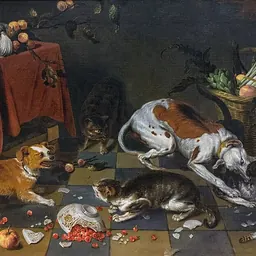
Hermans is known to have collaborated with other artists. A Still Life with Fruit, Hunting Trophies, a Parrot, a Cat and a Dog is a collaboration with the Flemish animalier Jan Fyt. In this painting each artist was responsible for different parts. The overall composition was done by Fijt, who also painted key parts of the composition, such as the dead hare, the partridges and the dog. The finishing of the painting was left to a studio assistant. While the assistant usually remained anonymous, in this composition he has been identified as Joannes Hermans. In Hermans' signed and dated Still life around a bust of Ceres from 1653 the same tufted parrot can be seen while the fruit is also rendered in an almost identical manner.
Don’t just read it —
keep it.
Full-length biographies made to live with: read them, listen on the way to work, watch them tonight.
- E-book
- Audio
- Video
Instant download · yours to keep · every purchase keeps this site free
Important facts
People in Joannes Hermans's life
Named in this biography and alive at the same time


Related people
Same field, nearest in time

Contemporaries
People whose lives overlapped Joannes Hermans's





Frequently asked questions
Who was Joannes Hermans?
Flemish painter (ca. 1630 – ca. 1677)
When was Joannes Hermans born?
Joannes Hermans was born in 1630 in Antwerp.
When did Joannes Hermans die?
Joannes Hermans died in 1667 in Rome.
What was Joannes Hermans's occupation?
Joannes Hermans was a painter.
What nationality was Joannes Hermans?
Joannes Hermans's recorded nationality: Habsburg Netherlands.
Sources & further reading
Cite this page
APA: Biography.guide. (2026). Joannes Hermans. https://biography.guide/joannes-hermans/
MLA: "Joannes Hermans." Biography.guide, https://biography.guide/joannes-hermans/.
Chicago: "Joannes Hermans." Biography.guide. https://biography.guide/joannes-hermans/.
Data last updated: 2026-09-20 · Spot an error? Report a correction.
Page generated 2026-09-27 05:30 UTC