
About David de Coninck
Lived 1636 – 1699 (aged 62–63). David de Coninck was a painter.
David de Coninck or David de Koninck, also known as Rammelaer (ca. 1644, Antwerp – after 1701, probably Brussels) was a Flemish painter who specialised in still lifes and landscapes with animals and hunting scenes. Recognised as a leading animal painter, de Coninck was able to develop an international career which caused him to work for extended periods in Paris, Rome and Vienna.
Life He was apprenticed to Pieter Boel in 1659. Pieter Boel was an accomplished animal painter who had been trained by Jan Fyt, the leading Flemish animal painter of the mid 17th century. De Coninck became a master in the Antwerp Guild of Saint Luke in 1663.
He moved to Paris where he worked with the prominent Flemish animal painter Nicasius Bernaerts for several years, probably until 1669.
De Coninck subsequently travelled to Rome where he lived from 1671 to 1694. Here he became a member of the Bentvueghels, an association of mainly Dutch and Flemish artists working in Rome, and took the nickname (the so-called 'bent name') 'Rammelaer' (which means 'rattle'). His name was inscribed in a niche in the Santa Costanza church in Rome where the Bentvueghels used to congregate.
On his return to the north he stayed for a time in Vienna. He returned to Antwerp in 1687. He moved to Brussels at some time between 1699 and 1701. The last record of de Coninck is his registration as a became a member of the Brussels Guild of Saint Luke in 1701. It is not known when or where he died.
Work
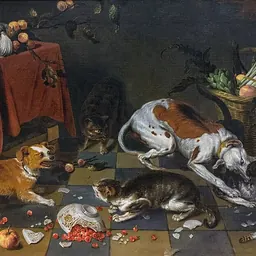
De Coninck painted still lifes, including fruit still lifes and hunting still lifes, landscapes with hunting scenes and architectural paintings. It is possible that early in his career he painted fruit still lifes, since there is a record that in 1668 two fruit still lifes made by a 'Koninck' were exported to Vienna. Some works of David de Coninck and Pieter Boel are still attributed to Fyt. As David de Coninck rarely signed his works, which are generally of a high quality and similar style they have often been confused with the works of Boel, Fyt and even Frans Snijders, the leading Flemish animal painter of the first half of the 17th century.
De Coninck's work influenced other artists in Italy such as Baldassare De Caro, Giovanni Crivelli (named 'il Crivellino'), Nicola Malinconico, Franz Werner von Tamm and Jacob Xavier Vermoelen.
Don’t just read it —
keep it.
Full-length biographies made to live with: read them, listen on the way to work, watch them tonight.
- E-book
- Audio
- Video
Instant download · yours to keep · every purchase keeps this site free
Important facts
more
David Fiamengo, David De Konink, David de Cronigh, David Coninck, David De Koning, Msù David, Monsu` david, Monsieur Davide, Monsu` Davide, D. De Koninck, Coninck, jun. D. Koninck, David Coonich, De Koning, Monsiù Davide, Monseur David, M.r David, De Koninck, De Konink, Mon.r David, Monsu Davide, D. de Coninck, Monsiu Davide, Monsu David fiammingo, monsu david, Monsieur DavidPeople in David de Coninck's life
Named in this biography and alive at the same time


Related people
Same field, nearest in time

Contemporaries
People whose lives overlapped David de Coninck's





Frequently asked questions
Who was David de Coninck?
Flemiish painter (c.1636-1699)
When was David de Coninck born?
David de Coninck was born in 1636 in Antwerp.
When did David de Coninck die?
David de Coninck died in 1699 in Brussels.
What was David de Coninck's occupation?
David de Coninck was a painter.
What nationality was David de Coninck?
David de Coninck's recorded nationality: Habsburg Netherlands.
Sources & further reading
Cite this page
APA: Biography.guide. (2026). David de Coninck. https://biography.guide/david-de-coninck/
MLA: "David de Coninck." Biography.guide, https://biography.guide/david-de-coninck/.
Chicago: "David de Coninck." Biography.guide. https://biography.guide/david-de-coninck/.
Data last updated: 2026-09-20 · Spot an error? Report a correction.
Page generated 2026-09-27 04:59 UTC