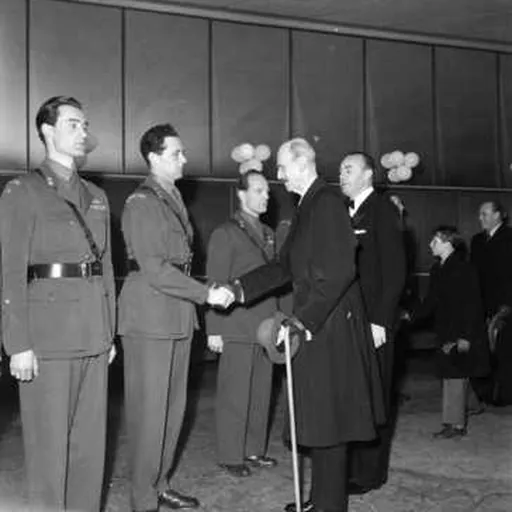
Joachim Rønneberg
Norwegian resistance member
About Joachim Rønneberg
Lived 1919 – 2018 (aged 99). Joachim Rønneberg was a Norwegian resistance fighter, military officer, radio journalist and norwegian Broadcasting Corporation.
Joachim Holmboe Rønneberg (30 August 1919 – 21 October 2018) was a Norwegian Army officer and broadcaster. He was known for his resistance work during World War II, most notably commanding Operation Gunnerside, and his post-war war information work.
Personal life Rønneberg was born in Ålesund, Møre og Romsdal, as the second son of Alf Rønneberg from Ålesund and Anna Krag Sandberg, and a member of the Rønneberg family. He was the brother of Erling Rønneberg, who was a well-known resistance member too, having received British commando training. On the maternal side he was a nephew of Ole Rømer Aagaard Sandberg, and thus a grandnephew of Ole Rømer Aagaard Sandberg, Sr. On the paternal side he was a second great grandson of Carl Rønneberg, On 19 September 1949, he married Liv Foldal, a crafts teacher born in 1925. He last lived in Ålesund where a statue honouring him made by Håkon Anton Fagerås was unveiled by Princess Astrid at the end of August 2014. Rønneberg died on 21 October 2018.
Career Rønneberg reported for national service in 1938, being told to report for duty with the surveying department in 1940.
World War II World War II broke out when Rønneberg was a young adult, and Norway was occupied by Germany from April 1940. He joined Norwegian Independent Company 1 (NOR.I.C.1) in 1941, He received military training in the United Kingdom,
Heavy water sabotage The Vemork hydroelectric plant in 1935. The heavy water was produced in the front building (the Hydrogen Production Plant).
Rønneberg, now a First Lieutenant and put in charge of training, selected and led the six-man Operation Gunnerside team, reinforcing the four-man team Grouse sent in earlier, during the heavy water sabotage action. The combined Norwegian team went into action against the Norsk Hydro heavy water production plant in Vemork in 1943, parachuting into the Hardangervidda plateau on 16 February. five of the saboteurs, led by Rønneberg, escaped safely to neutral Sweden by way of a 14-day march over a distance of after the successful completion of their mission. The six other members of the sabotage team hid out in various locations in Norway without being caught by the Germans. as well as a loss of production of of heavy water. Twenty-one civilians died in the bombing raid. The 2015 TV mini-series The Heavy Water War produced by the Norwegian Broadcasting Corporation also portrays Rønneberg's role in the heavy water operations.
The sabotage action against the Vemork plant was portrayed in the Franco-Norwegian 1948 film Operation Swallow: The Battle for Heavy Water, where Rønneberg was portrayed by Norwegian actor Claus Wiese. In 1965 the less-than-accurate American film The Heroes of Telemark, starring Kirk Douglas and Richard Harris, was released by Columbia Pictures. Rønneberg dismissed this film as a "hopeless" portrayal, when he told his memories in 2010 after many years of silence. In January 1945 Rønneberg had led a three-man unit of NOR.I.C.1 on a mission to destroy the Stuguflåt railway bridge, blowing up the bridge with a charge of plastic explosives, putting it out of service for three weeks. The team then escaped without casualties. His service with NOR.I.C.1 ended with the liberation of Norway in 1945. For his war service Rønneberg also received St. Olav's Medal With Oak Branch, Defence Medal 1940–1945 and Haakon VIIs 70th Anniversary Medal. In addition to his Norwegian decorations, he was also decorated by the British with the Distinguished Service Order (DSO), by the Americans with the Medal of Freedom with silver palm and by the French with the Legion of Honour and Croix de Guerre.
Post-war career After the war he began a career in broadcasting. He was hired in NRK Ålesund in 1948, was promoted to programme secretary in 1954 and sub-editor in 1977. He retired in 1988. He also participated in the rebuilding of Fieldfare Cabin in the valley Veltedalen in the summer of 1990, where he had hidden out the last year of the war with two other officers from NOR.I.C.1. Fieldfare Cabin today gives an image of Norwegian resistance during the war.
In his later years Rønneberg was involved in war information work, holding lectures for audiences around Norway. He said that he was particularly fond of holding talks for school children. Rønneberg was highly critical of the current situation for the Norwegian military, stating that its capacity for mobilisation was only 9% of the 1990 level. Rønneberg was a member of the Linge Club, a Norwegian veterans' association, until it was disbanded on 17 October 2007. In April 2013, Rønneberg was presented with a Union Jack during a ceremony at the Special Operations Executive (SOE) monument in London to mark 70 years since the successful Gunnerside mission.
Don’t just read it —
keep it.
Full-length biographies made to live with: read them, listen on the way to work, watch them tonight.
- E-book
- Audio
- Video
Instant download · yours to keep · every purchase keeps this site free
Important facts
People in Joachim Rønneberg's life
Named in this biography and alive at the same time





Related people
Same field, nearest in time




Contemporaries
People whose lives overlapped Joachim Rønneberg's



Frequently asked questions
Who was Joachim Rønneberg?
Norwegian resistance member (1919-2018)
When was Joachim Rønneberg born?
Joachim Rønneberg was born on 30 August 1919 in Ålesund Municipality.
When did Joachim Rønneberg die?
Joachim Rønneberg died on 21 October 2018 in Ålesund Municipality.
What was Joachim Rønneberg's occupation?
Joachim Rønneberg was a resistance fighter, military officer, radio journalist and norwegian Broadcasting Corporation.
What nationality was Joachim Rønneberg?
Joachim Rønneberg was Norwegian.
Sources & further reading
· Wikipedia: Joachim Rønneberg
Cite this page
APA: Biography.guide. (2026). Joachim Rønneberg. https://biography.guide/joachim-ronneberg/
MLA: "Joachim Rønneberg." Biography.guide, https://biography.guide/joachim-ronneberg/.
Chicago: "Joachim Rønneberg." Biography.guide. https://biography.guide/joachim-ronneberg/.
Data last updated: 2026-09-22 · Spot an error? Report a correction.
Portrait: Wikimedia Commons · author & licence
Page generated 2026-09-27 05:01 UTC