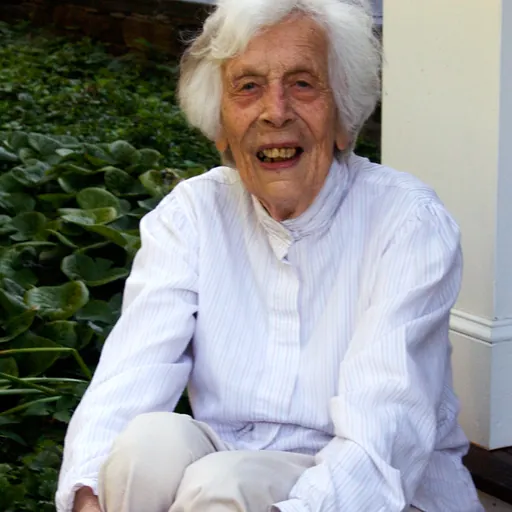
About Freya von Moltke
Lived 1911 – 2010 (aged 98). Freya von Moltke was a German resistance fighter, writer, jurist, journalist and peace activist, known for Kreisau Circle.
Freya von Moltke (née Deichmann; 29 March 1911 – 1 January 2010) was a German American lawyer and participant in the anti-Nazi opposition group, the Kreisau Circle, with her husband, Helmuth James von Moltke. During World War II, her husband acted to subvert German human-rights abuses of people in territories occupied by Germany and became a founding member of the Kreisau Circle, whose members opposed the government of Adolf Hitler.
The Nazi government executed her husband for treason, he having discussed with the Kreisau Circle group the prospects for a Germany based on moral and democratic principles that could develop after Hitler. Moltke preserved her husband's letters that detailed his activities during the war, and chronicled events from her perspective. She supported the founding of a center for international understanding at the former Moltke estate in Krzyżowa, Świdnica County, Poland (formerly Kreisau, Germany).
Early life and education Moltke was born Freya Deichmann in Cologne, Germany, the daughter of banker Carl Theodor Deichmann and his wife, Ada Deichmann (née von Schnitzler). In 1930, she began studying law at the University of Bonn and attended seminars at the University of Breslau. While working as a researcher she met her future husband Helmuth James von Moltke.
On 18 October 1931, the two married in her home town of Cologne. The couple initially resided in a modest house at the Moltke family's Kreisau estate in Silesia (German: Schlesien), then Germany, post WWII part of Poland. They moved to Berlin so her husband could complete his legal training. She studied law in Berlin and received a Juris Doctor degree from Friedrich Wilhelm University of Berlin in 1935. She joined work on the farm, while her husband started an international law practice in Berlin and studied to become an English barrister.
In 1933, Adolf Hitler, became chancellor of Germany, which Moltke's husband foresaw would be a disaster for Germany, not the transitory figure that others expected. The Moltkes encouraged their overseer to join the Nazi Party to shield the community of Kreisau from government interference.
In October 1941, her husband wrote, "Certainly more than a thousand people are murdered in this way every day, and another thousand German men are habituated to murder.... What shall I say when I am asked: And what did you do during that time?" In the same letter he said, "Since Saturday the Berlin Jews are being rounded up. Then they are sent off with what they can carry.... How can anyone know these things and walk around free?" for a speaking tour in the United States.
After World War II, Moltke publicized her husband's ideas and actions during the war, to serve as an example of principled opposition. As early as 1949 she traveled to the United States to lecture on "Germany: Past and present", "Germany: Totalitarianism versus democracy", "German youth and the new education", and "Women's position in the new Germany".
After her escape from Silesia, Moltke moved to South Africa, where she settled with her two young sons, Caspar and Konrad. She worked as a social worker and a therapist for disabilities.
In 1956, unable to further tolerate Apartheid, she returned to Berlin where she commenced her work in publicizing the Kreisau Circle. Her effort was supported by Eugen Gerstenmaier, then president of the Bundestag, among others.
Von Moltke has been a subject of many interviews and articles. In 1995, she told interviewer Alison Owings: "People who lived through the Nazi time, and who still live, who did not lose their lives because they were opposed, all had to make compromises."
With the reunification of Germany, Moltke was supportive of transforming the former Moltke estate in Kreisau into a meeting place to promote German-Polish and European mutual understanding. Poland and Germany invested 30 million Deutsche Mark in renovating the venue. It opened in 1998 as the Kreisau International Youth Center. In 2004, a fund was established to promote the long-term support of the meeting place and further the work done there. As of 2007, Moltke actively supported this initiative as the honorary chair of the board of trustees of the Kreisau Foundation for European Understanding (the supporting entity for the Kreisau meeting site) and the Institute for Cultural Infrastructure, Sachsen in Görlitz. Freya von Moltke died in Norwich, Vermont, on 1 January 2010, at the age of 98. In the same year, she accepted the Bruecke Prize from the city of Görlitz, Germany, in recognition of her life's work.
Moltke met with three German Chancellors in connection with her life's work, Helmut Kohl in 1998 to introduce him to the Kreisau International Youth Center built in Krzyżowa, Gerhard Schroeder in 2004 at a wreath-laying ceremony to honor Nazi resisters, and Angela Merkel in 2007 at a commemoration of the birth centenary of her husband, Helmuth von Moltke, where Merkel described her husband as a symbol of "European courage". Moltke's life served as the basis of a play by Marc Smith, A Journey to Kreisau.
In January 2011, a documentary of her life, including her last interview in English, premiered at Goethe-Institut, Boston.
Don’t just read it —
keep it.
Full-length biographies made to live with: read them, listen on the way to work, watch them tonight.
- E-book
- Audio
- Video
Instant download · yours to keep · every purchase keeps this site free
Important facts
Family & relationships
People in Freya von Moltke's life
Named in this biography and alive at the same time

Related people
Same field, nearest in time




Contemporaries
People whose lives overlapped Freya von Moltke's






Frequently asked questions
Who was Freya von Moltke?
German writer and scholar (1911–2010)
When was Freya von Moltke born?
Freya von Moltke was born on 29 March 1911 in Cologne.
When did Freya von Moltke die?
Freya von Moltke died on 1 January 2010 in Norwich.
What was Freya von Moltke's occupation?
Freya von Moltke was a resistance fighter, writer, jurist, journalist and peace activist.
What was Freya von Moltke known for?
Freya von Moltke was known for Kreisau Circle.
What nationality was Freya von Moltke?
Freya von Moltke was German.
Sources & further reading
Cite this page
APA: Biography.guide. (2026). Freya von Moltke. https://biography.guide/freya-von-moltke/
MLA: "Freya von Moltke." Biography.guide, https://biography.guide/freya-von-moltke/.
Chicago: "Freya von Moltke." Biography.guide. https://biography.guide/freya-von-moltke/.
Data last updated: 2026-09-23 · Spot an error? Report a correction.
Portrait: Wikimedia Commons · author & licence
Page generated 2026-09-27 05:05 UTC