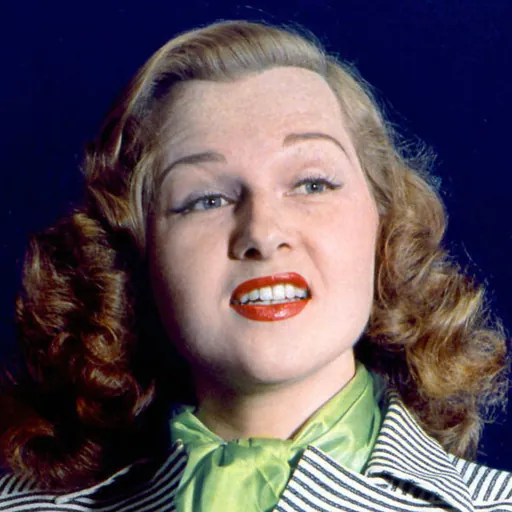
About Jo Stafford
Lived 1917 – 2008 (aged 90). Jo Stafford was an American singer, jazz musician, actor, musician and jazz singer.
Jo Elizabeth Stafford (November 12, 1917 – July 16, 2008) was an American traditional pop singer, whose career spanned five decades from the late 1930s to the early 1980s. Admired for the purity of her voice, she originally underwent classical training to become an opera singer before following a career in popular music and by 1955 had achieved more worldwide record sales than any other female artist. Her 1952 song "You Belong to Me" topped the charts in the United States and United Kingdom, becoming the second single to top the UK Singles Chart and the first by a female artist to do so.
Born in remote oil-rich Coalinga, California, near Fresno in the San Joaquin Valley, Stafford made her first musical appearance at age 12. While still at high school, she joined her two older sisters to form a vocal trio named the Stafford Sisters, who found moderate success on radio and in film. In 1938, while the sisters were part of the cast of Twentieth Century Fox's production of Alexander's Ragtime Band, Stafford met the future members of the Pied Pipers and became the group's lead singer. Bandleader Tommy Dorsey hired them in 1939 to perform vocals with his orchestra. From 1940 to 1942, the group often performed with Dorsey's new male singer, Frank Sinatra.
In addition to her singing with the Pied Pipers, Stafford was featured in solo performances with Dorsey. After leaving the group in 1944, she recorded a series of pop songs now regarded as standards for Capitol Records and Columbia Records. Many of her recordings were backed by the orchestra of Paul Weston. She also performed duets with Gordon MacRae and Frankie Laine. Her work with the United Service Organizations giving concerts for soldiers during World War II earned her the nickname "G.I. Jo". Starting in 1945, Stafford was a regular host of the National Broadcasting Company (NBC) radio series The Chesterfield Supper Club and later appeared in television specialsincluding two series called The Jo Stafford Show, in 1954 in the U.S. and in 1961 in the UK.
Stafford married twice, first in 1937 to musician John Huddleston (the couple divorced in 1943), then in 1952 to Paul Weston, with whom she had two children. She and Weston developed a comedy routine in which they assumed the identity of an incompetent lounge act named Jonathan and Darlene Edwards, parodying well-known songs. The act proved popular at parties and among the wider public when the couple released an album as the Edwardses in 1957. In 1961, the album Jonathan and Darlene Edwards in Paris won Stafford her only Grammy Award for Best Comedy Album and was the first commercially successful parody album. Stafford largely retired as a performer in the mid-1960s, but continued in the music business. She had a brief resurgence in popularity in the late 1970s when she recorded a cover of the Bee Gees hit, "Stayin' Alive" as Darlene Edwards. In the 1990s, she began re-releasing some of her material through Corinthian Records, a label founded by Weston. She died in 2008 in Century City, Los Angeles, and is interred with Weston at Holy Cross Cemetery, Culver City. Her work in radio, television, and music is recognized by three stars on the Hollywood Walk of Fame.
Early years
Jo Elizabeth Stafford was born in Coalinga, California, in 1917, to Grover Cleveland Stafford and Anna Stafford (née York)a second cousin of World War I hero Sergeant Alvin York. Other authors, including the music biographer Gene Lees refer to her as Jo. Both her parents enjoyed singing and sharing music with their family. Anna insisted that her children should take piano lessons, but Jo was the only one among her sisters who took a keen interest in it, and through this, she learned to read music. Her second was far more dramatic. As a student at Long Beach Polytechnic High School with the lead in the school musical, she was rehearsing on stage when the 1933 Long Beach earthquake destroyed part of the school. With her mother's encouragement, Stafford originally planned to become an opera singer and studied voice as a child, taking private lessons from Foster Rucker, an announcer on California radio station KNX. The two older Staffords were already part of a trio with an unrelated third member when the act got a big booking at Long Beach's West Coast Theater. Pauline was too ill to perform, and Jo was drafted in to take her place so they could keep the engagement. She asked her glee club teacher for a week's absence from school, saying her mother needed her at home, and this was granted. The performance was a success, and Jo became a permanent member of the group. The Staffords were subsequently heard on KNX's The Singing Crockett Family of Kentucky, and California Melodies, a network radio show aired on the Mutual Broadcasting System. The couple divorced in 1943. The Stafford Sisters made their first recording,"Let's Get Together and Swing" with Louis Prima, in 1936. In 1937, Jo worked behind the scenes with Fred Astaire on the soundtrack of A Damsel in Distress, creating the arrangements for the film, and with her sisters she arranged the backing vocals for "Nice Work If You Can Get It". Stafford said that her arrangement had to be adapted because Astaire had difficulty with some of the syncopation. In her words: "The man with the syncopated shoes couldn't do the syncopated notes".
The Pied Pipers By 1938, the Staffords were involved with Twentieth Century Fox's production of Alexander's Ragtime Band. The studio brought in many vocal groups to work on the film, including the Four Esquires, the Rhythm Kings, and the King Sisters, who began to sing and socialize between takes. The Stafford Sisters, the Four Esquires and the Rhythm Kings became a new vocal group called the Pied Pipers.
The Pied Pipers in 1944: Pictured here are Charles Lowry, Jo Stafford, Clark Yocum, and John Huddleston.
As the Pied Pipers, they worked on local radio and movie soundtracks. When Alyce and Yvonne King threw a party for their boyfriends' visit to Los Angeles, the group was invited to perform.
Weston persuaded Dorsey to audition the group in 1938, and the eight drove together to New York City.
When Frank Sinatra joined the Dorsey band, he and the Pied Pipers often performed together on songs, alternating between his solos and him singing with the group. Sometimes they both had solos as well as being in the group. Stafford commented that he was very careful to blend his voice with theirs when singing with them. Their version of "I'll Never Smile Again" topped the Billboard Chart for 12 weeks in 1940 and helped to establish Sinatra as a singer. Her public debut as a soloist with the band occurred at New York's Hotel Astor in May 1942. Bill Davidson of Collier's reported in 1951 that because Stafford weighed in excess of 180 lb, Dorsey was reluctant to give her a leading vocal role in his orchestra, believing she was not sufficiently glamorous for the part. Following their departure from the orchestra, the Pied Pipers played a series of vaudeville dates in the Eastern United States. When they returned to California, they were signed to appear in the 1943 Universal Pictures movie Gals Incorporated. From there, they joined the NBC Radio show Bob Crosby and Company. In addition to working with Bob Crosby, they also appeared on radio shows hosted by Sinatra and Johnny Mercer and were one of the first groups signed to Mercer's new label, Capitol Records, which was founded in 1942. Weston, who left Dorsey's band in 1940 to work with Dinah Shore, became music director at Capitol.
Solo career
Capitol Records and United Service Organization
While Stafford was still working for Dorsey, Johnny Mercer told her, "Some day I'm going to have my own record company, and you're going to record for me." Her performance was well-received; an article in the July 1945 edition of Band Leaders magazine described it as "sensational", but Stafford did not enjoy singing before live audiences, and it was the only nightclub venue she ever played. On April 5, 1946, the entire cast, including Stafford and Perry Como, participated in the first commercial radio broadcast from an airplane. The initial plan was to use the stand-held microphones used in studios, but when these proved to be problematic, the cast switched to hand-held microphones, which because of the plane's cabin pressure became difficult to hold. Three flights were made that day; a rehearsal in the afternoon, then two in the eveningone for the initial 6:00 pm broadcast and another at 10:00 pm for the West Coast broadcast.
Stafford moved from New York to California in November 1946, continuing to host Chesterfield Supper Club from Hollywood. In 1948, she restricted her appearances on the show to Tuesdays, and Peggy Lee hosted the Thursday broadcasts. Stafford left the show when it was expanded to 30 minutes, making her final appearance on September 2, 1949. She returned to the program in 1954; it ended its run on NBC Radio the following year. During her time with Chesterfield Supper Club, Stafford revisited some of the folk music she had enjoyed as a child. Weston, her conductor on the program, suggested using some of the folk music for the show. With her renewed interest in folk tunes came an interest in folklore; Stafford established a contest to award a prize to the best collection of American folklore submitted by a college student. The annual Jo Stafford Prize for American Folklore was handled by the American Folklore Society, with the first prize of $250 awarded in 1949.
In 1954, James Conkling, president of Columbia Records, presented Stafford with a diamond-studded plaque to mark the sale of 25 million of her records.
Stafford continued to record. She duetted with Gordon MacRae on a number of songs. In 1948, their version of "Say Something Sweet to Your Sweetheart" sold over a million copies. The following year, they repeated their success with "My Happiness", and Stafford and MacRae recorded "Whispering Hope" together. At the time, she was hosting Club Fifteen with Bob Crosby for CBS Radio. When that happened, Capitol wanted Stafford to record eight more songs before December 15, 1950, and she found herself in the unusual situation of simultaneously working for two competing record companies, an instance that was very rare in an industry where musicians were seen as assets. In 1954, Stafford became the second artist after Bing Crosby to sell 25 million records for Columbia. She was presented with a diamond-studded disc to mark the occasion. She presented a weekly show that aired in Eastern Europe, and Collier's published an article about the program in its April 21, 1951, issue that discussed her worldwide popularity, including in countries behind the Iron Curtain. The article, titled "Jo Stafford: Her Songs Upset Joe Stalin", earned her the wrath of the U.S. Communist Daily Worker newspaper, which published a column critical of Stafford and VOA. (The newspaper dismissed Voice of America as "one of the standing jokes of Europe" and criticized Stafford for her "average earnings of $300,000, just like the rest of us hometown girls with our chintz aprons and chocolate cookie recipes".) (Because of Stafford's status as a divorcee, Weston and she had to apply for permission to marry in a Catholic church.) The couple left for Europe for a combined honeymoon and business trip: Stafford had an engagement at the London Palladium. Stafford and Weston had two children; Tim was born in 1952 and Amy in 1956. Both children followed their parents into the music industry. Tim Weston became an arranger and producer who took charge of Corinthian Records, his father's music label, and Amy Weston became a session singer, performing with a trio, Daddy's Money, and singing in commercials. "You Belong to Me" was Stafford's biggest hit, topping the charts in the United States and the United Kingdom. In the UK, it was the first song by a female singer to top the chart. The record first appeared on U.S. charts on August 1, 1952, and remained there for 24 weeks. In the UK, it entered the charts on November 14, 1952, at number 2, reached number one on January 16, 1953, and stayed on the charts for 19 weeks. In a July 1953 interview, Paul Weston said his wife's big hit was really the "B" side of the single "Pretty Boy", which both Weston and Columbia Records believed would be the big seller.
In 1953, Stafford signed a four-year $1 million deal with CBS-TV. She hosted the 15-minute The Jo Stafford Show on CBS from 1954 to 1955, with Weston as her conductor and music arranger. She appeared on NBC's Club Oasis in 1958, and on the ABC series The Pat Boone Chevy Showroom in 1959. In the early 1960s, Stafford hosted a series of television specials called The Jo Stafford Show, which were centered around music. The shows were produced in England and featured British and American guests including Claire Bloom, Stanley Holloway, Ella Fitzgerald, Mel Tormé, and Rosemary Clooney.
Both Stafford and Weston returned to Capitol in 1961. The albums issued by Reprise were released between 1961 and 1964, and were mostly remakes of songs from her past. Sinatra sold Reprise to Warner Bros. in 1963, and they retargeted the label at a teenage audience, letting go many of the original artists who had signed up with Sinatra. In late 1965, both Stafford and Weston signed to Dot Records.
Comedy performances
During the 1940s, Stafford briefly performed comedy songs under the name "Cinderella G. Stump" with Red Ingle and the Natural Seven. In 1947, she recorded a hillbilly-style parody of "Temptation", pronouncing its title "Tim-tayshun". Stafford created Stump after Weston suggested her for the role when Ingle said his female vocalist was unavailable for the recording session. After meeting Ingle at a recording studio, she gave an impromptu performance. The speed of her voice was intentionally increased for the song, giving it the hillbilly sound, and the listening public did not initially know that her voice was on the record. Because it was a lighthearted, impromptu performance and she accepted the standard scale pay, Stafford waived all royalties from the record. Stafford and Ingle performed the song on network television in 1960 for Startime. Stafford recorded a second song with Ingle in 1948. "The Prisoner of Love's Song" was a parody of "Prisoner of Love", and featured in an advertisement for Capitol releases in the January 8, 1949, edition of Billboard magazine. Jo Stafford as Cinderella G. Stump with Red Ingle performing their 1947 song, "Tim-Tay-Shun", on Startime in 1960 Throughout the 1950s, Stafford and Weston entertained party guests by performing skits in which they impersonated a poor lounge act. Stafford sang off-key in a high pitched voice and Weston played songs on the piano in unconventional rhythms. Weston began his impression of an unskilled pianist in or around 1955, assuming the guise "when things got a little quiet, or when people began taking themselves too seriously at a Hollywood party." He put on an impromptu performance of the act the following year at a Columbia Records sales convention in Key West, Florida, after hearing a particularly bad hotel pianist. The audience was very appreciative of his rendition of "Stardust", particularly Columbia executives George Avakian and Irving Townsend, who encouraged Weston to make an album of such songs. Avakian named Weston's character Jonathan Edwards, for the 18th century Calvinist preacher of the same name, and asked him to record under this alias. Weston worried that he might not be able to find enough material for an entire album, and he asked his wife to join the project. In 1958, Stafford and Weston appeared as the Edwardses on Jack Benny's television program Shower of Stars, and in 1960 on The Garry Moore Show. The Piano Artistry of Jonathan Edwards was followed up with an album of popular music standards, Jonathan and Darlene Edwards in Paris, which was released in 1960 and won that year's Grammy Award for Best Comedy Album. The Academy issued two awards for the category that year; Bob Newhart also received an award for "Spoken Word Comedy" for his album The Button-Down Mind Strikes Back! The Grammy was Stafford's only major award.
The couple continued to release comedy albums for several years, and in 1977 released a cover of the Bee Gees' "Stayin' Alive" as a single, with an Edwards interpretation of Helen Reddy's "I Am Woman" as its "B" side. To mark the occasion, an interview with Stafford and Westonin which they assumed the persona of the Edwardsesappeared in the December 1982 edition of Los Angeles Magazine. The Westons devoted more time to Share Inc., a charity aiding people with developmental disabilities in which they had been active for many years. Around 1983, Concord Records tried to persuade Stafford to change her mind and come out of retirement, but although an album was planned, she did not feel she would be satisfied with the finished product, and the project was shelved. In Larry Kart's Chicago Tribune article of May 1, 1988, Weston recalls, "We almost made an album about five years ago for Concord Jazz, just after Rosie (Rosemary Clooney) began recording for them." After the lawsuit was settled, Stafford and her son Tim reactivated Corinthian Records, which Weston, a devout Christian, had started as a label for religious music in the 1970s, and they began releasing some of her old material. Stafford began suffering from congestive heart failure in October 2007, from which she died aged 90 on July 16, 2008. She was buried with her husband at the Holy Cross Cemetery in Culver City, California.
Style, awards, and recognition Stafford was admired by critics and the listening public for the purity of her voice and was considered one of the most versatile vocalists of her era. Peter Levinson said that she was a coloratura soprano, whose operatic training allowed her to sing a natural falsetto. Her style encompassed a number of genres, including big band, ballads, jazz, folk and comedy. The singer Judy Collins has cited Stafford's folk recordings as an influence on her own musical career.
In their guise of Jonathan and Darlene Edwards, Weston and Stafford earned admiration from their show-business peers. Pianist George Shearing was a fan and would play "Autumn in New York" in the style of Edwards if he knew the couple were in the audience. Art Carney, who played Ed Norton in the comedy series The Honeymooners, once wrote the Edwardses a fan letter as Norton.
In 1960, Stafford said working closely with Weston had good and bad points. His knowledge of her made arranging her music easy for him, but sometimes it caused difficulties. Weston knew Stafford's abilities and would write or arrange elaborate music because he knew she was capable of performing it. She also said she did not believe she could perform in Broadway musicals because she thought her voice was not powerful enough for stage work. In 2003, she recalled that rehearsal time was often limited before she recorded a song, and how Weston would sometimes slip musical arrangements under the bathroom door as she was in the bath getting ready to go to the studio. In 1952, listeners of Radio Luxembourg voted Stafford their favorite female singer. The New York Fashion Academy named her one of the Best Dressed Women of 1955. Songbirds magazine has reported that, by 1955, Stafford had amassed more worldwide record sales than any other female artist, and that she was ranked fifth overall. She won a Grammy for Jonathan and Darlene Edwards in Paris, and The Pied Pipers' recording of "I'll Never Smile Again" was inducted into the Grammy Hall of Fame in 1982, as was Stafford's version of "You Belong to Me" in 1998. She was inducted into the Big Band Academy of America's Golden Bandstand in April 2007. Stafford and Weston were founding members of the National Academy of Recording Arts and Sciences.
Publications
Don’t just read it —
keep it.
Full-length biographies made to live with: read them, listen on the way to work, watch them tonight.
- E-book
- Audio
- Video
Instant download · yours to keep · every purchase keeps this site free
Important facts
People in Jo Stafford's life
Named in this biography and alive at the same time



Related people
Same field, nearest in time




Contemporaries
People whose lives overlapped Jo Stafford's


Frequently asked questions
Who was Jo Stafford?
American singer (1917–2008)
When was Jo Stafford born?
Jo Stafford was born on 12 November 1917 in Coalinga.
When did Jo Stafford die?
Jo Stafford died on 16 July 2008 in Los Angeles.
What was Jo Stafford's occupation?
Jo Stafford was a singer, jazz musician, actor, musician and jazz singer.
What nationality was Jo Stafford?
Jo Stafford was American.
Sources & further reading
Cite this page
APA: Biography.guide. (2026). Jo Stafford. https://biography.guide/jo-stafford/
MLA: "Jo Stafford." Biography.guide, https://biography.guide/jo-stafford/.
Chicago: "Jo Stafford." Biography.guide. https://biography.guide/jo-stafford/.
Data last updated: 2026-09-20 · Spot an error? Report a correction.
Portrait: Wikimedia Commons · author & licence
Page generated 2026-09-27 04:58 UTC