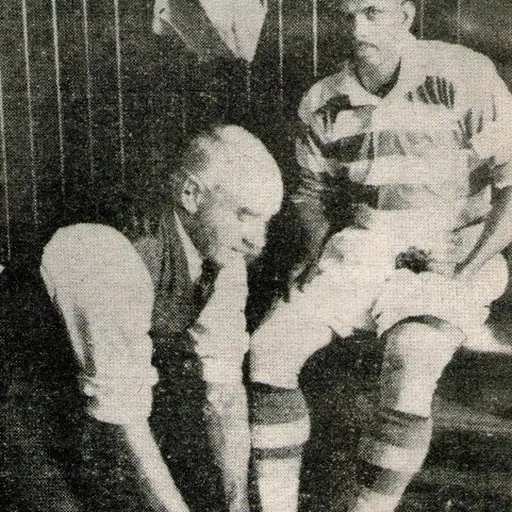
Jimmy McMenemy
Scottish footballer
About Jimmy McMenemy
Lived 1880 – 1963 (aged 82–83). Jimmy McMenemy was a British association football player and association football coach.
James McMenamin (11 October 1880 – 23 June 1965),
Early life James was born in Rutherglen, Lanarkshire, on 11 October 1880 to John McMenamin and Hannah Regan; his father adopted the name 'McMenamin' after he moved to Scotland from County Tyrone. John's brother, also called James, settled in Rutherglen during the same period with his wife Ann Smith but maintained the traditional spelling 'McMenemy'. This – and also due to the player himself using both styles – has led to some mis-attributing of the player's date of birth to that of his cousin (James McMenemy, born at Rutherglen on 23 August 1880). alongside Alec Bennett.
In June 1902, as well as an apparent resemblance to Napoleon Bonaparte, he was also said to be "a master of the deceptive movement" who "seldom troubled himself with the physical side of the game – he had no need." One of his first important actions was away from the pitch when he successfully persuaded Bennett to join him at the club; the pair would form Celtic's first famous forward line, along with Davie Hamilton (another former Cambuslang Hibs player), Jimmy Quinn and Peter Somers.
1908 Celtic team photo with the League Championship, Scottish Cup and Glasgow Cup trophies; McMenemy is top row, third left (counting players only)McMenemey was in the team that defeated Rangers 3–2 in the 1904 Scottish Cup final after being down 2–0, and also played and opened the scoring in a playoff match against the same opposition to decide the 1904–05 league title. which took the next three titles, but McMenemy remained with Celtic while others were replaced.
On the eve of World War I in season 1913–14, the club were again crowned champions and Cup winners. This team, including new stars Patsy Gallacher, Jimmy McColl and Andy McAtee plus survivors from the earlier successful squad such as Alec McNair and 'Sunny Jim' Young would win a further three titles, and set a sequence of 62 league games unbeaten (65 including the minor Glasgow Cup and Glasgow Merchants Charity Cup) which would not be surpassed for a century. In October 1913, McMenemy suffered a broken collar bone during a match against Aberdeen. After jumping up to win a header, McMenemy collided mid-air with John Wyllie, "and they both fell like a log". McMenemy was not to play for Celtic again until 27 December in a 6-0 victory over Ayr United.
McMenemy, now in his mid-30s, was one of the Celtic players who worked in reserved occupations during the conflict – in his case manufacturing munitions – so was not called to frontline action and able to continue to playing football whenever possible (in summer 1918 he was due to be called up, with one brother having been killed and another wounded on the battlefield, but fell ill with influenza and did not leave Scotland before the armistice in November of that year).
Prior to season 1918–19, 38-year-old McMenemy retired from playing, only to return to Celtic by the halfway point of the season, (although the only final in which he scored was 1912 against Clyde), an equally impressive total considering the trophy was withheld in 1909 and five editions were not contested during the war.
McMenemy made 515 appearances for Celtic in the League and Scottish Cup, scoring 166 goals. He is also the club's oldest goalscorer (39 years, 56 days v Motherwell, 6 December 1939) He also holds the record for scoring for Celtic in the most consecutive seasons, scoring in every season from 1902-03 to 1919-20.
In June 1920, McMenemy left Celtic and joined Partick Thistle where, in April 1921, aged, 40, he helped them to their one and only Scottish Cup victory, beating Rangers 1–0 in the final which was held at Celtic Park. He played on at Firhill for two more years, retiring in 1923.
International McMenemy played 12 times for the Scotland national team, scoring five goals, and also represented the Scottish League XI 14 times, scoring twice.
At the age of 40 he also took part in a 1921 summer tour of North America as a member of 'Third Lanark Scotland XI' (organised by Third Lanark and composed of players from seven different clubs); he was reunited with old teammate and rival Alec Bennett who thereafter became the Thirds manager.
Coaching and later life After retiring from playing, McMenemy spent some years away from football and spent time as a publican. He came back to Partick Thistle as a coach, then in 1934 returned to Celtic as trainer assisting Willie Maley (the same manager who had brought him to the club three decades earlier), helping players such as Jimmy Delaney and Willie Buchan to develop and taking charge of the squad which won the Empire Exhibition Trophy in 1938, having already secured that season's League title.
Maley retired in 1940, however McMenemy was not chosen to succeed him, the role instead going to Jimmy McStay.
In 2013, the Evening Times newspaper ranked him in 12th position among Celtic's greatest-ever players.
In 2014, the 'Celtic Graves Society' held a commemorative event for McMenemy in Dalbeth St Peters Cemetery to recognise his achievements, attended by family members and former players. – just six years after his father's last win – and the Scottish League Championship with Motherwell in 1932; Harry played for Newcastle United where he won the FA Cup in 1932; Frank played for Hamilton Academical and Crystal Palace; and James (Maryhill) Joe (Strathclyde) and Neil (Strathclyde, Ayr United) were prominent junior players but did not play at the professional level. Joe McMenemy is also credited with saving the sister of Sean Fallon from drowning during a holiday in Sligo, after which the families became acquainted; Fallon would go on to serve Celtic as a player and coach for many years.
Lawrie McMenemy, the former manager of Southampton and many other teams, is a distant relation of the family.
Honours Rutherglen Glencairn Scottish Junior Cup: 1901–02
Celtic Scottish League (11): 1904–05, 1905–06, 1906–07, 1907–08, 1908–09, 1909–10, 1913–14, 1914–15, 1915–16, 1916–17, 1918–19 Budapest Cup: 1914
Partick Thistle Scottish Cup: 1920–21
Scotland British Home Championship (2): 1909–10, 1911–12 (shared)
Don’t just read it —
keep it.
Full-length biographies made to live with: read them, listen on the way to work, watch them tonight.
- E-book
- Audio
- Video
Instant download · yours to keep · every purchase keeps this site free
Important facts
People in Jimmy McMenemy's life
Named in this biography and alive at the same time





Related people
Same field, nearest in time


Contemporaries
People whose lives overlapped Jimmy McMenemy's

Frequently asked questions
Who was Jimmy McMenemy?
Scottish footballer
When was Jimmy McMenemy born?
Jimmy McMenemy was born on 23 August 1880 in Rutherglen.
When did Jimmy McMenemy die?
Jimmy McMenemy died in 1963 in Glasgow.
What was Jimmy McMenemy's occupation?
Jimmy McMenemy was an association football player and association football coach.
What nationality was Jimmy McMenemy?
Jimmy McMenemy was British.
Sources & further reading
Cite this page
APA: Biography.guide. (2026). Jimmy McMenemy. https://biography.guide/jimmy-mcmenemy/
MLA: "Jimmy McMenemy." Biography.guide, https://biography.guide/jimmy-mcmenemy/.
Chicago: "Jimmy McMenemy." Biography.guide. https://biography.guide/jimmy-mcmenemy/.
Data last updated: 2026-09-23 · Spot an error? Report a correction.
Portrait: Wikimedia Commons · author & licence
Page generated 2026-09-27 05:06 UTC