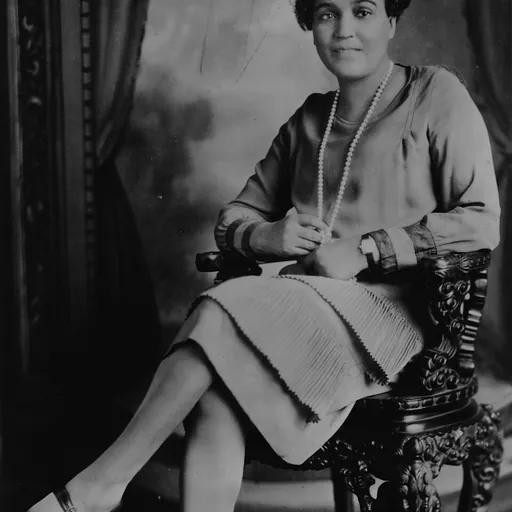
About Jessie Redmon Fauset
Lived 1882 – 1961 (aged 79). Jessie Redmon Fauset was an American poet, novelist, writer, essayist, literary editor and teacher.
Jessie Redmon Fauset (April 27, 1882 – April 30, 1961) was an American editor, poet, essayist, novelist, and educator. Her work helped sculpt African-American literature in the 1920s as she focused on portraying a true image of African-American life and history. Her black fictional characters were working professionals which was an inconceivable concept to American society during this time. Her story lines related to themes of racial discrimination, "passing", and feminism.
From 1919 to 1926, Fauset's position as literary editor of The Crisis, an NAACP magazine, allowed her to contribute to the Harlem Renaissance by promoting literary work that related to the social movements of this era. Through her work as a literary editor and reviewer, she encouraged black writers to represent the African-American community realistically and positively.
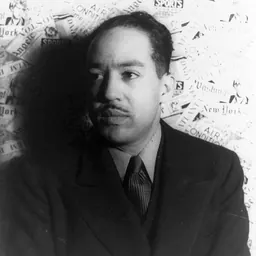
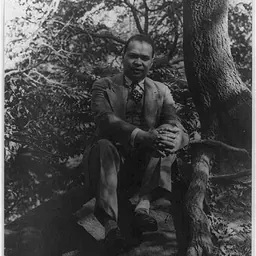
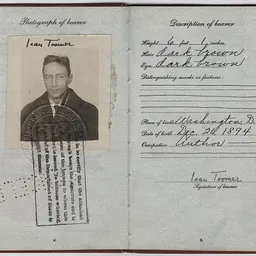
She is known for discovering and mentoring other African-American writers, including Langston Hughes, Jean Toomer, Countee Cullen, and Claude McKay.
Life and work She was born Jessie Redmona Fauset (later known as Jessie Redmon Fauset) on April 27, 1882, in Fredericksville, Camden County, Snow Hill Center Township, New Jersey (now known as Lawnside, New Jersey).
She was the seventh child of Redmon Fauset, an African Methodist Episcopal minister, and Annie (née Seamon) Fauset. Jessie's mother died when she was young, and her father remarried. He had three children with his second wife Bella, a white Jewish woman who converted to Christianity. Bella brought three children to the family from her first marriage. Both parents emphasized education for their children. Civil rights activist and anthropologist Arthur Fauset was her half-brother. Her father died when she was young; two of her half-siblings were still under the age of five. She attended the Philadelphia High School for Girls, the city's top academic school. She graduated as valedictorian of her class and likely the school's first African-American graduate. She wanted to study at Bryn Mawr College, and the valedictorian of Girls' High was traditionally awarded a scholarship to the college. However, Bryn Mawr president M. Carey Thomas raised money for Fauset to attend Cornell University instead. Carey Thomas would prevent any black or Jewish students from attending Bryn Mawr during her tenure.
She continued her education at Cornell University in upstate New York, graduating in 1905 with a degree in classical languages. During her time at Cornell University in 1903 through part of 1904, Fauset lived at Sage College. She would win Phi Beta Kappa honors. For many years she was considered to be the first black woman accepted to Phi Beta Kappa society, Fauset later received her master's degree in French from the University of Pennsylvania (1919).
Following college, Fauset became a teacher at Dunbar High School (then named as M Street High School), the academic high school for black students in Washington, DC, which had a segregated public school system. She taught French and Latin, She taught in New York City public schools until 1944.
In 1929, when she was 47, Fauset married for the first time, to insurance broker Herbert Harris. They moved from New York City to Montclair, New Jersey, where they led a quieter life.
There is Confusion was widely praised upon release. In the New York Times, Ernest Boyd wrote: "Compared with the ordinary story of negro life Jessie Redmon Fauset's There is Confusion assumes the proportions of an important book; it is well executed, so well, in fact, that no Ku Kluxer could stand it." Alain Locke wrote in The Crisis: "ere in refreshing contrast with the bulk of fiction about the Negro, we have a novel of the educated and aspiring classes." This novel traces the family histories of Joanna Mitchell and Peter Bye, who must each come to terms with their complex racial histories. Plum Bun has warranted the most critical attention. It explores the theme of "passing". The mixed-race protagonist, Angela Murray, who has partial European ancestry, passes for white in order to gain some advantages. In the course of the novel, she eventually reclaims her African-American identity. The Chinaberry Tree has not received much critical attention. Set in New Jersey, this novel explores the longing for "respectability" among the contemporary African-American middle class. The protagonist Laurentine seeks to overcome her "bad blood" through marriage to a "decent" man. Ultimately, Laurentine must redefine "respectable" as she finds her own sense of identity. Comedy, American Style, Fauset's last novel, explores the destructive power of "color mania" because he believed it was educated literary material that the educated reader anticipated as it shone light on a higher class of black people rather than the usual "servant" type of character that was portrayed in past literature. Despite the mixed discussion on Fauset's work in the 1920s, by the 1930s people stopped talking about her and she became a forgotten writer. Locke felt that the reason people stopped talking about Fauset was due to a change in the literary scene because of the Great Depression and Second World War.
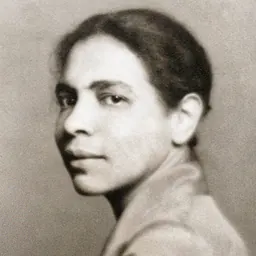
Current scholarship It was not until after the 1970s, a period of a feminist movement, that Fauset began to regain praise. In 1981, author Carolyn Wedin Sylvander wrote a book about Fauset, Jessie Redmon Fauset, Black American Writer, which analyses and shows great appreciation of her novels, short stories and poems. Other critics such as Wilbert Jenkins acknowledge Fauset in his 1986 essay "Jessie Fauset: A Modern Apostle of Black Racial Pride" for showing "awareness of African American cultural history" and demonstrating how to celebrate "black identity". Jenkins also argues that Fauset is alongside other early black feminists because in addition to focusing on racial identity, she explores "female consciousness". Fauset is recognized today as an important contributor to the Harlem Renaissance. American and African-American literature professor Ann duCille compares Fauset to other Harlem Renaissance writers such as Nella Larsen for expressing feminism in her literary work. Plum Bun: A Novel Without a Moral (1928) (a further study of the passing phenomenon; ) The Chinaberry Tree: A Novel of American Life (1931) Comedy, American Style (1933)
Poems "Rondeau." The Crisis. April 1912: 252. "La Vie C'est La Vie." The Crisis. July 1922: 124. "Dead Fires." Palms. October 1926: 17. "'Courage!' He Said." The Crisis. November 1929: 378.
Short stories "Emmy." The Crisis. December 1912: 79–87; January 1913: 134–142. "My House and a Glimpse of My Life Therein." The Crisis. July 1914: 143–145. "Double Trouble." The Crisis. August 1923: 155–159; September 1923: 205–209.
Essays "Impressions of the Second Pan-African Congress." The Crisis. November 1921: 12–18. "What Europe Thought of the Pan-African Congress." The Crisis. December 1921: 60–69. "The Gift of Laughter." In Locke, Alaine. The New Negro: An Interpretation. New York: A. and C. Boni, 1925. "Dark Algiers the White." The Crisis. 1925–26 (vol. 29–30): 255–258, 16–22.
Don’t just read it —
keep it.
Full-length biographies made to live with: read them, listen on the way to work, watch them tonight.
- E-book
- Audio
- Video
Instant download · yours to keep · every purchase keeps this site free
Important facts
People in Jessie Redmon Fauset's life
Named in this biography and alive at the same time



Related people
Same field, nearest in time
Contemporaries
People whose lives overlapped Jessie Redmon Fauset's

Frequently asked questions
Who was Jessie Redmon Fauset?
American novelist (1882–1961)
When was Jessie Redmon Fauset born?
Jessie Redmon Fauset was born on 27 April 1882 in Camden County, Snow Hill.
When did Jessie Redmon Fauset die?
Jessie Redmon Fauset died on 30 April 1961 in Philadelphia.
What was Jessie Redmon Fauset's occupation?
Jessie Redmon Fauset was a poet, novelist, writer, essayist, literary editor and teacher.
What nationality was Jessie Redmon Fauset?
Jessie Redmon Fauset was American.
Sources & further reading
· Wikipedia: Jessie Redmon Fauset
Cite this page
APA: Biography.guide. (2026). Jessie Redmon Fauset. https://biography.guide/jessie-redmon-fauset/
MLA: "Jessie Redmon Fauset." Biography.guide, https://biography.guide/jessie-redmon-fauset/.
Chicago: "Jessie Redmon Fauset." Biography.guide. https://biography.guide/jessie-redmon-fauset/.
Data last updated: 2026-09-23 · Spot an error? Report a correction.
Portrait: Wikimedia Commons · author & licence
Page generated 2026-09-27 05:05 UTC