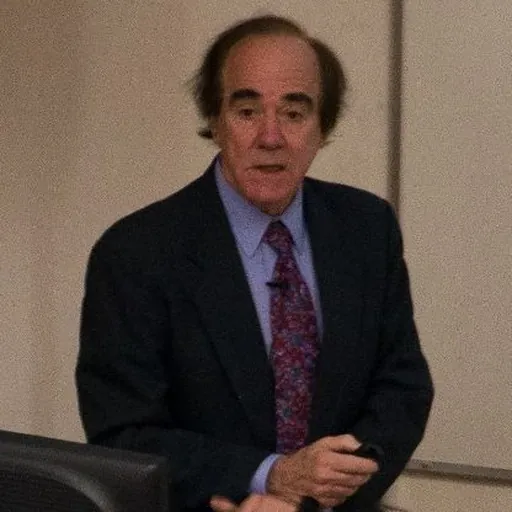
About Jeffrey P. Buzen
Born 1943. Jeffrey P. Buzen is an American mathematician, computer scientist and engineer, known for BGS Systems and Buzen's algorithm.
Jeffrey Peter Buzen (born May 28, 1943) is an American computer scientist in system performance analysis best known for his contributions to queueing theory. His PhD dissertation and his 1973 paper Computational algorithms for closed queueing networks with exponential servers have guided the study of queueing network modeling for decades.
Born in Brooklyn, Buzen holds three degrees in Applied Mathematics -- an ScB (1965) from Brown University and, from Harvard University, an MS (1966) and a PhD (1971). He was a systems programmer at the National Institutes of Health in Bethesda, Maryland (1967–69), where his technique for optimizing the performance of a realtime biomedical computer system led to his first publication at a 1969 IEEE conference. After completing his PhD, he held concurrent appointments as a lecturer in computer science at Harvard and as a systems engineer at Honeywell (1971-76). Some of his students at Harvard have gone on to become well-known figures in computing. Buzen was PhD thesis advisor for Robert M. Metcalfe (1973), Turing Award winner and co-inventor of Ethernet, and for John M. McQuillan (1974), developer the original adaptive routing algorithms used in ARPAnet and Internet. Buzen also co-taught a two-semester graduate-level course on operating systems (AM 251a/AM251br) that Microsoft co-founder Bill Gates took during his freshman year (1973-74). Gates wrote "It was the only 'computer course' I officially took at Harvard."
In addition to being an educator and a researcher, Buzen is also an entrepreneur. Along with fellow Harvard applied mathematics PhDs Robert Goldberg and Harold Schwenk, he co-founded BGS Systems in 1975. The company, which began operations in his basement, for technical excellence and professional contributions as a teacher and inspirer of others. He also received the ACM SIGMETRICS Achievement Award in 2010.
He was elected a member of the National Academy of Engineering in 2003 for contributions to the theory and commercial application of computer system performance models.
Don’t just read it —
keep it.
Full-length biographies made to live with: read them, listen on the way to work, watch them tonight.
- E-book
- Audio
- Video
Instant download · yours to keep · every purchase keeps this site free
Important facts
People in Jeffrey P. Buzen's life
Named in this biography and alive at the same time


Related people
Same field, nearest in time


Contemporaries
People whose lives overlapped Jeffrey P. Buzen's


Frequently asked questions
Who is Jeffrey P. Buzen?
American computer scientist
When was Jeffrey P. Buzen born?
Jeffrey P. Buzen was born on 28 May 1943 in Brooklyn.
What is Jeffrey P. Buzen's occupation?
Jeffrey P. Buzen is a mathematician, computer scientist and engineer.
What is Jeffrey P. Buzen known for?
Jeffrey P. Buzen is known for BGS Systems and Buzen's algorithm.
What nationality is Jeffrey P. Buzen?
Jeffrey P. Buzen is American.
Sources & further reading
Cite this page
APA: Biography.guide. (2026). Jeffrey P. Buzen. https://biography.guide/jeffrey-p-buzen/
MLA: "Jeffrey P. Buzen." Biography.guide, https://biography.guide/jeffrey-p-buzen/.
Chicago: "Jeffrey P. Buzen." Biography.guide. https://biography.guide/jeffrey-p-buzen/.
Data last updated: 2026-09-22 · Spot an error? Report a correction.
Portrait: Wikimedia Commons · author & licence
Page generated 2026-09-27 05:01 UTC