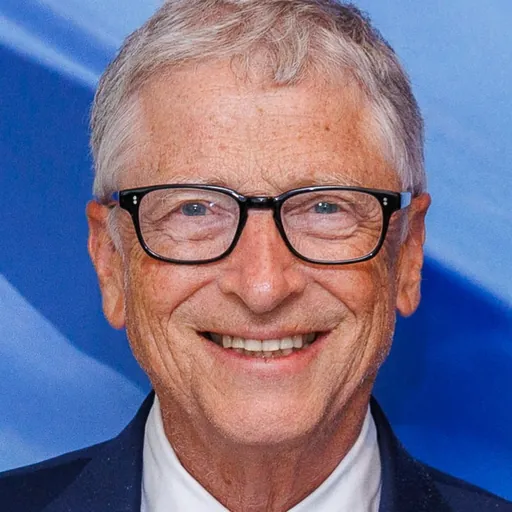
Bill Gates
American businessman, investor, and philanthropist (born 1955)
About Bill Gates
Born 1955. Bill Gates is an American entrepreneur, programmer, computer scientist, bridge player, investor and philanthropist, known for Bill & Melinda Gates Foundation and Microsoft.
William Henry Gates III (born October 28, 1955) is an American businessman and philanthropist. A pioneer of the microcomputer revolution of the 1970s and 1980s, he co-founded the software company Microsoft in 1975 with his childhood friend Paul Allen. Following Microsoft's initial public offering in 1986 and the subsequent increase in its stock price, Gates became the world's then-youngest billionaire in 1987, at age 31. Forbes magazine ranked him as the world's wealthiest person in their The World's Billionaires list for 18 out of 24 years between 1995 and 2017, including 13 years consecutively from 1995 to 2007. Gates became the first centibillionaire in 1999, when his net worth briefly surpassed US$100 billion. According to Forbes, as of July 2026, his net worth stood at US$106.5 billion, making him the 19th-wealthiest individual in the world.
Born and raised in Seattle, Washington, Gates was privately educated at Lakeside School, where he befriended Allen and developed his computing interests. In 1973, he enrolled at Harvard University, where he took classes including Math 55 and graduate-level computer science courses, but he dropped out in 1975 to co-found and lead Microsoft. He served as its CEO for the next 25 years and also became president and chairman of the board when the company was incorporated in 1981. Succeeded as CEO by Steve Ballmer in 2000, he transitioned to chief software architect, a position he held until 2008. He stepped down as chairman of the board in 2014 and became technology adviser to CEO Satya Nadella and other Microsoft leaders, a position he still holds. He resigned from the board in 2020.
Over time, Gates reduced his role at Microsoft to focus on his philanthropic work with the Bill & Melinda Gates Foundation, the world's largest private charitable organization, which he and his then-wife, Melinda French Gates, co-chaired from 2000 until 2024. Focusing on areas including health, education, and poverty alleviation, Gates became known for his efforts to combat transmissible diseases such as tuberculosis, malaria, and polio. After French Gates resigned as co-chair following the couple's divorce, the foundation was renamed the Gates Foundation, with Gates as its sole chair.
Gates is the founder and chairman of several other companies, including BEN, Cascade Investment, TerraPower, Gates Ventures, and Breakthrough Energy. In 2010, he and Warren Buffett founded the Giving Pledge, whereby they and other billionaires pledged to give at least half their wealth to philanthropy. Named as one of the 100 most influential people of the 20th century by Time magazine in 1999, he has received numerous other honors and accolades, including a Presidential Medal of Freedom, awarded jointly to him and French Gates in 2016 for their philanthropic work. The subject of several documentary films, he published the first of three planned memoirs, Source Code: My Beginnings, in 2025.
Early life and education William Henry Gates III was born on October 28, 1955, in Seattle, Washington, as the only son of Bill Gates Sr. (1925–2020) and his first wife, Mary Maxwell Gates (1929–1994). His ancestry includes English, German, and Irish/Scots-Irish. His father was a prominent lawyer, and his mother served on the board of directors of First Interstate BancSystem and United Way of America. Gates's maternal grandfather, J. W. Maxwell, was a national bank president. Gates also has an older sister, Kristi (Kristianne), and a younger sister, Libby. He is the fourth of his name in his family, but is known as William Gates III or "Trey" (i.e., three) because his father had the "II" suffix. The family lived in the Sand Point area of Seattle in a home that was damaged by a rare tornado when Gates was 7.
When Gates was young, his parents wanted him to pursue a career in law. During his childhood, his family regularly attended a church of the Congregational Christian Churches, a Protestant Reformed denomination.
Gates was small for his age and was bullied as a child.
At age 13, Gates enrolled in the private Lakeside Prep School. When he was in the eighth grade, the Mothers' Club at the school used proceeds from Lakeside School's rummage sale to buy a Teletype Model 33 ASR terminal and a block of computer time on a General Electric (GE) computer for the students. Gates took an interest in programming the GE system in BASIC, and he was excused from math classes to pursue his interest. He wrote his first computer program on this machine, an implementation of tic-tac-toe that allowed users to play games against the computer. Gates was fascinated by the machine and how it would always execute software code perfectly.
After the Mothers Club donation was exhausted, Gates and other students sought time on systems, including DEC PDP minicomputers. One of these systems was a PDP-10 belonging to Computer Center Corporation (CCC), which banned Gates, Paul Allen, Ric Weiland, and Gates's best friend and first business partner, Kent Evans, for the summer after it caught them exploiting bugs in the operating system to obtain free computer time.
The four students formed the Lakeside Programmers Club to make money. At the end of the ban, they offered to find bugs in CCC's software in exchange for extra computer time. Rather than using the system remotely via Teletype, Gates went to CCC's offices and studied source code for various programs that ran on the system, including Fortran, Lisp, and machine language. The arrangement with CCC continued until 1970, when the company went out of business. He was a national merit scholar when he graduated from Lakeside School in 1973. He scored 1590 out of 1600 on the SAT and enrolled at Harvard University in the autumn of 1973.
Gates did not stay at Harvard long enough to choose a concentration, but took mathematics (including Math 55) and graduate-level computer science courses. While at Harvard, he met fellow student and future Microsoft CEO Steve Ballmer. Gates left Harvard after two years while Ballmer stayed and graduated magna cum laude. Years later, Ballmer succeeded Gates as Microsoft's CEO and maintained that position from 2000 until his resignation in 2014.
Gates devised an algorithm for pancake sorting as a solution to one of a series of unsolved problems presented in a combinatorics class by Professor Harry Lewis. His solution held the record as the fastest version for over 30 years, and its successor is faster by only 2%. His solution was formalized and published in collaboration with Harvard computer scientist Christos Papadimitriou.
Gates remained in contact with Paul Allen and joined him at Honeywell during the summer of 1974. In 1975, the MITS Altair 8800 was released based on the Intel 8080 CPU, and Gates and Allen saw the opportunity to start their own computer software company. Gates dropped out of Harvard that same year. His parents were supportive of him after seeing how much he wanted to start his own company. He explained his decision to leave Harvard: "If things hadn't worked out, I could always go back to school. I was officially on leave."
Business career
Microsoft BASIC
Gates read the January 1975 issue of Popular Electronics, which demonstrated the Altair 8800, and contacted Micro Instrumentation and Telemetry Systems (MITS) to inform them that he and others were working on a BASIC interpreter for the platform. In reality, Gates and Allen did not have an Altair and had not written code for it; they merely wanted to gauge MITS's interest. MITS president Ed Roberts agreed to meet them for a demonstration, and over the course of a few weeks, they developed an Altair emulator that ran on a minicomputer and then the BASIC interpreter. and Gates took a leave of absence from Harvard to work with him at MITS in November 1975. Allen named their partnership "Micro-Soft", a combination of "microcomputer" and "software". Their first office was in Albuquerque. The first employee Gates and Allen hired was their high school collaborator Ric Weiland.
Gates' ideas about programming and memories of the Altair BASIC project are described in the book Programmers at Work, a collection of interviews published by Microsoft Press in 1986.
IBM partnership IBM, the leading supplier of computer equipment to commercial enterprises at the time, approached Microsoft in July 1980 concerning software for its upcoming personal computer, the IBM PC, after Gates's mother mentioned Microsoft to John Opel, IBM's then CEO. IBM's discussions with Digital Research went poorly, and they did not reach a licensing agreement. IBM representative Jack Sams mentioned the licensing difficulties during a subsequent meeting with Gates and asked if Microsoft could provide an operating system. A few weeks later, Gates and Allen proposed using 86-DOS, an operating system similar to CP/M, that Tim Paterson of Seattle Computer Products (SCP) had made for hardware similar to the PC. Microsoft made a deal with SCP to be the exclusive licensing agent of 86-DOS, and later the full owner. Microsoft employed Paterson to adapt the operating system for the PC and delivered it to IBM as PC DOS for a one-time fee of $50,000.
The contract itself only earned Microsoft a relatively small fee. It was the prestige brought to Microsoft by IBM's adoption of its operating system that would be the origin of Microsoft's transformation from a small business to the leading software company in the world. Gates had not offered to transfer the copyright on the operating system to IBM because he believed that other personal computer makers would clone IBM's PC hardware. They did, making the IBM-compatible PC, running DOS, a de facto standard. The sales of MS-DOS (the version of DOS sold to customers other than IBM) made Microsoft a major player in the industry. The press quickly identified Microsoft as being very influential on the IBM PC. PC Magazine asked if Gates was "the man behind the machine?".
Gates oversaw Microsoft's company restructuring on June 25, 1981, which re-incorporated the company in Washington state and made Gates the president and chairman of the board, with Paul Allen as vice president and vice chairman. In early 1983, Allen left the company after receiving a Hodgkin lymphoma diagnosis, effectively ending the formal business partnership between Gates and Allen, which had been strained months prior due to a contentious dispute over Microsoft equity. Later in the decade, Gates repaired his relationship with Allen, and together the two donated millions to their childhood school, Lakeside.
Windows
Microsoft and Gates launched their first retail version of Microsoft Windows on November 20, 1985, in an attempt to fend off competition from Apple's Macintosh GUI, which had captivated consumers with its simplicity and ease of use. In August 1986, the company struck a deal with IBM to develop a separate operating system called OS/2. Although the two companies successfully developed the first version of the new system, the partnership deteriorated due to mounting creative differences. The operating system grew out of DOS in an organic fashion over a decade until Windows 95, which hid the DOS prompt by default. Windows XP was released one year after Gates stepped down as Microsoft CEO. Windows 8.1 was the last version of the OS released before Gates left the chair of the firm to John W. Thompson on February 5, 2014.
Management style
During Microsoft's early years, Gates was an active software developer, particularly in the company's programming language products, but his primary role in most of the company's history was as a manager and executive. He has not officially been on a development team since working on the TRS-80 Model 100, but he wrote code that shipped with the company's products as late as 1989.
Jerry Pournelle wrote in 1985 when Gates announced Microsoft Excel: "Bill Gates likes the program, not because it's going to make him a lot of money (although I'm sure it will do that), but because it's a neat hack." During the late 1990s, he was criticized for his business tactics, which were considered anti-competitive. This opinion has been upheld by numerous court rulings.
In June 2006, Gates announced that he would transition out of his role at Microsoft to dedicate more time to philanthropy. He gradually divided his responsibilities between two successors when he placed Ray Ozzie in charge of management and Craig Mundie in charge of long-term product strategy. The process took two years to fully transfer his duties to Ozzie and Mundie, and was completed on June 27, 2008.
Business ventures and investments (partial list) Gates has a multi-billion dollar investment portfolio with stakes in companies in multiple sectors and has participated in several entrepreneurial ventures beyond Microsoft, including:
AutoNation, an automotive retailer which trades on the NYSE and in which Gates has a 16% stake. bgC3 LLC, a think-tank and research company founded by Gates. Canadian National Railway (CN), a Canadian Class I freight railway. As of 2019, Gates is the single largest shareholder of the company. Cascade Investment LLC, a private investment and holding company incorporated in the United States, founded and controlled by Gates and headquartered in Kirkland, Washington. Gates is the largest private owner of farmland in the United States with his landholdings owned through Cascade Investment totalling 242,000 acres across 19 states. He is the 49th largest private owner of land in the US. Carbon Engineering, a for-profit venture founded by David Keith, which Gates helped fund. It is also supported by Chevron Corporation and Occidental Petroleum. SCoPEx, Keith's academic venture in "sun-dimming" geoengineering, which Gates provided most of the $12 million for. Corbis (originally named Interactive Home Systems, then Corbis and now known as Branded Entertainment Network), a digital image licensing and rights services company founded and chaired by Gates. Corbis Images, its enormous photo image library, was sold to a Chinese firm in January 2016. EarthNow, a Seattle-based startup company aiming to blanket the Earth with live satellite video coverage. Gates is a large financial backer. Eclipse Aviation, a defunct manufacturer of very light jets. Gates was a major stake-holder early on in the project. Impossible Foods, a company that develops plant-based substitutes for meat products. Some of the $396 million Patrick O. Brown collected for his business came from Gates around 2014 to 2017. Ecolab, a global provider of water, hygiene and energy technologies and services to the food, energy, healthcare, industrial and hospitality markets. Combined with the shares owned by the Foundation, Gates owns 11.6% of the company. A shareholder agreement in 2012 allowed him to own up to 25% of the company, but this agreement was removed. ResearchGate, a social networking site for scientists. Gates participated in a $35 million round of financing along with other investors. TerraPower, a nuclear reactor design company co-founded and chaired by Gates, which is developing next generation traveling-wave reactor nuclear power plants in an effort to tackle climate change. Breakthrough Energy Ventures, a closed fund for wealthy individuals who seek ROI on a 20-year horizon (see next section), which "is funding green start-ups and a host of other low-carbon entrepreneurial projects, including everything from advanced nuclear technology to synthetic breast milk". It was founded by Gates in 2015. Ginkgo Bioworks, a biotech startup that received $350 million in venture funding in 2019, in part from Gates's investment firm Cascade Investment. Luminous Computing, a company that develops neuromorphic photonic integrated circuits for artificial intelligence acceleration. Mologic, a British diagnostic technology company that Gates purchased, along with the Soros Economic Development Fund, "which has developed 10-minute Covid lateral flow tests that it aims to make for as little as $1".
Later life
Since leaving day-to-day operations at Microsoft, Gates has continued his philanthropy and works on other projects. He stepped down as chairman of Microsoft in February 2014 to become a technology advisor at the firm to support newly appointed CEO Satya Nadella.
Gates provided his perspective on a range of issues in an interview that was published in the March 2014 issue of Rolling Stone magazine. In the interview, he provided his perspective on climate change, his charitable activities, various tech companies and people involved in them, and the state of America. In response to a question about his greatest fear when he looks 50 years into the future, Gates stated: "there'll be some really bad things that'll happen in the next 50 or 100 years, but hopefully none of them on the scale of, say, a million people that you didn't expect to die from a pandemic, or nuclear or bioterrorism." Gates also identified innovation as the "real driver of progress" and pronounced that "America's way better today than it's ever been." Gates has often expressed concern about the potential harms of superintelligence; in a Reddit "ask me anything", he stated that:
Gates delivers a speech at the World Economic Forum in Switzerland, January 2008.
In an interview that was held at the TED conference in March 2015, with Baidu co-founder and CEO, Robin Li, Gates said he would "highly recommend" Nick Bostrom's recent work, Superintelligence: Paths, Dangers, Strategies. During the conference, Gates warned that the world was not prepared for the next pandemic, a situation that would come to pass in late 2019 when the COVID-19 pandemic began. In March 2018, Gates met at his home in Seattle with Mohammed bin Salman, the crown prince and de facto ruler of Saudi Arabia, to discuss investment opportunities for Saudi Vision 2030. In June 2019, Gates admitted that losing the mobile operating system race to Android was his biggest mistake. He stated that it was within their skill set of be the dominant player, but partially blames the antitrust litigation during that time. That same year, Gates became an advisory board member of the Bloomberg New Economy Forum.
In March 2020, Microsoft announced Gates would be leaving his board positions at Berkshire Hathaway and Microsoft to dedicate himself to philanthropic endeavors such as climate change, global health and development, and education. The Wall Street Journal reported in May 2021 that Gates stepped down before Microsoft's board finished its investigation into Gates's alleged inappropriate sexual relationship with a Microsoft employee, which an external law firm had begun probing in late 2019.
During the COVID-19 pandemic, Gates has been looked at by media outlets as an expert on the issue, despite not being a public official or having any prior medical training. His foundation did, however, establish the COVID-19 Therapeutics Accelerator in 2020 to hasten the development and evaluation of new and repurposed drugs and biologics to treat patients for COVID-19 and, as of February 2021, Gates expressed that he and Anthony Fauci frequently talk and collaborate on matters including vaccines and other medical innovations to fight the pandemic.
Philanthropy In an interview with the BBC in 2025, Gates stated that his charitable donations have totalled $100 billion, of which $60 billion have gone to the Bill & Melinda Gates Foundation.
Bill & Melinda Gates Foundation
Gates studied the work of Andrew Carnegie and John D. Rockefeller, and donated some of his Microsoft stock in 1994 to create the "William H. Gates Foundation". In 2000, Gates and his wife combined three family foundations and donated stock valued at $5 billion to create the Bill & Melinda Gates Foundation, which was identified by the Funds for NGOs company in 2013, as the world's largest charitable foundation, with assets reportedly valued at more than $34.6 billion. The foundation allows benefactors to access information that shows how its money is being spent, unlike other major charitable organizations such as the Wellcome Trust. Gates, through his foundation, also donated $20 million to the Carnegie Mellon University for a new building to be named Gates Center for Computer Science which opened in 2009.
Gates has credited the generosity and extensive philanthropy of David Rockefeller as a major influence. He and his father met with Rockefeller several times, and their charity work is partly modeled on the Rockefeller family's philanthropic focus, whereby they are interested in tackling the global problems that are ignored by governments and other organizations.
The foundation is organized into five program areas: Global Development Division, Global Health Division, United States Division, and Global Policy & Advocacy Division. Among others, it supports a wide range of public health projects, granting aid to fight transmissible diseases such AIDS, tuberculosis and malaria, as well as widespread vaccine programs to eradicate polio. It grants funds to learning institutes and libraries and supports scholarships at universities. The foundation established a water, sanitation and hygiene program to provide sustainable sanitation services in poor countries. Its agriculture division supports the International Rice Research Institute in developing Golden Rice, a genetically modified rice variant used to combat vitamin A deficiency. The foundation aims to provide women and girls in the developing world with information and support regarding contraception and, ultimately, universal access to consensual family planning. In 2007, the Los Angeles Times criticized the foundation for investing its assets in companies that have been accused of worsening poverty, pollution and pharmaceutical firms that do not sell to developing countries. Although the foundation announced a review of its investments to assess social responsibility, it was subsequently canceled and upheld its policy of investing for maximum return, while using voting rights to influence company practices.
Gates delivered his thoughts in a fireside chat moderated by journalist and news anchor Shereen Bhan virtually at the Singapore FinTech Festival on December 8, 2020, on the topic, "Building Infrastructure for Resilience: What the COVID-19 Response Can Teach Us About How to Scale Financial Inclusion".
Gates gained a reputation for being distant from others; an industry executive complained in 1981 that "Gates is notorious for not being reachable by phone and for not returning phone calls". He saw competition in personal terms; when Borland's Turbo Pascal performed better than Microsoft's own tools, he yelled at programming director Greg Whitten "for half an hour" because, Gates believed, Borland's Philippe Kahn had surpassed Gates. An Atari executive recalled that he showed Gates a game and defeated him 35 of 37 times. When they met again a month later, Gates "won or tied every game. He had studied the game until he solved it. That is a competitor".
In the early 1980s, while business partner Paul Allen was undergoing treatments for cancer, Gates—according to Allen—conspired to reduce Allen's share in Microsoft by issuing himself stock options. In his autobiography, Allen would later recall that Gates was "scheming to rip me off. It was mercenary opportunism plain and simple".
Gates has often been accused of bullying Microsoft employees. He met regularly with Microsoft's senior managers and program managers, and the managers described him as being verbally combative, berating them for perceived holes in their business strategies or proposals that placed the company's long-term interests at risk. Gates interrupted presentations with such comments as "that's the stupidest thing I've ever heard" and "why don't you just give up your options and join the Peace Corps?" The target of his outburst would then have to defend the proposal in detail until Gates was fully convinced. When subordinates appeared to be procrastinating, he was known to remark sarcastically, "I'll do it over the weekend".
Connection with Jeffrey Epstein
A 2019 New York Times article reported that Gates's relationship with financier Jeffrey Epstein started in 2011, a few years after Epstein was convicted for procuring a child for prostitution, and continued for some years, including a visit to Epstein's house with his wife in the fall of 2013, despite her declared discomfort. Gates said in 2011 about Epstein: "His lifestyle is very different and kind of intriguing although it would not work for me". However, Gates visited Epstein "many times, despite [Epstein's] past". Also in attendance were representatives of the International Peace Institute which has received millions in grants from the Gates Foundation, including a $2.5 million "community engagement" grant in October 2013. In 2023, it was reported that Epstein threatened to expose an alleged affair Gates had with a Russian bridge player.
In December 2025, Gates appeared in two photos released by the House Oversight and Government Reform Committee from documents in Jeffrey Epstein's estate. These photos were part of thousands of other files ordered to be released pursuant to the Epstein Files Transparency Act.
In January 2026, unsealed Epstein files revealed two 2013 draft emails by Epstein alleging Gates' extramarital affairs with "Russian girls" and "married women", resulting in him contracting an STD, and that an associate secretly obtained antibiotics for Melinda Gates while facilitating encounters. The emails accused Gates of ending their friendship after a failed Gates Foundation–JPMorgan deal and mentioned Epstein's resignation amid marital disputes and inappropriate activities. Nikolic resigned from the Gates Foundation in 2014,
In February 2026, Gates cancelled his scheduled keynote address at the India AI Impact Summit hours before it was due to take place. According to multiple news reports, the withdrawal came amid renewed public scrutiny over his past associations with Jeffrey Epstein, although the Gates Foundation stated the decision was made to ensure the summit remained focused on its core priorities.
On June 10, 2026, Gates sat for a voluntary closed-door transcribed interview with the House Oversight and Government Reform Committee as part of its investigation into Epstein. The committee released the full transcript on June 23, 2026, alongside that of Epstein's former executive assistant Lesley Groff.
In an opening statement, Gates said he had been introduced to Epstein in 2011 by colleagues he trusted, on the basis that Epstein could raise billions of dollars for global health from his clients. He described three meetings in 2011 and two in 2012, followed by more extensive discussions in 2013 and 2014 about potential giving structures, and said the contacts ended in December 2014 after a group Epstein had assembled proved to be a "dead end"; no fund was established and no money was raised. Gates called meeting Epstein "a grave error in judgment", said "I should never have met with Epstein in the first place", and stated: "I never witnessed nor had any indication that Epstein was engaged in ongoing criminal conduct. I never went to his island, his ranch, or his Florida home. I have never victimized anyone." He added that "while he may have sought to foster a personal relationship, I was never interested in that and never reciprocated." Asked by Representative Robert Garcia, who noted that some of Epstein's employees had themselves been abused, Gates said he had never knowingly spent time with victims but acknowledged, "I may have been in the presence of victims." He denied the claims in those notes, saying "I never had an STD". A spokesperson for Gates said he "answered every question asked of him during the nearly six-hour interview".
2025 climate memo In October 2025, Gates issued a statement saying that climate change does not pose an existential threat to civilization, stating that while it remains a serious problem, it was more important to give money to other causes such as solving poverty and improving healthcare. The statement was criticized by climate scientists, who stated that many of the issues Gates described as more of a priority result from climate change. Katharine Hayhoe said: "Climate change is not a separate bucket...The reason we care about climate change is that it's the hole in every bucket." According to prominent climate scientist Michael E. Mann: "There is no greater threat to developing nations than the climate crisis...He's got this all backwards."
Gates's statement was received by some climate change deniers as proof that climate change is a "hoax". Donald Trump reacted by posting on social media that he had "just won the War on the Climate Change Hoax" because Gates had "finally admitted that he was completely WRONG on the issue." Gates responded to Trump's statement saying that it was "a gigantic misreading of the memo", telling Axios that he would actually increase his spending on climate and health.
The memo came a day after the United Nations said humanity had missed the 1.5-degree target and warning of "devastating consequences", some of which are linked to tipping points, like in the Amazon, Greenland, Western Antarctica, and coral reefs. The memo was also released around the same time Hurricane Melissa, strengthened by climate change, struck the Caribbean islands whose damage was calculated as costing Jamaica alone 30%–250% of its annual GDP.
Awards and recognition
Time magazine listed Gates as one of the 100 most influential people of the 20th century in 1999, as well as one of the 100 most influential people in 2004, 2005, and 2006 respectively. Time also collectively named Gates, his wife Melinda and U2's lead singer Bono as the 2005 Persons of the Year for their humanitarian efforts. In 2006, he was voted eighth in the list of "Heroes of our time" published by New Statesman. Gates was listed in the Sunday Times power list in 1999, named CEO of the year by Chief Executive Officers magazine in 1994, ranked number one in the "Top 50 Cyber Elite" by Time in 1998, ranked number two in the Upside Elite 100 in 1999, and was also included in The Guardian as one of the "Top 100 influential people in media" in 2001. Gates has received honorary doctorates from Nyenrode Business Universiteit (1996), KTH Royal Institute of Technology (2002), Waseda University (2005), Tsinghua University (2007), Harvard University (2007), the Karolinska Institute (2007), the University of Cambridge (2009), and Northern Arizona University (2023). He was also made an honorary trustee of Peking University in 2007. In 1994, he was honored as the 20th Distinguished Fellow of the British Computer Society (DFBCS). In 1999, Gates received New York Institute of Technology's President's Medal. Gates was elected a Member of the US National Academy of Engineering in 1996 "for contributions to the founding and development of personal computing". Entomologists named Bill Gates' flower fly, , in his honor in 1997. He was awarded American Library Association Honorary Membership in 1998. In 2002, Bill and Melinda Gates received the Jefferson Award for Greatest Public Service Benefiting the Disadvantaged. Gates was made an Honorary Knight Commander of the Order of the British Empire (KBE) by Queen Elizabeth II in 2005. He was given the 2006 James C. Morgan Global Humanitarian Award from the Tech Awards. In January 2006, he was awarded the Grand Cross of the Order of Prince Henry by the then president of Portugal, Jorge Sampaio. In November 2006, he was awarded the Placard of the Order of the Aztec Eagle, together with his wife Melinda who was awarded the Insignia of the same order, both for their philanthropic work around the world in the areas of health and education, particularly in Mexico, and specifically in the program "". Gates received the 2010 Bower Award for Business Leadership from The Franklin Institute for his achievements at Microsoft and his philanthropic work. Also in 2010, he was honored with the Silver Buffalo Award by the Boy Scouts of America, its highest award for adults, for his service to youth. According to Forbes, Gates was ranked as the fourth most powerful person in the world in 2012, up from fifth in 2011. In 2015, Gates and his wife Melinda received the Padma Bhushan, India's third-highest civilian award for their social work in the country. In 2016, Barack Obama honored Bill and Melinda Gates with the Presidential Medal of Freedom for their philanthropic efforts. In 2017, François Hollande awarded Bill and Melinda Gates with France's highest national order, as Commanders in the Legion of Honour, for their charity efforts. He was elected a foreign member of the Chinese Academy of Engineering in 2017. In 2019, Gates was awarded the Professor Hawking Fellowship of the Cambridge Union in the University of Cambridge. In 2020, Gates received the Grand Cordon of the Order of the Rising Sun for his contributions to Japan and the world in regard to worldwide technological transformation and advancement of global health. In 2021, Gates was nominated at the 11th annual Streamy Awards for the crossover for his personal YouTube channel. In 2022, Gates received the Hilal-e-Pakistan, the second-highest civilian award in Pakistan for his social work in the country. In June 2025, Ethiopian prime minister Abiy Ahmed Ali conferred the national honour of Ethiopian Special Order on Bill Gates. In June 2025, Nigerian president Bola Ahmed Tinubu conferred the national honour of Commander of the Order of the Federal Republic on Bill Gates.
In popular culture Documentary films about Gates
The Machine That Changed the World (1990) Triumph of the Nerds (1996) Nerds 2.0.1 (1998) Waiting for "Superman" (2010) The Virtual Revolution (2010) Inside Bill's Brain: Decoding Bill Gates (2019) What's Next? The Future with Bill Gates (2024)
Feature films 1999: Pirates of Silicon Valley, a film that chronicles the rise of Apple and Microsoft from the early 1970s to 1997. Gates is portrayed by Anthony Michael Hall. 2002: Nothing So Strange, a mockumentary featuring Gates as the subject of a modern assassination. Gates briefly appears at the start, played by Steve Sires. 2010: The Social Network, a film that chronicles the development of Facebook. Gates is portrayed by Steve Sires. 2015: Steve Jobs vs. Bill Gates: The Competition to Control the Personal Computer, 1974–1999: Original film from the National Geographic Channel for the American Genius series.
Video and film clips
1983: Steve Jobs hosts Gates and others in the "Macintosh dating game" at the Macintosh pre-launch event (a parody of the television game show The Dating Game) 1991: Gates spoke to the Berkeley Macintosh Users Group lively weekly Thursday night meeting with questions and answers in PSL Hall (renamed Pimentel Hall in 1994) at University of California, Berkeley 2007: , All Things Digital Since 2009, Gates has given numerous TED talks on current concerns such as innovation, education and fighting global diseases
Radio Gates was the guest on BBC Radio 4's Desert Island Discs on January 31, 2016, in which he talked about his relationships with his father and Steve Jobs, meeting Melinda Ann French, the start of Microsoft and some of his habits (for example reading The Economist "from cover to cover every week"). His choice of things to take on a desert island were, for music: "Blue Skies" by Willie Nelson; a book: The Better Angels of Our Nature by Steven Pinker; and luxury item: a DVD Collection of Lectures from The Teaching Company.
Television Gates starred as himself in a brief appearance on the Frasier episode "The Two Hundredth Episode". He also made a guest appearance as himself on the TV show The Big Bang Theory, in an episode titled "The Gates Excitation". He also appeared in a cameo role in 2019 on the series finale of Silicon Valley. Gates was parodied in The Simpsons episode "Das Bus". In 2023, Gates was the interviewee in an episode of the Amol Rajan Interviews series on BBC Two, and was the subject of an episode of the UK Channel 4 series The Billionaires Who Made Our World. In 2025, he also made a guest appearance via video call in Hindi TV show Kyunki Saas Bhi Kabhi Bahu Thi 2.
Works In 1989, Gates wrote the foreword to the Microsoft Press book Learn BASIC Now, by Michael Halvorson and David Rygmyr, reflecting on the growth of the BASIC language and its use in most of the era's personal computers. He also sketched out plans for BASIC's use as a universal language to embellish or alter the performance of a range of software applications.
Gates has authored several books. The Road Ahead, co-authored with Microsoft executive Nathan Myhrvold and journalist Peter Rinearson, was published in November 1995. It summarized the implications of the personal computing revolution and described a future profoundly changed by the arrival of a global information superhighway. His second book, Business @ the Speed of Thought, co-authored with Collins Hemingway, was published in 1999, and discusses how business and technology are integrated, and shows how digital infrastructures and information networks can help to get an edge on the competition. In 2021 he published How to Avoid a Climate Disaster, which presents what Gates learned in over a decade of studying climate change and investing in innovations to address climate problems. Following the COVID-19 pandemic Gates published How to Prevent the Next Pandemic in 2022 which proposes a "Global Epidemic Response and Mobilization" (GERM) team with annual funding of $1 billion, under the auspices of the WHO.
The first of Gates's planned three memoirs, Source Code was published in February 2025.
Don’t just read it —
keep it.
Full-length biographies made to live with: read them, listen on the way to work, watch them tonight.
- E-book
- Audio
- Video
Instant download · yours to keep · every purchase keeps this site free
Important facts
Family & relationships
People in Bill Gates's life
Named in this biography and alive at the same time

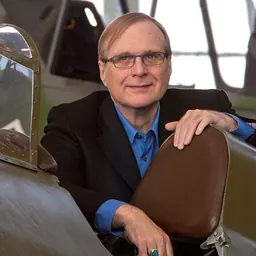




Related people
Same field, nearest in time



Contemporaries
People whose lives overlapped Bill Gates's
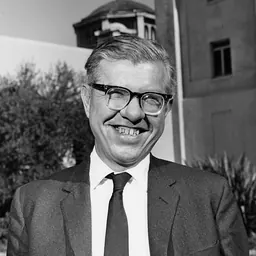
Frequently asked questions
Who is Bill Gates?
American businessman, investor, and philanthropist (born 1955)
When was Bill Gates born?
Bill Gates was born on 28 October 1955 in Seattle.
What is Bill Gates's occupation?
Bill Gates is an entrepreneur, programmer, computer scientist, bridge player, investor and philanthropist.
What is Bill Gates known for?
Bill Gates is known for Bill & Melinda Gates Foundation and Microsoft.
What nationality is Bill Gates?
Bill Gates is American.
Sources & further reading
Cite this page
APA: Biography.guide. (2026). Bill Gates. https://biography.guide/bill-gates-entrepreneur/
MLA: "Bill Gates." Biography.guide, https://biography.guide/bill-gates-entrepreneur/.
Chicago: "Bill Gates." Biography.guide. https://biography.guide/bill-gates-entrepreneur/.
Data last updated: 2026-09-22 · Spot an error? Report a correction.
Portrait: Wikimedia Commons · author & licence
Page generated 2026-09-27 05:04 UTC