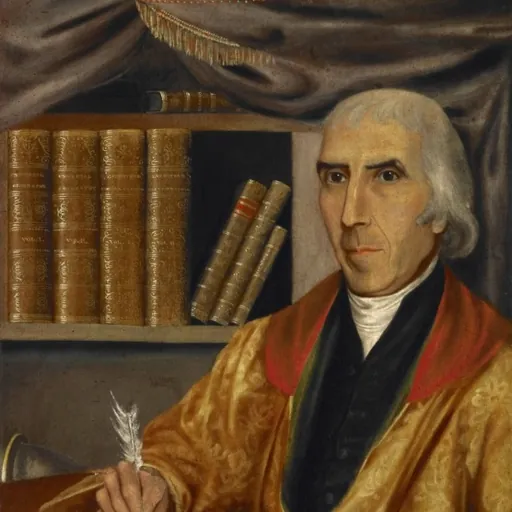
About Jedidiah Morse
Lived 1761 – 1826 (aged 64). Jedidiah Morse was an American geographer, university teacher, clergyman, politician, christian minister and cleric.
Jedidiah Morse (August 23, 1761 – June 9, 1826) was an American geographer and preacher whose textbooks became a staple for students in the United States. He was the father of the telegraphy pioneer and painter Samuel Morse, and his textbooks earned him the sobriquet of "father of American geography".
Early life and education Born to a New England family in Woodstock, Connecticut, his parents were Jedidiah Morse and Sarah Child. Morse did his undergraduate work and earned a divinity degree at Yale University (M.A. 1786). While pursuing his theological studies under Jonathan Edwards and Samuel Watts, he established a school for young women in 1783 in New Haven.
Career In the summer of 1785, he was licensed to preach, but continued to occupy himself with teaching. He became a tutor at Yale in June 1786, but, resigning this office, was ordained on November 9, 1786, and settled in Midway, Georgia, where he remained until August of the following year. He spent the winter of 1787 and 1788 in New Haven in geographical work, preaching on Sundays to vacant parishes in the vicinity.
Throughout his life, Morse was much occupied with religious controversy, and in upholding the faith of the New England church against the assaults of Unitarianism. Ultimately his persevering opposition to liberal views of religion brought on him a persecution that affected deeply his naturally delicate health. He was very active in 1804 in the movement that resulted in enlarging the Massachusetts general assembly of Congregational ministers, and in 1805 unsuccessfully opposed, as a member of the board of overseers, the election of Henry Ware to the Hollis Chair of Divinity at Harvard. He participated in the organization of the Park Street Church in Boston in 1808, when all the Congregational churches of that city, except the Old South Church, had abandoned the orthodox faith. In 1805, he established The Panoplist for the purpose of illustrating and defending the commonly received orthodoxy of New England, and continued its sole editor for five years. This journal later became The Missionary Herald. He followed that with American Geography (1789), which was widely cited and copied. New editions of his school textbooks and the more weighty works often came out annually, earning him the informal title, "father of American geography". His postponed gazetteer for his work of 1784 was bested by Joseph Scott's Gazetteer of the United States in 1795. With the aid of Noah Webster and Rev. Samuel Austin, Morse published his gazetteer as Universal Geography of the United States (1797).
Native American peoples Morse rebutted certain racist views published in the Encyclopædia Britannica concerning the Native American peoples, e.g., that their women were "slavish" and that their skins and skulls were thicker than those of other humans.
He took great interest in requiring Native Americans to become Christian, and in 1820 was appointed by the US secretary of war to visit and observe various tribes on the border in order to devise the most effective ways of assimilating them to European-American culture. This work occupied his attention during two winters, and he wrote up the results of his investigations in Report to the Secretary of War on Indian Affairs (New Haven, 1822).
Other endeavors Morse was an active member of the Massachusetts Historical Society, was elected a member of the American Antiquarian Society in 1813, and was also a member of various other literary and scientific bodies. He made significant contributions to Dobson's Encyclopædia, the first encyclopedia published in the United States after the Revolution. Morse published 25 sermons and addresses on special occasions; also A Compendious History of New England, with Elijah Harris (Charlestown, 1804); and Annals of the American Revolution (Hartford, 1824).
Marriage and family Morse's gravestone at the Grove Street Cemetery in New Haven. Morse married Elizabeth Ann Finley Breese after starting as pastor in Charlestown. He and his wife had a family of several children, including their first child Samuel F. B. Morse, the future painter and telegraphy pioneer. Other sons were Sidney Edwards Morse, who also published a geography text, and Richard Cary Morse (1795–1868), who assisted his father in his geographical work and founded with brother Sidney the New York Observer.
The senior Morse died in 1826 and was buried at the Grove Street Cemetery.
Selected works Morse, Jedidiah (1793). The American universal geography, or, A view of the present state of all the empires, kingdoms, states, and republics in the known world, and of the United States of America in particular. In two parts.
Don’t just read it —
keep it.
Full-length biographies made to live with: read them, listen on the way to work, watch them tonight.
- E-book
- Audio
- Video
Instant download · yours to keep · every purchase keeps this site free
Important facts
Family & relationships
People in Jedidiah Morse's life
Named in this biography and alive at the same time

Related people
Same field, nearest in time



Contemporaries
People whose lives overlapped Jedidiah Morse's




Frequently asked questions
Who was Jedidiah Morse?
American geographer and clergyman (1761-1826)
When was Jedidiah Morse born?
Jedidiah Morse was born on 23 August 1761 in Woodstock.
When did Jedidiah Morse die?
Jedidiah Morse died on 9 June 1826 in New Haven.
What was Jedidiah Morse's occupation?
Jedidiah Morse was a geographer, university teacher, clergyman, politician, christian minister and cleric.
What nationality was Jedidiah Morse?
Jedidiah Morse was American.
Sources & further reading
Cite this page
APA: Biography.guide. (2026). Jedidiah Morse. https://biography.guide/jedidiah-morse/
MLA: "Jedidiah Morse." Biography.guide, https://biography.guide/jedidiah-morse/.
Chicago: "Jedidiah Morse." Biography.guide. https://biography.guide/jedidiah-morse/.
Data last updated: 2026-09-22 · Spot an error? Report a correction.
Portrait: Wikimedia Commons · author & licence
Page generated 2026-09-27 05:03 UTC