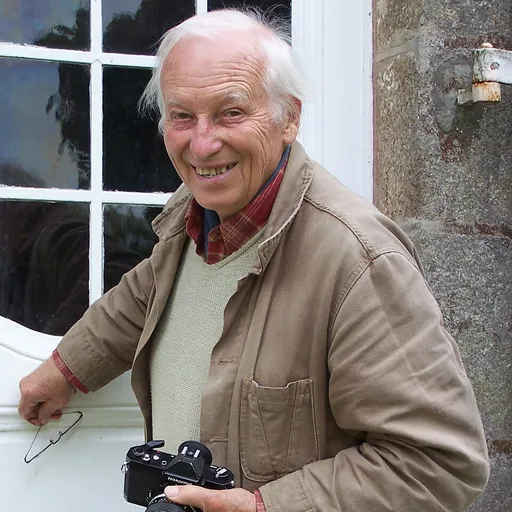
About Jean-Loup Trassard
Lived 1933 – 2026 (aged 92). Jean-Loup Trassard was a French photographer, writer and prose writer.
Jean-Loup Trassard (11 August 1933 – 13 January 2026) was a French writer and photographer.
Trassard viewed himself as a "writer of agriculture." From 1961, he published short texts, narratives, photographs and texts in which he recounted his "territory" by Gallimard and Le Temps qu'il fait. The vision he offered of the traditional rural civilization, which disappears irrevocably, is viewed as being both ethnological and poetic.
In 2012, he was awarded the grand prix of the Société des gens de lettres Magdeleine-Cluzel for the entirety of his work.
Early life and education Trassard was born in Saint-Hilaire-du-Maine on 11 August 1933. His father, René, was an entrepreneur ("fermier de droits de place" - "communal farmer"-) on the markets, which was a service to the communes organizing markets, in Brittany and in Normandy. He was a single child who went to the secular school of the village. Catechism, communions and masses were little appreciated.
He lived a childhood dominated by agricultural work in the countryside, which would influence all his work as a writer and photographer. His mother died in 1945.
Trassard had poor beginnings in high school (by correspondence then at Lycée Michelet in Vanves). From the 4th year to the philosophy class, he attended the Lycée of Laval, whose last two years he spent as a boarder. He obtained a degree in law from the Faculté de droit de Paris. Between these legal studies, he followed the courses of ethnology at the Musée de l'Homme and especially, during two years, the courses of prehistory of André Leroi-Gourhan.
Early career in literature He got married in 1955. His first child, François, was born in 1957. At the end of 1959, he sent his first texts to Jean Paulhan who received him at the La Nouvelle Revue française (NRF) and led him to Georges Lambrichs, the new literary director at Gallimard.
In July 1960, came his first publication, Le lait de taupes ("Mole milk") at the NRF. In 1960, he became a farmer of communal rights alongside his father, then in his place after his death in 1968. He maintained this profession until 31 December 2000. In 1961, Trassard established a friendship with Jean Clay, a journalist and historian of art, who, for a time, was his first reader and an important supporter. Clay later became the publisher of the publishing house.
In 1962, Trassard remarried after his first marriage ended. He had a daughter, Laure, in 1968.
Later career in literature and photography During his relationship with Lambrichs, he was acquainted with Dominique Aury and Constance Delaunay, and also with all the authors of the new series of Lambrichs, Le Chemin: Jacques Borel, Le Clézio, Michel Butor, Georges Perros, Jean Roudaut, Pierre Bourgeade, Ludovic Janvier, Marianne Alphant, Max Loreau and many others, including Henri Thomas, though he was older.
The magazines successively directed by Lambrichs, then the NRF, in which he actively participated, gave rise to various meetings where the authors met. Some of them became and remained very close friends of Trassard: , Michel Deguy, Gérard Macé. From time to time, he published in the magazine Poésie, directed by Deguy. In 1980, he met Georges Monti, a publisher installed at Cognac.
The first exhibition of his photographs took place in 1983, at La Rochelle (Chapelle Fromentin, expo. collective), then at Montpellier in 1987 (Médiathèque) and at Caen in 1991 (Théâtre). In 1992, sixty photographs by Trassard were exhibited for three months at Centre Pompidou under the title La campagne de Jean-Loup Trassard. Bernard Lamarche-Vadel, a writer and art critic, introduced him into the world of photography.
He was a breeder of: Maine-Anjou cows, calves under the mother, oxen fed in traditional ways. From 1953 until his death in 2026, he divided his time, in varying proportions, between the Mayenne countryside and Paris. He extended his action locally by creating the association Mémoire rurale au Pays de l'Ernée in 1999, whose aim is to trace the evolution of lifestyles in the 20th century on the territory in order to leave a trace for future generations.
Don’t just read it —
keep it.
Full-length biographies made to live with: read them, listen on the way to work, watch them tonight.
- E-book
- Audio
- Video
Instant download · yours to keep · every purchase keeps this site free
Important facts
People in Jean-Loup Trassard's life
Named in this biography and alive at the same time



Related people
Same field, nearest in time



Contemporaries
People whose lives overlapped Jean-Loup Trassard's


Frequently asked questions
Who was Jean-Loup Trassard?
French photographer
When was Jean-Loup Trassard born?
Jean-Loup Trassard was born on 11 August 1933 in Saint-Hilaire-du-Maine.
When did Jean-Loup Trassard die?
Jean-Loup Trassard died on 13 January 2026 in Ernée.
What was Jean-Loup Trassard's occupation?
Jean-Loup Trassard was a photographer, writer and prose writer.
What nationality was Jean-Loup Trassard?
Jean-Loup Trassard was French.
Sources & further reading
· Wikipedia: Jean-Loup Trassard
Cite this page
APA: Biography.guide. (2026). Jean-Loup Trassard. https://biography.guide/jean-loup-trassard/
MLA: "Jean-Loup Trassard." Biography.guide, https://biography.guide/jean-loup-trassard/.
Chicago: "Jean-Loup Trassard." Biography.guide. https://biography.guide/jean-loup-trassard/.
Data last updated: 2026-09-23 · Spot an error? Report a correction.
Portrait: Wikimedia Commons · author & licence
Page generated 2026-09-27 05:04 UTC