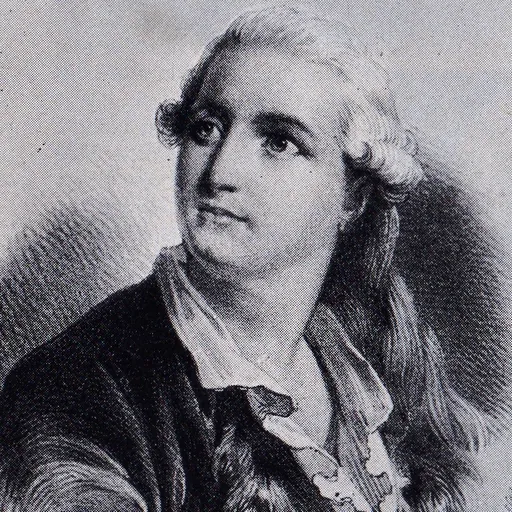
About Jean Dauberval
Lived 1742 – 1806 (aged 63). Jean Dauberval was a French ballet dancer, choreographer, dancer and ballet master.
Jean Dauberval or Jean D'Auberval (born Jean Bercher; 19 August 1742 –, 14 February 1806) was a French dancer and ballet master. He is most noted for creating the ballet, La fille mal gardée, one of the most enduring and popular works of the ballet repertoire.
Training and Career Dauberval was trained at the school of the Paris Opéra where he studied under the great Jean-Georges Noverre. He was appointed premier danseur of the ballet of the Académie Royale de Musique in 1763, and, in 1771, he was named ballet master. From 1781 until 1783, he was engaged as Maître de Ballet to the Académie, and in 1783–84 season in London's King's Theatre.
In 1783, Dauberval moved to Bordeaux, where he accepted the post of maître de ballet to the Grand Théâtre de Bordeaux, a position he held until 1791. In 1789, Dauberval created his most enduring ballet, La Fille mal gardée, in which his wife, the dancer Marie-Madeleine Crespé, who is known to history as Madame Théodore, created the role of Lison. (The role is known as "Lise" today.) Charles Didelot sometimes referred to as the father of the Russian ballet , and Salvatore Vigano who in Italy, introduced dance-drama were Dauberval's pupils.
During his time, he was admired most for his ability to integrate dramatic action into dance.
Noted works
The Pastimes of Terpsicore (1783, King's Theatre, London) Friendship lead to Love (1783, King's Theater, London) The Slaves of Conquering Bacchus (1784, King's Theater, London) Le Réveil du bonheur (1784, King's Theater, London) Orpheo (1784, King's Theatre, London) The Four Ages of Man (1784, King's Theatre, London) Pygmalion (1784, King's Theatre, London) Le Déserteur, ou La Clémence Royale (1784, King's Theatre, London) Le Page inconstant (1787, based on La Folle Journée, ou Le Mariage de Figaro by Beaumarchais, Grand-Théâtre, Bordeaux) Psyché et l'Amour (1788, Grand-Théâtre, Bordeaux) La Fille mal gardée (1789, Grand-Théâtre, Bordeaux) Amphion et Thalie, ou L’Élève des Muses (1791, Pantheon Theatre, London) Telemachus in the Island of Calipso (1791, Pantheon Theatre, London) Le Triomphe de la Folie (1791, Pantheon Theatre, London) Le Siège de Cythère (1791, Pantheon Theatre, London) La Fontaine d’amour (1791, Pantheon Theatre, London) L’Amant déguisé (1791, Pantheon Theatre, London) La Fête villageoise (1791, Pantheon Theatre, London)
Don’t just read it —
keep it.
Full-length biographies made to live with: read them, listen on the way to work, watch them tonight.
- E-book
- Audio
- Video
Instant download · yours to keep · every purchase keeps this site free
Important facts
People in Jean Dauberval's life
Named in this biography and alive at the same time

Related people
Same field, nearest in time


Contemporaries
People whose lives overlapped Jean Dauberval's






Frequently asked questions
Who was Jean Dauberval?
French ballet dancer and choreographer
When was Jean Dauberval born?
Jean Dauberval was born on 19 August 1742 in Montpellier.
When did Jean Dauberval die?
Jean Dauberval died on 14 February 1806 in Tours.
What was Jean Dauberval's occupation?
Jean Dauberval was a ballet dancer, choreographer, dancer and ballet master.
What nationality was Jean Dauberval?
Jean Dauberval was French.
Sources & further reading
Cite this page
APA: Biography.guide. (2026). Jean Dauberval. https://biography.guide/jean-dauberval/
MLA: "Jean Dauberval." Biography.guide, https://biography.guide/jean-dauberval/.
Chicago: "Jean Dauberval." Biography.guide. https://biography.guide/jean-dauberval/.
Data last updated: 2026-09-21 · Spot an error? Report a correction.
Portrait: Wikimedia Commons · author & licence
Page generated 2026-09-27 05:01 UTC