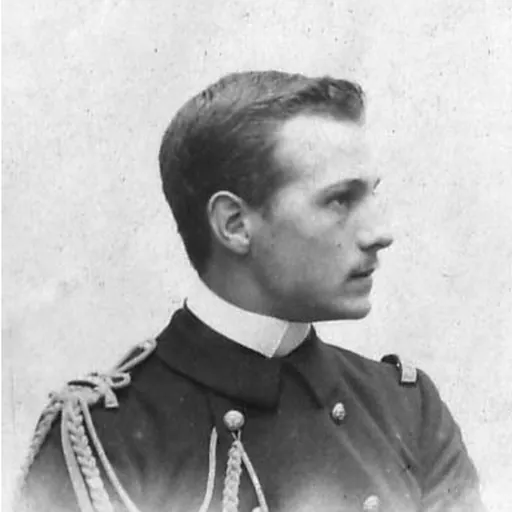
About Jean Cras
Lived 1879 – 1932 (aged 53). Jean Cras was a French composer, naval officer, scholar and soldier.
Jean Émile Paul Cras (; 22 May 1879 – 14 September 1932) was a 20th-century French composer and career naval officer. His musical compositions were inspired by his native Brittany, his travels to Africa, and most of all, by his sea voyages. As a naval commander he served with distinction in the Adriatic Campaign during World War I.
Biography
Life and naval career The "Cras Navigation Plotter", foreground, designed by Jean Cras.
Cras was born and died in Brest. His father was a naval medical officer. He was accepted into the navy at the age of seventeen. As a midshipman cadet on the French cruiser Iphigénie, he travelled in the Americas, the West Indies and Senegal. He was promoted to Lieutenant in 1908. His mathematical skills led to his proposing a number of innovations in technical practices which were adopted by the navy, including his invention of an electrical selector and a navigational plotter protractor known as (aka Cras ruler, Cras protractor, Cras plotter). (However, it was difficult to operate by some, which inspired the later development of the Breton plotter by Yvonnick Gueret.)
With the outbreak of war in 1914 Cras was appointed as adjutant to Admiral Augustin Boué de Lapeyrère. He later worked in the Submarine Defense Service. In 1916 he was appointed commander of the torpedo boat Commandant Bory. During the Adriatic campaign he sank a submarine and was commended for his bravery in rescuing a sailor who had fallen overboard. The String Trio in particular integrates a wide range of styles, including North African influences. It was described as a 'miraculous' work by André Himonet in 1932, achieving "perfectly balanced sonority and a plenitude of expression between which one dare not choose." The Trio for Strings and Piano also blends African and Eastern melodic patterns with Breton musical traditions into a coherent whole. The critic Michel Fleury compares his work to the Japonist style of the artist Henri Rivière revealing "a stylised Breton land, as though it had been passed through the sieve of his varied experiences gained in the four quarters of the globe."
Selected works
Opera
Polyphème, opera in five acts on a lyric drama by Albert Samain (1910–1918, Ed. Salabert) (f.p. Opéra-Comique, Paris, 29 December 1922.) Published excerpts: N° 1: «Oh ! qui m'enlèvera...», Polyphème: Act III, scene 1, (1921, Senart) N° 2: «Il est parti... Pourquoi faut-il que l'heure arrive», Galatée: Act IV, scene 5, (1921, Senart) Le Sommeil de Galatée, musical interlude from Act I, (1922, Senart)
Vocal compositions (1892–1896, numerous songs in manuscript, "Album de jeunesse") Panis angelicus (August 1899, ms.) Sept mélodies, (poems by Rodenbach, Droin, Verlaine, Baudelaire) for voice and piano (1899–1905, Ed. Salabert) 1. Douceur du soir, poem by Georges Rodenbach (1901) 2. Mains lasses, poem by Georges Rodenbach (1905) 3. L'espoir luit, poem by Paul Verlaine (Sagesse III), (1900, 1st ed.; 1909, éd. mutuelle de la Schola Cantorum) 4. Le Son du cor, poem by Paul Verlaine (Sagesse X), (1900) 5. Rêverie, poem by Alfred Droin, (1903, 1st ed.; 1909, éd. mutuelle de la Schola Cantorum) 6. Nocturne, poem by Alfred Droin, (1903, 1st ed.; 1909, éd. mutuelle de la Schola Cantorum) 7. Correspondances, poem by Charles Baudelaire (1901) Ave verum, for voice, violin, organ (or harmonium) (1905, ms.) Deuxième messe à 4 voix a capella (1907–1908, ms.) 1. Kyrie (1907) 2. Gloria (1907) 3. Sanctus (1908) 4. Benedictus (1908) Regina coeli, voices with organ (1909, pub. 1914, Ed. Schola Cantorum) Ave Maria, for voice with organ (August 1910, ms.) Elégies (four poems by Albert Samain), for voice with orchestra (1910, Ed. Durand) L'Offrande lyrique (seven poems by Rabindranath Tagore, transl. André Gide), for voice with piano (1920/1921, Ed. Salabert) Image (poem by E. Schneider), for voice with piano (1921, Ed. Salabert) Fontaines (five poems by Lucien Jacques), for voice & orchestra, or for voice & piano (1923, Ed. Salabert) Cinq Robaïyats (five Persian quatrains by Omar Khayyam, transl. Franz Toussaint), for voice with piano (1924, Ed. Salabert) Dans la montagne (poems by Maurice Boucher), five chorales for male quartet (1925, Ed. Salabert) Hymne en l'honneur d'une Sainte (text by Jean Cras) for female voices with organ (1925, Ed. Salabert) Vocalise-Etude, for voice and piano (1928, Ed. Leduc) La Flûte de Pan for voice, Pan-pipes, violin, viola and cello (four poems by Lucien Jacques), (1928, Ed. Salabert) Soir sur la mer (poem by Virginie Hériot), for voice and piano (1929, Ed. Salabert) Trois Noëls (poems by Léon Chancerel), for voices and chorus with piano (1929, Ed. Salabert) Trois chansons bretonnes (poems by Jean Cras), for voice and piano (1932, Ed. Salabert) Deux chansons: le roi Loudivic, Chanson du barde, extracts from Chevalier étranger by Tanguy Malmanche, for voice and piano (1932, Ed.Salabert)
Chamber music
Voyage symbolique (premier trio), for piano, violin & cello (1899, ms.) L'Esprit (première sonate), for violin & piano (1900, ms.) L'Âme (deuxième sonate), for viola & piano (1900, ms.) La Chair (troisième sonate), for cello & piano (1900, Ed. Durand) Trio en ut pour piano, violon et violoncelle (1907, Ed. Durand) À ma Bretagne, string quartet (1909, Ed. Salabert) Quintette, for flute, harp, violin, viola, & cello, or for piano and string quartet (1922, Ed. Salabert) Prélude et danse: Demain, saxophone quartet (1924–1926, ms.) Deux Impromptus pour harpe (1925, Ed. Salabert) Trio pour violon, alto et violoncelle (1926 Spring; 1927, Senart) Quatre petites pièces pour violon et piano: 1. Air varié (1926, Ed. Salabert) 2. Habanera (1927, Ed. Salabert) 3. Evocation (1928, Ed.Salabert) 4. Epilogue (1929, Ed. Salabert) Suite en duo, for flute & harp, or for violin & piano (1927, Ed. Salabert) Quintette pour harpe, flûte, violon, alto et violoncelle (1928, Ed. Salabert) Légende, for cello & piano (reduction of work for cello & orchestra) (1930, Senart)
Piano works
Impromptu pastoral (1900, ms.) Petite pièce en fa mineur (1901, ms.) Valse en mi majeur (1904, ms.) Cinq poèmes intimes pour piano: (1912, E. Demets) 1. En Islande (1902, Ed. Eschig) 2. Preludio con fughetta (1902, Ed. Eschig) 3. Au fil de l'eau (1911, Ed. Eschig) 4. Recueillement (1904, Ed. Eschig) 5. La maison du matin (1911, Ed. Eschig) Deux Paysages: Paysage maritime, Paysage champêtre, piano solo (1917, Ed. Durand) Danze (1917, Rouart, Lerolle et cie.) Quatre Danze: Danza morbida, Danza scherzosa, Danza tenera, Danza animata, piano solo (1917, Ed. Salabert) Âmes d'enfants, pour 6 petites mains, piano six hands (1917, ms.), piano four hands (1922, Senart), also orchestrated (1918, Ed. Salabert) Premier anniversaire, «A mon petit Jean-Pierre» (1 May 1919, ms.) First string quartet, version for piano, 4 mains, (1921, Rouart, Lerolle et cie.) Deux impromptus, for piano or harp, (1926, Senart)
Organ
Chorale (1904, ms.) Grande marche nuptiale pour orgue (1904, Ed. Schola Cantorum)
Orchestral works
Andante religieux (1901, ms.) Âmes d'enfants, orchestration of work for «piano et 6 petites mains» (1921, Senart) Journal de bord, Suite symphonique (1927, Ed. Salabert) Légende pour violoncelle et orchestre (1929, Ed. Salabert) Concerto pour piano et orchestre (1931, Ed. Salabert), (reduction for 2 pianos, 1932, Senart)
Don’t just read it —
keep it.
Full-length biographies made to live with: read them, listen on the way to work, watch them tonight.
- E-book
- Audio
- Video
Instant download · yours to keep · every purchase keeps this site free
Important facts
People in Jean Cras's life
Named in this biography and alive at the same time



Related people
Same field, nearest in time



Contemporaries
People whose lives overlapped Jean Cras's


Frequently asked questions
Who was Jean Cras?
French composer, Commander of French Navy (1879–1932)
When was Jean Cras born?
Jean Cras was born on 22 May 1879 in Brest.
When did Jean Cras die?
Jean Cras died on 14 September 1932 in Brest.
What was Jean Cras's occupation?
Jean Cras was a composer, naval officer, scholar and soldier.
What nationality was Jean Cras?
Jean Cras was French.
Sources & further reading
Cite this page
APA: Biography.guide. (2026). Jean Cras. https://biography.guide/jean-cras/
MLA: "Jean Cras." Biography.guide, https://biography.guide/jean-cras/.
Chicago: "Jean Cras." Biography.guide. https://biography.guide/jean-cras/.
Data last updated: 2026-09-22 · Spot an error? Report a correction.
Portrait: Wikimedia Commons · author & licence
Page generated 2026-09-27 05:04 UTC