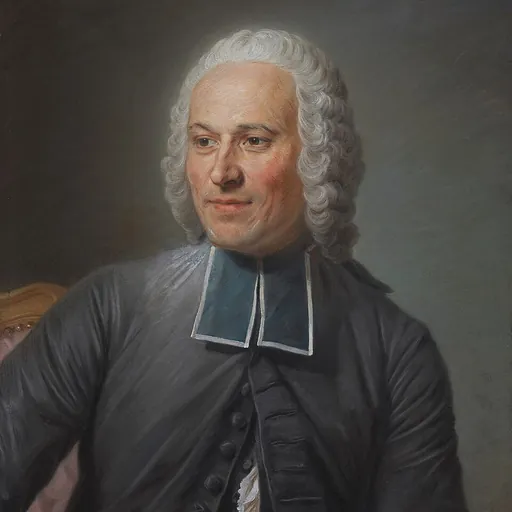
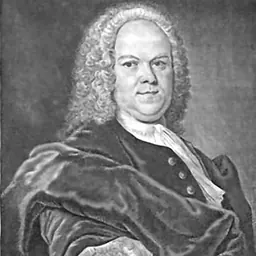
Jean-Antoine Nollet
French clergyman and physicist
About Jean-Antoine Nollet
Lived 1700 – 1770 (aged 69). Jean-Antoine Nollet was a French physicist, university teacher, catholic priest and parson, known for Osmosis.
Jean-Antoine Nollet (; 19 November 170025 April 1770) This association gave Nollet the opportunity to come into contact with important natural philosophers. In particular, it is likely that he came into contact with Du Fay and Réaumur, two leading members of the Royal Academy of Sciences. Nollet assisted them with experiments in a wide variety of topics (e.g., anatomy of insects, fertilization of frogs, thermometry, pneumatics, phosphorescence, magnetism, and electricity) from about 1731 to 1735. In the period from 1731 to 1733, Nollet assisted Du Fay, especially with electrical experiments, and travelled with du Fay in 1734 to meet physicists in England and in 1736 to the Netherlands. He was a member of the Royal Society of London from 1734. He is reputed to have given the name to the Leyden jar after it was invented by Pieter van Musschenbroek. To finance his own experimental instruments, Nollet started building and selling duplicate instruments in 1735.
From at least 1743, the Royal Academy of Sciences identified Nollet as the person who was particularly in charge of research about electricity.
In 1753 he became the first professor of experimental physics in France, at the collège de Navarre, University of Paris.
Nollet held lectures aimed to popularise physics with the use of instruments. These lectures, collected together and published as Leçons de physique expérimentale and L’Art des expériences, continued to inspire self-taught scientists through the 19th century.
Scientific work
One of many experimental demonstrations of static electricity which he carried out was the "Electric boy", in which a young man was suspended from the ceiling using insulating silk cords, and electrified, causing his body to accumulate charge. Objects were attracted to him, and close proximity of another person could lead to sparks.
In 1746 Nollet gathered about two hundred monks into a circle about a mile (1.6 km) in circumference, with pieces of iron wire connecting them. He then discharged a battery of Leyden jars (the battery here does not refer to an electric battery, but a group as in an artillery battery) through the human chain and observed that each man reacted at substantially the same time to the electric shock, showing that the speed of electricity's propagation was very high.
In 1748 he discovered the phenomenon of osmosis in natural membranes. He covered with pig bladder the mouth of a flask of ethanol, then submerged it in water. After 5 or 6 hours, the pig bladder became convex, and when he pricked it, liquid shot out rising more than 1 foot in height.
In the same year, he also invented an electroscope.
In 1750 Nollet was the first to report a phenomenon that is known today as electrostatic spraying. He noted that water flowing from a vessel would aerosolize if the vessel was electrified and placed near electrical ground.
Writings 1735: Cours de physique expérimentale Paris. 1743-1764: Leçons de physique expérimentale (6 vols.). Paris. 1745: 1746: Observations sur quelques nouveaux phénomènes d'Électricité" Mémoires de l'Académie Royale des Sciences de l'Année 1746, Paris, 1751, pp. 1-23. Partial English translation in: Magie, W.F. (1935). "The Leyden Jar." Source book in physics. Cambridge: Harvard University Press. pp. 403–406. Essai sur l'électricité des corps. Paris.(2nd ed.), 1750. (link to 3rd printing, 1765) Paris. 1747: Part of a Letter from Abbè Nollet, of the Royal Academy of Sciences at Paris, and F. R. S. to Martin Folkes Esq; Presisident of the Same, concerning Electricity (Translated from the French by Tho. Stack, M.D. F.R.S.). Philosophical Transactions, 45: 187–194, 1748. 1749: Recherches Sur Les Causes Particulieres Des Phénoménes Électriques. Paris.
Nouvelle Édition, 1754, Paris. 1750: Extract of the Observations Made in Italy, by the Abbe Nollet, F.R.S. on the Grotta de Cani (Translated from the French by Tho. Stack, M.D. F.R.S.). Philosophical Transactions, 47: 48–61, 1752. 1759: Leçons de physique expérimentale, Vol. 1 (5th ed.) Paris. 1760: Lettres sur l'electricite (Premiere Partie, Nouvelle Édition) Paris. (5 of the letters are to Benjamin Franklin) 1770: L'Art des expériences. (3 vols.) (1st and 2nd ed.; 1784, 3rd. ed.; 1787, Nouvelle edition) Paris.
Don’t just read it —
keep it.
Full-length biographies made to live with: read them, listen on the way to work, watch them tonight.
- E-book
- Audio
- Video
Instant download · yours to keep · every purchase keeps this site free
Important facts
People in Jean-Antoine Nollet's life
Named in this biography and alive at the same time
Related people
Same field, nearest in time




Contemporaries
People whose lives overlapped Jean-Antoine Nollet's




Frequently asked questions
Who was Jean-Antoine Nollet?
French clergyman and physicist (1700-1770)
When was Jean-Antoine Nollet born?
Jean-Antoine Nollet was born on 19 December 1700 in Pimprez.
When did Jean-Antoine Nollet die?
Jean-Antoine Nollet died on 24 April 1770 in Paris.
What was Jean-Antoine Nollet's occupation?
Jean-Antoine Nollet was a physicist, university teacher, catholic priest and parson.
What was Jean-Antoine Nollet known for?
Jean-Antoine Nollet was known for Osmosis.
What nationality was Jean-Antoine Nollet?
Jean-Antoine Nollet was French.
Sources & further reading
· Wikipedia: Jean-Antoine Nollet
· DBpedia: Jean-Antoine Nollet
Cite this page
APA: Biography.guide. (2026). Jean-Antoine Nollet. https://biography.guide/jean-antoine-nollet/
MLA: "Jean-Antoine Nollet." Biography.guide, https://biography.guide/jean-antoine-nollet/.
Chicago: "Jean-Antoine Nollet." Biography.guide. https://biography.guide/jean-antoine-nollet/.
Data last updated: 2026-09-21 · Spot an error? Report a correction.
Portrait: Wikimedia Commons · author & licence
Page generated 2026-09-27 05:00 UTC