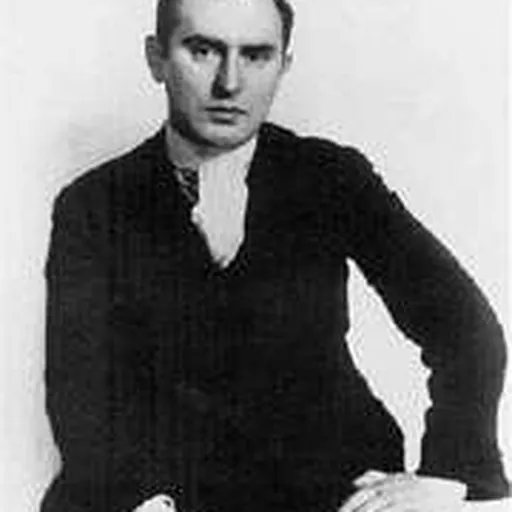
Jankel Adler
Jewish-Polish painter and printmaker whose siblings were murdered by Nazis
About Jankel Adler
Lived 1895 – 1949 (aged 53). Jankel Adler was a Polish and German painter, printmaker, draftsperson and artist.
Jankel Adler (born Jankiel Jakub Adler; 26 July 1895 – 25 April 1949) was a Polish-Jewish avant-garde painter and printmaker active primarily in Germany, France and England. He began his career as an engraver in Belgrade before studying arts in Germany. Co-founding the Yung-yidish group in Łódź, he later became involved with the Cologne Progressives and the Union of Progressive International Artists in Germany. He began teaching at Kunstakademie Düsseldorf and was a student of the Swiss abstract painter Paul Klee who had an important influence on Adler's work.
Facing Nazi persecution, Adler fled to Paris in 1933, where he actively opposed fascism. His works were targeted by the Nazis, with several displayed in the Degenerate Art Exhibition. Adler volunteered for the Polish army during World War II but was later discharged for health reasons, eventually settling in Scotland and then Aldbourne, England. He later discovered that none of his siblings survived the Holocaust. Adler died in Aldbourne in 1949.
Biography
Early life and work Jankiel Jakub Adler was born as the seventh of ten children in Tuszyn, a suburb of Łódź. In 1912 he began training as an engraver with his uncle in Belgrade. He moved in 1914 to Germany where he lived for a time with his sister in Barmen, (now part of Wuppertal). There he studied at the college of arts and crafts with professor Gustav Wiethücher.
From 1918 to 1919 he went back to Łódź, where he was joint founder of Yung-yidish, a group of young Jewish artists. In 1920 he returned briefly to Berlin; in 1921 he returned to Barmen, and in 1922 he moved to Düsseldorf. In May 1922 he attended the International Congress of Progressive Artists and signed the "Founding Proclamation of the Union of Progressive International Artists". He also joined Franz Seiwert and Otto Freundlich in an artists group known as the Cologne Progressives. He became a teacher at the Academy of Arts, and became acquainted with Paul Klee, who influenced his work. A painting by Adler received a gold medal at the exhibition "German art Düsseldorf" in 1928. Frau und Kind, 1929In 1929 and 1930 he went on study trips in Mallorca and other places in Spain. During the election campaign of July 1932 he published, with a group of leftist artists and intellectuals, an urgent appeal against the policy of the National Socialists and for communism. As a modern artist, and especially as a Jew, he faced persecution under Hitler's regime which took power in 1933. In that year, two of his pictures were displayed by the Nazis at the Mannheimer Arts Center as examples of degenerate art, and Adler left Germany, staying in Paris where he regarded his exile consciously as political resistance against the fascist regime in Germany. In the years that followed, he made numerous journeys to Poland, Italy, Yugoslavia, Czechoslovakia, Romania and the Soviet Union. He also spent time in Paris, working at Atelier 17. In 1937, twenty-five of his works were seized from public collections by the Nazis and four were shown in the Degenerate Art Exhibition in Munich.
Late career With the outbreak of World War II in 1939, he volunteered for the Polish army that had been reconstituted in France; in 1941 he was discharged for health reasons and lived thereafter in Kirkcudbright in Scotland where his work at this time included his Venus of Kirkcudbright. In 1943 he moved to London, and around 1945 a wealthy patron, Jimmy Bomford, arranged for him to live at Aldbourne, Wiltshire. He later learned that none of his nine siblings in Poland had survived The Holocaust. on 25 April 1949 at the age of 53, and is buried at the Jewish cemetery in Bushey, Hertfordshire.
Work
Adler was strongly influenced by Picasso and Léger. He enjoyed experimenting with materials, for example sand admixtures. He often painted Jewish subjects, and painted a few abstract compositions.
Don’t just read it —
keep it.
Full-length biographies made to live with: read them, listen on the way to work, watch them tonight.
- E-book
- Audio
- Video
Instant download · yours to keep · every purchase keeps this site free
Important facts
People in Jankel Adler's life
Named in this biography and alive at the same time

Related people
Same field, nearest in time


Contemporaries
People whose lives overlapped Jankel Adler's
Frequently asked questions
Who was Jankel Adler?
Jewish-Polish painter and printmaker whose siblings were murdered by Nazis (1895-1949)
When was Jankel Adler born?
Jankel Adler was born on 26 July 1895 in Tuszyn.
When did Jankel Adler die?
Jankel Adler died on 25 April 1949 in Whitley Cottage.
What was Jankel Adler's occupation?
Jankel Adler was a painter, printmaker, draftsperson and artist.
What nationality was Jankel Adler?
Jankel Adler was Polish and German.
Sources & further reading
Cite this page
APA: Biography.guide. (2026). Jankel Adler. https://biography.guide/jankel-adler/
MLA: "Jankel Adler." Biography.guide, https://biography.guide/jankel-adler/.
Chicago: "Jankel Adler." Biography.guide. https://biography.guide/jankel-adler/.
Data last updated: 2026-09-22 · Spot an error? Report a correction.
Portrait: Wikimedia Commons · author & licence
Page generated 2026-09-27 05:01 UTC