
About James Marshall-Cornwall
Lived 1887 – 1985 (aged 98). James Marshall-Cornwall was a British military personnel.
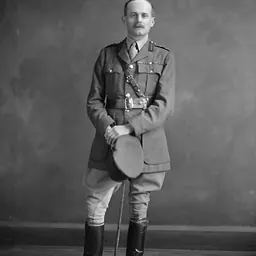
General Sir James Handyside Marshall-Cornwall, (27 May 1887 – 25 December 1985) was a senior British Army officer and military historian.
Education Cornwall went to Rugby School and the Royal Military Academy, Woolwich. Commissioned into the Royal Field Artillery in 1907, during his first spell of annual leave he travelled to Germany to study German. He later passed the Civil Service Commission examination as a first-class German interpreter, the first of the eleven interpreterships he was to gain. He passed as a first-class interpreter in French, Norwegian, Swedish, Hollander Dutch, and Italian.
Military career On the outbreak of the First World War, Cornwall joined the Intelligence Corps at Le Havre. In 1915 he was appointed to the rank of captain at 2nd Corps Headquarters in the Second Army. In 1916 he was promoted to temporary major at the General Headquarters of the British Expeditionary Force (BEF), under General Sir Douglas Haig. In 1918, Cornwall was posted to the War Office as head of the MI3 section of the military intelligence directorate, where he remained until the armistice.
Cornwall was decorated with the Military Cross in 1915, the Distinguished Service Order and the French Legion of Honour in 1917, the Belgian Order of the Crown and Croix de Guerre in 1918, and the United States Distinguished Service Medal in 1919.
In 1919, after attending the first postwar course at the Staff College, Camberley, Cornwall was sent to the peace conference in Paris, where he worked with Reginald Leeper and Harold Nicolson on the new boundaries of Europe. Several jobs in the Middle East in the 1920s gave him the opportunity to study the Turkish and modern Greek languages. In 1927 he was sent to China with the Royal Artillery (Shanghai Defence Force), to protect British life and property in the Shanghai International Settlement. This enabled him to acquire Mandarin and to travel extensively in the Far East with his wife.
From 1928 to 1932 Marshall-Cornwall (as he was now known) held the post of military attaché in Berlin. In 1934, after two years as commander of the 51st Highland Division, He retired from the army in 1943.
In 1985, one of his last articles was a book review of Colonel Z, a book about the life of Claude Dansey, a man that he knew well. In his review, he only made three minor revisions.
Personal life
Cornwall met Marjorie Coralie Scott Owen, who was driving an ambulance for a Red Cross mission to White Russian refugees, while encamped in the Izmit peninsula. They were married in Wales in April 1921. In 1927 he inherited a small estate in Scotland from his uncle William Marshall, on condition that he should assume the surname of Marshall. As Marshall was one of his forenames, this was achieved by the insertion of a hyphen. The Marshall-Cornwalls had a son and two daughters. Their elder daughter died aged fourteen in 1938 after an operation for appendicitis in Switzerland. Their son was killed in France in 1944. He is buried on the spot where he fell, in an orchard near Cahaignes, Normandy. After the war, the landowner presented the site of the grave to the casualty's father, who in turn, requested that the grave remain undisturbed. His other daughter, Janet, married Michael Willoughby, 12th Baron Middleton on 14 October 1947.
Marshall-Cornwall died, aged 98, on Christmas Day 1985.
Publications Geographic Disarmament: A Study of Regional Demilitarisation (1935) Marshal Massena (1965) Napoleon as Military Commander (1967) Grant as Military Commander (1970) Foch as Military Commander (1972) Haig as Military Commander (1973) History of the Geographical Club (1976) A Memoir: Wars & Rumours of Wars (1984) (autobiography)
Don’t just read it —
keep it.
Full-length biographies made to live with: read them, listen on the way to work, watch them tonight.
- E-book
- Audio
- Video
Instant download · yours to keep · every purchase keeps this site free
Important facts
People in James Marshall-Cornwall's life
Named in this biography and alive at the same time






Related people
Same field, nearest in time




Contemporaries
People whose lives overlapped James Marshall-Cornwall's


Frequently asked questions
Who was James Marshall-Cornwall?
British Army general (1887–1985)
When was James Marshall-Cornwall born?
James Marshall-Cornwall was born on 27 May 1887.
When did James Marshall-Cornwall die?
James Marshall-Cornwall died on 25 December 1985.
What was James Marshall-Cornwall's occupation?
James Marshall-Cornwall was a military personnel.
What nationality was James Marshall-Cornwall?
James Marshall-Cornwall was British.
Sources & further reading
· Wikipedia: James Marshall-Cornwall
· DBpedia: James Marshall-Cornwall
Cite this page
APA: Biography.guide. (2026). James Marshall-Cornwall. https://biography.guide/james-marshall-cornwall/
MLA: "James Marshall-Cornwall." Biography.guide, https://biography.guide/james-marshall-cornwall/.
Chicago: "James Marshall-Cornwall." Biography.guide. https://biography.guide/james-marshall-cornwall/.
Data last updated: 2026-09-20 · Spot an error? Report a correction.
Page generated 2026-09-27 05:07 UTC