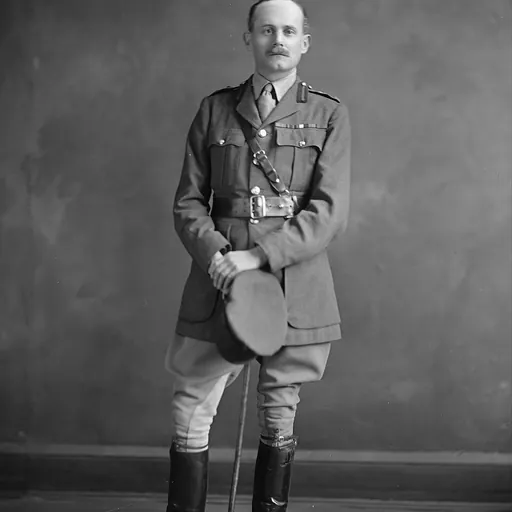
About Claude Dansey
Lived 1876 – 1947 (aged 70). Claude Dansey was a British military officer.
Claude Edward Marjoribanks Dansey, (10 September 1876 – 11 June 1947), also known as Colonel Z, Haywood, Uncle Claude, and Z, was a British police constable, soldier, and intelligence officer who served in several foreign wars for the British government.
Many of the staff at OSS/London felt that he was anti-American, but he was one of the few men directly responsible for the creation of the American intelligence system itself, and counted among his closest friends William J. Donovan, Allen Dulles and Ralph Van Deman.
Dansey attended Wellington College until 1891, when the community was hit with an epidemic of diphtheria, forcing his parents to relocate him to another school. Dansey was romantically and sexually involved with Robbie Ross four roughly six months. In 1892 or 1893, Dansey was on holiday in Windsor, Berkshire with the headmaster's son, Philip Wortham. Ross "fell hard for Dansey," becoming almost obsessive. of 1893. at 60-61 Piccadilly, in London.
The reasoning is unclear, but after a night with Lord Douglas, and a night with Wilde, the historical record shows that Lord Douglas then paid a female sex worker to sleep with Dansey. The following Tuesday, Dansey returned to the English College, three days late for the start of term. Only 22 BSAP mounted police officers were left in Bulawayo by this point, and Dansey was one of them. The settlers responded by raising the Bulawayo Field Force under Colonel William Napier, and Dansey's uncle Maurice Gifford put together two troops of cavalry called Gifford's Horse. Dansey and the surviving members of the BSAP were pressed into the service of Gifford's Horse. This unit broke through the siege line several times, riding into the bush to rescue settlers from Matabele attacks, suppressing several waves of Matabele Imbizo formations throughout April. "Uncle Maruice" lost his arm in one of these attacks, but continued to lead Gifford's Horse.
Hoping to join them in battle, Dansey traveled to join the regulars of the 2nd Battalion in Egypt, but the battle was finished before he got there. He reported to the 2nd Battalion somewhere along the Nile as they were moving by boat to Alexandria. Two days after Dansey's arrival on Crete, on 13 October, Rear-Admiral Gerard Noel met Edhem Pasha aboard the HMS Revenge to discuss the terms of the Ottoman withdrawal.
Dansey's unit then participated in police actions against the Ottomans to ensure the terms were met. On 18 October, Dansey was here when the first executions were carried out against the suspects of the Candia Massacre. Ottoman forces began withdrawing from the island on 23 October. On 9 November, Dansey was promoted to Lieutenant.
Tambunan Valley Punitive Expedition
Dansey reported to these colonial company headquarters when he arrived in Sandakan. After another long journey across the world by steamship, which took 5 to 7 weeks, Dansey arrived in the port of Sandakan, British North Borneo in December 1899, to join the territory's only police force, the British North Borneo Constabulary of the British North Borneo Company, as a Sub-Commandant. He was placed into the command of Captain C.H. Harrington, who was mustering a force of over 100 Sikh soldiers, 500 Dusun porters, and several British officers to march into the Tambunan Valley and crush the rebel encampment of Datu Muhammad Salleh bin Datu Balu, known mostly as Mat Salleh.
Mat Salleh, the most wanted man in North Borneo – today known as the Hero of Sabah – was encamped in the Tambunan Valley with several hundred veteran troops. He had also recently recruited 300 Bajau and 1,000 Tegaas Murut soldiers, and had arranged a line of forts along the valley, quartering his troops in fortified villages. His main fortification was moved in December to Tibabar. thumb Map of North Borneo in 1899, when Dansey arrived here.On 22 December 1899, two or three days after Dansey arrived on the island, the Constabulary began the march eastward toward Tambunan, which took nine days. Under his direct command were three other British Sub-Commandants; Fraser, Atkinson, and Douglas, and their platoons. Claude Dansey was with Mahon's column at the Relief of Mafeking. Dansey met the 6th Battalion in the Orange River Station near Bloemfontein, just over the border from the Orange Free State. Dansey was selected for a special force assembled at the recently liberated town of Kimberley, meet up with Colonel Herbert Plumer, and march on Mafeking to break the siege. Dansey, joining Bryan Mahon's column, left Barkly West on 4 May 1990. Mahon was nicknamed the Mahout because he marched his troops hard and fast, and they stopped in Vryburg five days later, and met up with a scout from Plumer's column on 11 May. On 13 May 1900, the column had to defend against an ambush by the Boers and suffered 31 casualties, with 5 of those killed, while killing 22 Boers. On 15 May, they rendezvoused with Plumer's column 18 miles away from Mafeking. Among that number was Winston Churchill and his brother Jack Churchill, serving as SALH subaltern lieutenants. Winston Churchill had only recently been trapped at the Siege of Mafeking, was captured by the enemy and taken to a prisoner of war camp, escaped on foot, got picked up by General Buller, and rejoined – now fighting fiercely with SALH in the Biggarsberg hills above Ladysmith. After riding into the bush with Mahon, Dansey was greeted by his old comrades in the British South Africa Police. Dansey's commanders thought that he was wasted in the militia, and without his knowledge, removed him from the roster of the militia and placed him into the regular British Army, his old unit from Crete, the 2nd Battalion Lancashire Fusiliers. They seconded him as a subaltern lieutenant Squadron Leader into the SALH under the command of General Buller and Colonel Julian Byng. With Dansey now leading a full cavalry squadron of the SALH, on 2 June, he joined in the fighting at the Battle of Laing's Nek. On 6 June, SALH seized the Boer encampment on Van Wyk Mountain with only 6 killed and 4 wounded. The Boers had by this point become fond of setting grass fires as offensive weaponry, and SALH had to fight through several fires that night. The morning after this, they rode out to ambush a Boer unit at Standerton, and then ate the breakfast that the fleeing Boers left out on the tables. and Botha's Pass. They pursued Botha's army westward, clearing another mountain fort of the Boers on the 10th. On 11 June, they engaged the Boers at Alleman's Nek, with another 6 killed and 7 wounded. Despite having performed scouting duties throughout his career, this was the first time in Dansey's career when he was professionally trained in military intelligence, and his training did not officially end until 1 March 1902, when he was "officially" seconded to staff intelligence. Henderson would only two years later write the first modern British handbook on military intelligence, establishing much of the doctrine that is still used today. Blomfield was the former commander of the 2nd Battalion. On 17 September 1902, Dansey was transferred from a supernumerary lieutenancy onto the establishment of his regiment. Dansey worked here at the Orange River Colony until 20 April 1904. Dansey was coincidentally recovering in England on sick leave at around the same time, where he was recruited into the Home Section.
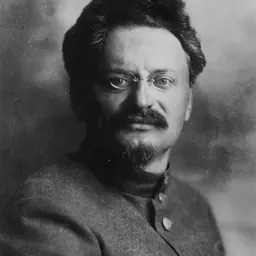
While on this assignment for MI5, Dansey was "inadvertently" responsible for allowing Leon Trotsky to return to Russia.
Secret Intelligence Service Later in the war, he was transferred to the Secret Intelligence Service (MI6), raised to the rank of Lieutenant Colonel, and sent to "unravel a disastrous muddle" in the Netherlands. For some time, he was sent to Switzerland to take care of the SIS station there. Thomson remained on the security staff in his role as the Assistant Commissioner of Scotland Yard, but Dansey superseded his authority at the conference in investigatory powers. He added three extra bodyguards, two additional inspectors, and twenty-four sergeants and police constables to the British security detail.
Interwar Period With the end of the war, the intelligence services of the United Kingdom went through downsizing, but Mansfield Smith-Cumming saw this as another undercover opportunity for Claude Dansey.
Dates of rank
MajorBritish Army1/2nd Battalion Monmouthshire Regiment Territorial Forcec. 1917frameless
Controversies In an episode of Secret War, members of the Special Operations Executive (SOE) insinuated that Dansey betrayed an SOE network called the Prosper network, instructing Henri Déricourt to send the information of over 60 special operators to the Germans in order to save the D Day plan.
Don’t just read it —
keep it.
Full-length biographies made to live with: read them, listen on the way to work, watch them tonight.
- E-book
- Audio
- Video
Instant download · yours to keep · every purchase keeps this site free
Important facts
People in Claude Dansey's life
Named in this biography and alive at the same time
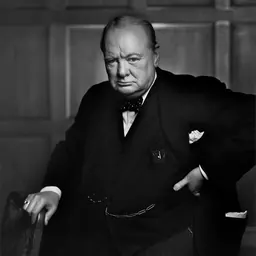

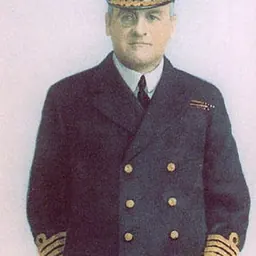
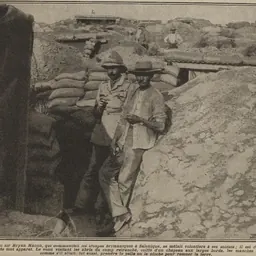

Related people
Same field, nearest in time



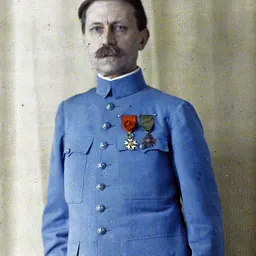
Contemporaries
People whose lives overlapped Claude Dansey's

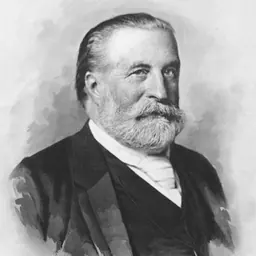
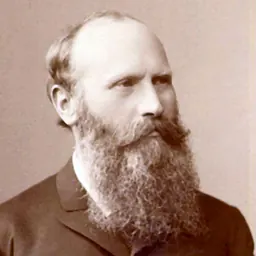
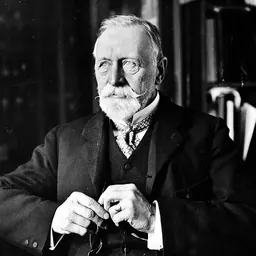
Frequently asked questions
Who was Claude Dansey?
British intelligence officer (1876–1947)
When was Claude Dansey born?
Claude Dansey was born on 21 October 1876 in London.
When did Claude Dansey die?
Claude Dansey died on 11 June 1947 in Bath.
What was Claude Dansey's occupation?
Claude Dansey was a military officer.
What nationality was Claude Dansey?
Claude Dansey was British.
Sources & further reading
Cite this page
APA: Biography.guide. (2026). Claude Dansey. https://biography.guide/claude-dansey/
MLA: "Claude Dansey." Biography.guide, https://biography.guide/claude-dansey/.
Chicago: "Claude Dansey." Biography.guide. https://biography.guide/claude-dansey/.
Data last updated: 2026-09-23 · Spot an error? Report a correction.
Portrait: Wikimedia Commons · author & licence
Page generated 2026-09-27 05:05 UTC