
About James Jay
Lived 1732 – 1815 (aged 82–83). James Jay was an American politician.
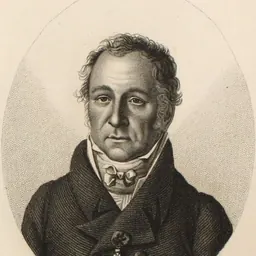
Sir James Jay (October 16, 1732 – 1815) was an American physician and politician. He was brother of John Jay, one of the Founding Fathers of the United States. While initially a supporter of American independence, he later changed his views becoming a Loyalist and went into exile in London after the Treaty of Paris recognised independence.
Early life The Jays were a prominent merchant family in New York City, descended from Huguenots who had come to New York to escape religious persecution in France. In 1685 the Edict of Nantes had been revoked, thereby abolishing the rights of Protestants and confiscating their property. Among those affected was Jay's paternal grandfather, Augustus Jay. He moved from France to New York, where he built a successful merchant empire. Jay's father, Peter Jay, born in New York City in 1704, became a wealthy trader in furs, wheat, timber, and other commodities.
James' mother was Mary Van Cortlandt, who had married Peter Jay in 1728, in the Dutch Church. They had ten children together, seven of whom survived into adulthood. Mary's father, Jacobus Van Cortlandt, had been born in New Amsterdam in 1658. Cortlandt served on the New York General Assembly, was twice mayor of New York City, and also held a variety of judicial and military offices. Two of his children (the other one being his son Frederick) married into the Jay family.
Career James Jay studied medicine in Edinburgh, and became a practicing physician. Along with William Smith, he was instrumental in obtaining the endowments for Benjamin Franklin's projected college in Philadelphia (now known as the University of Pennsylvania) in 1755, and King's College in New York (now Columbia University). For the purpose of soliciting contributions for the latter college, he visited England in 1762, where he was knighted by King George III in 1763.
His writings include two pamphlets relating to the collections made for the colleges in America (1771 and 1774) and Reflections and Observations on the Gout (1772).
Politics On October 7, 1778, Sir James was appointed by the New York State Assembly as one of the representatives from the Southern District in the New York State Senate, to fill the vacancy caused by the death of Philip Livingston. He sat in the 2nd, 3rd, 4th and 5th New York State Legislatures. At first he was a supporter of independence. He actively promoted the Bill of Attainder and Confiscation which the legislature passed on 22 October 1779 directed at 59 loyalists. This bill was an anathema to Jay's brother John who saw it as persecuting people for their opinions.
In 1782, Sir James connived to get himself arrested by the British so he could present a plan of reconciliation with Great Britain, as he was very suspicious of the French. He was treated as a spy and imprisoned, and his senate seat was declared vacant. Guy Carleton released him and allowed him to go to England. This led to suspicions about his loyalties among the revolutionaries. In a letter to Peter Van Schaak of 17 September 1782, John Jay stated that "If after making so much bustle in and for America, he has, as it is surmised, improperly made his peace with Britain, I shall endeavor to forget that my father has such a son." After the Revolution, the brothers had little contact with one another.
Later life By the end of 1784, Sir James had returned to America where he resumed the practice of medicine and attended William Livingston (the first Governor of New Jersey and father of Sarah Livingston Jay, his brother John's wife) in his final illness. (although some sources claim they never married). including Mary (née Jay) Okill (1785–1859), a "vivacious woman" and was mother of Mary Helena Okill (1815–1893) (who married Dennis Hart Mahan, a military theorist, civil engineer and professor at the United States Military Academy at West Point; they were the parents of naval historian and theorist Rear Admiral Alfred Thayer Mahan).
Sir Jay died in 1815. He was buried in Jay Cemetery in Rye.
Don’t just read it —
keep it.
Full-length biographies made to live with: read them, listen on the way to work, watch them tonight.
- E-book
- Audio
- Video
Instant download · yours to keep · every purchase keeps this site free
Important facts
People in James Jay's life
Named in this biography and alive at the same time




Related people
Same field, nearest in time




Contemporaries
People whose lives overlapped James Jay's





Frequently asked questions
Who was James Jay?
Colonial American physician
When was James Jay born?
James Jay was born on 16 October 1732 in New York City.
When did James Jay die?
James Jay died in 1815.
What was James Jay's occupation?
James Jay was a politician.
What nationality was James Jay?
James Jay was American.
Sources & further reading
Cite this page
APA: Biography.guide. (2026). James Jay. https://biography.guide/james-jay/
MLA: "James Jay." Biography.guide, https://biography.guide/james-jay/.
Chicago: "James Jay." Biography.guide. https://biography.guide/james-jay/.
Data last updated: 2026-09-20 · Spot an error? Report a correction.
Page generated 2026-09-27 05:18 UTC