
About James Barnet
Lived 1827 – 1904 (aged 76–77). James Barnet was an Australian architect and civil servant.
James Johnstone Barnet (1827 – 16 December 1904) was the Colonial Architect for Colonial New South Wales, serving from 1862 to 1890.
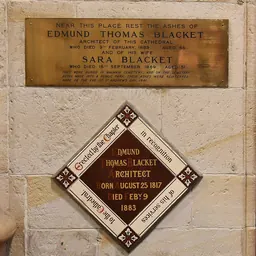
Early life Barnet was born the son of a builder in Arbroath, Scotland, and was educated at the local high school. In 1843, at the age of sixteen, Barnet moved to London, where he became a builder's apprentice, studying drawing under William Dyce RA and architecture with CJ Richardson FRIBA. He then became of clerk of works with the Worshipful Company of Fishmongers. In 1854, he married and sailed for Sydney, Australia, with his new wife, Rosa. In Sydney, he worked first as a builder for Edmund Blacket, then became Clerk of Works at the University of Sydney. He held that position for twenty-five years until the Office was reorganised in 1890.
In that period the department built 169 post and telegraph offices, 130 courthouses, 155 police stations, 110 lock-ups, 20 lighthouses and many other types of buildings. His major works include the General Post Office building in Sydney, Callan Park Lunatic Asylum, the Australian Museum, the Colonial Secretary's building, Lands Department building, and the Anderson Stuart Building at Sydney University.
Major Sydney public buildings Major public buildings in Sydney by Barnet include: ) Parramatta Post Office Public Works Building State Library of New South Wales Traffic Court No. 2, Sydney Victoria Lodge, Botanical Gardens
The Colonial Architect's office was also responsible for maintenance of public buildings. Between 1865 and 1881, Barnet had supervised 1,490 projects. Other roles were assigned to Barnet: for example, he was put in charge of the arrangements for the visit of the Duke of Edinburgh in 1868.
Sydney International Exhibition building
In 1879, Barnet was put in charge of the design and erection of the Sydney International Exhibition building. The Colonial Architect's Office completed this large task in nine months, including preparing 412 drawings, management of the accounts and payments associated with the project, and supervision of the building. Night shifts were used to get through the project using the first electric light in Sydney. Although the project was judged a success at the end, Barnet was constantly criticised in Parliament during the construction. The project overran its budget of £50,000 by more than three times, costing £184,570.
Defence buildings Between 1870 and 1889 Barnet was on the commission set up to plan the colony's defence. Barnet built new batteries and barracks. In July 1889, defence works became the responsibility of a military works branch of the Public Works Department. The new director was Lieutenant–Colonel F.R. de Wolski. De Wolski criticised Barnet's work. Barnet was not prompt in handing over plans and documents for defence works. There had been rumours about the project at Bare Island battery in Botany Bay. On 1 July 1890, a royal commission was set up to investigate the letting of contracts and report on the work completed. The evidence presented by staff of the Colonial Architect's office and Barnet was contradictory. The commission found that the work was below standard and the Colonial Architect's supervision of the project was not adequate. While the minister supported Barnet, the commission's censure was a regrettable end to his distinguished career. Barnet resigned as Colonial Architect. He believed that de Wolski had significantly influenced the commission and held that the commission’s findings were unjust, petty and spiteful.
After his retirement in 1899 he published a short overview of architecture in his adopted colony, entitled Architectural work in Sydney, New South Wales, 1788-1899.
He had little time for the new styles of architecture becoming fashionable in Sydney at the end of the nineteenth century, particularly those that followed American trends. Barnet was also critical of domestic architectural fashions, cluttered with what he saw as useless ornamentation, and "surmounted with blazing red tiles from France."
Personal life Barnet died in 1904 and is buried in the Presbyterian section of Rookwood Cemetery. His wife had died in 1890. He was survived by four daughters and three sons, two of whom also practiced as architects.
Gallery
Don’t just read it —
keep it.
Full-length biographies made to live with: read them, listen on the way to work, watch them tonight.
- E-book
- Audio
- Video
Instant download · yours to keep · every purchase keeps this site free
Important facts
People in James Barnet's life
Named in this biography and alive at the same time



Related people
Same field, nearest in time


Contemporaries
People whose lives overlapped James Barnet's




Frequently asked questions
Who was James Barnet?
Australian architect (1827–1904)
When was James Barnet born?
James Barnet was born in 1827 in Arbroath.
When did James Barnet die?
James Barnet died on 16 December 1904 in Forest Lodge.
What was James Barnet's occupation?
James Barnet was an architect and civil servant.
What nationality was James Barnet?
James Barnet was Australian.
Sources & further reading
Cite this page
APA: Biography.guide. (2026). James Barnet. https://biography.guide/james-barnet/
MLA: "James Barnet." Biography.guide, https://biography.guide/james-barnet/.
Chicago: "James Barnet." Biography.guide. https://biography.guide/james-barnet/.
Data last updated: 2026-09-20 · Spot an error? Report a correction.
Page generated 2026-09-27 05:32 UTC