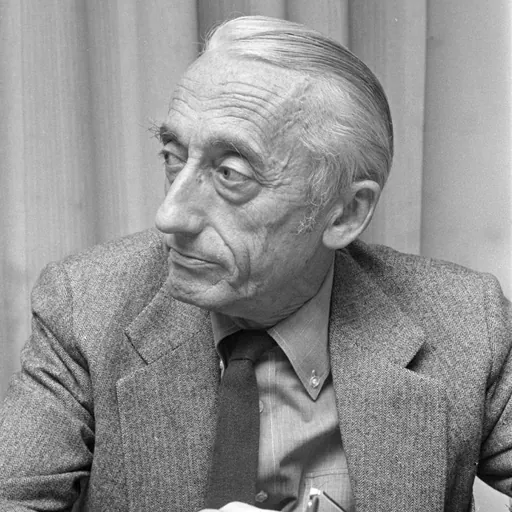
About Jacques Cousteau
Lived 1910 – 1997 (aged 87). Jacques Cousteau was a French zoologist, explorer, filmmaker, innovator, photographer and conservationist.
The Cousteau Society logo depicts the nymph Calypso, the namesake of his research vessel, also used as its house flag. Jacques-Yves Cousteau (, also ; ; 11 June 191025 June 1997) was a French naval officer, oceanographer, filmmaker and author. He co-invented the first successful open-circuit self-contained underwater breathing apparatus (SCUBA), called the Aqua-Lung, which assisted him in producing some of the first underwater documentaries.
Cousteau wrote many books describing his undersea explorations. In his first book, The Silent World: A Story of Undersea Discovery and Adventure, Cousteau surmised the existence of the echolocation abilities of porpoises. The book was adapted into an underwater documentary called The Silent World. Co-directed by Cousteau and Louis Malle, it was one of the first films to use underwater cinematography to document the ocean depths in color. The film won the 1956 at the Cannes Film Festival and remained the only documentary to do so until 2004 (when Fahrenheit 9/11 received the award). It was also awarded the Academy Award for Best Documentary in 1957.
From 1966 to 1976, he hosted The Undersea World of Jacques Cousteau, a documentary television series. A second documentary series, The Cousteau Odyssey, ran from 1977 to 1982 on public television stations.
Biography
Early life Cousteau was born on 11 June 1910, in Saint-André-de-Cubzac, Gironde, France, to Daniel Cousteau and Élisabeth Duranthon. He had one brother, Pierre-Antoine. Cousteau completed his preparatory studies at the Collège Stanislas in Paris. In 1930, he entered the École navale and graduated as a gunnery officer. However, an automobile accident, which broke both his arms, cut short his career in naval aviation. The accident forced Cousteau to change his plans to become a naval pilot, so he then indulged his passion for the ocean.
In Toulon, where he was serving on the Condorcet, Cousteau carried out his first underwater experiments, thanks to his friend Philippe Tailliez who in 1936 lent him some Fernez underwater goggles, predecessors of modern swimming goggles.
On 12 July 1937, he married Simone Melchior, his business partner, with whom he had two sons, Jean-Michel (born 1938) and Philippe (1940–1979). His sons took part in the adventures of the Calypso. In 1991, six months after his wife Simone's death from cancer, he married Francine Triplet. They already had a daughter Diane Cousteau (born 1980) and a son, Pierre-Yves Cousteau (born 1982, during Cousteau's marriage to his first wife).
Early 1940s: innovation of modern underwater diving The years of World War II were decisive for the history of diving. After the armistice of 1940, the family of Simone and Jacques-Yves Cousteau took refuge in Megève, where he became a friend of the Ichac family who also lived there. Jacques-Yves Cousteau and Marcel Ichac shared the same desire to reveal to the general public unknown and inaccessible places—for Cousteau the underwater world and for Ichac the high mountains. The two neighbors took the first ex-aequo prize of the Congress of Documentary Film in 1943, for the first French underwater film: Par dix-huit mètres de fond (18 meters deep), made without breathing apparatus the previous year in the Embiez islands in Var, with Philippe Tailliez and Frédéric Dumas, using a depth-pressure-proof camera case developed by mechanical engineer Léon Vèche, an engineer of Arts and Measures at the Naval College.
In 1943, they made the film Épaves (Shipwrecks), in which they used two of the very first Aqua-Lung prototypes. These prototypes were made in Boulogne-Billancourt by the Air Liquide company, following instructions from Cousteau and Émile Gagnan.
Having kept bonds with the English speakers (he spent part of his childhood in the United States and usually spoke English) and with French soldiers in North Africa (under Admiral Lemonnier), Jacques-Yves Cousteau (whose villa "Baobab" at Sanary (Var) was opposite Admiral Darlan's villa "Reine"), helped the French Navy to join again with the Allies; he assembled a commando operation against the Italian espionage services in France, and received several military decorations for his deeds. At that time, he kept his distance from his brother Pierre-Antoine Cousteau, a "pen anti-semite" who edited the collaborationist newspaper Je suis partout (I am everywhere) and who received the death sentence in 1946. However, this was later commuted to a life sentence, and Pierre-Antoine was released in 1954.
During the 1940s, Cousteau is credited with improving the Aqua-Lung design which gave birth to the open-circuit scuba technology used today. According to his first book, The Silent World: A Story of Undersea Discovery and Adventure (1953), Cousteau started diving with Fernez goggles in 1936, and in 1939 used the self-contained underwater breathing apparatus invented in 1926 by Commander Yves le Prieur. Cousteau was not satisfied with the length of time he could spend underwater with the Le Prieur apparatus so he improved it to extend underwater duration by adding a demand regulator, invented in 1942 by Émile Gagnan.
Late 1940s: GERS and Élie Monnier In 1946, Cousteau and Tailliez showed the film Épaves ("Shipwrecks") to Admiral Lemonnier, who gave them the responsibility of setting up the GRS (Groupement de Recherches Sous-marines, Underwater Research Group) of the French Navy in Toulon. A little later it became the GERS (Groupe d'Études et de Recherches Sous-Marines, Underwater Studies and Research Group), then the COMISMER (Commandement des Interventions Sous la Mer, Undersea Interventions Command), and finally the CEPHISMER (Centre Expert Plongée Humaine et Intervention Sous la Mer, Expert Centre for Human Diving and Undersea Intervention). In 1947, Chief Petty Officer Maurice Fargues became the first diver to die using an Aqua-Lung, while attempting a new depth record to 120 m with the GERS near Toulon.
In 1948, between missions of mine clearance, underwater exploration and technological and physiological tests, Cousteau undertook a first campaign in the Mediterranean on board the sloop Élie Monnier, with Philippe Tailliez, Frédéric Dumas, Jean Alinat and the scenario writer Marcel Ichac. The small team also undertook the exploration of the Roman wreck of Mahdia (Tunisia). It was the first underwater archaeology operation using autonomous diving, opening the way for scientific underwater archaeology. Cousteau and Marcel Ichac brought back from there the Carnets diving film (presented and preceded with the Cannes Film Festival 1951).
Cousteau and the Élie Monnier then took part in the rescue of Professor Jacques Piccard's bathyscaphe, the FNRS-2, during the 1949 expedition to Dakar. Thanks to this rescue, the French Navy was able to reuse the sphere of the bathyscaphe to construct the FNRS-3.
The adventures of this period are told in the two books The Silent World (1953, by Cousteau and Dumas) and Plongées sans câble (1954, by Philippe Tailliez).
1950–1970s In 1949, Cousteau left the French Navy.
In 1950, he founded the French Oceanographic Campaigns (FOC), and leased a ship called Calypso from Thomas Loel Guinness for a symbolic one franc a year. Cousteau refitted the Calypso as a mobile laboratory for field research and as his principal vessel for diving and filming. He also carried out underwater archaeological excavations in the Mediterranean, in particular at Grand-Congloué (1952).
With the publication of his first book in 1953, The Silent World, Cousteau correctly predicted the existence of the echolocation abilities of porpoises. He reported that his research vessel, the Élie Monier, was heading to the Straits of Gibraltar and noticed a group of porpoises following them. Cousteau changed course a few degrees off the optimal course to the center of the strait, and the porpoises followed for a few minutes, then diverged toward mid-channel again. It was evident that they knew where the optimal course lay, even if the humans did not. Cousteau concluded that the cetaceans had something like sonar, which was a relatively new feature on submarines.
In 1954, Cousteau conducted a survey of Abu Dhabi waters on behalf of British Petroleum. Among those accompanying him was Louis Malle who made a black-and-white film of the expedition for the company. Cousteau won the at the Cannes Film Festival in 1956 for The Silent World co-produced with Malle. In 1957, Cousteau took over as leader of the Oceanographic Museum of Monaco.
Cousteau also took part in inventing the "SP-350 Denise Diving Saucer" in 1959 which was an invention best for exploring the ocean floor, as it allowed one to explore on solid ground. Cousteau organized a publicity campaign which in less than two weeks gained wide popular support. The train carrying the waste was stopped by women and children sitting on the railway tracks, and it was sent back to its origin.
In the 1960s, Cousteau was involved with a set of three projects to build underwater "villages"; the projects were named Precontinent I, Precontinent II and Precontinent III. Each ensuing project was aimed at increasing the depth at which people continuously lived under water, and were an attempt at creating an environment in which men could live and work on the seafloor. The projects are best known as Conshelf I (1962), Conshelf II (1963), and Conshelf III (1965). The names "Precontinent", and "Continental Shelf Station" (Conshelf) were used interchangeably by Cousteau.
A meeting with American television companies (ABC, Metromedia, NBC) created the series The Undersea World of Jacques Cousteau, with the character of the commander in the red bonnet inherited from standard diving dress intended to give the films a "personalized adventure" style. This documentary television series ran for 10 years from 1966 to 1976. A second documentary series, The Cousteau Odyssey, ran from 1977 to 1982 on public television stations.
In 1970, he wrote the book The Shark: Splendid Savage of the Sea with his son Philippe. In this book, Cousteau described the oceanic whitetip shark as "the most dangerous of all sharks".
In December 1972, two years after the volcano's last eruption, The Cousteau Society was filming Voyage au bout du monde on Deception Island, Antarctica, when Michel Laval, Calypsos second in command, was struck and killed by a rotor of the helicopter that was ferrying between Calypso and the island.
In 1973, along with his two sons and Frederick Hyman, he created the Cousteau Society for the Protection of Ocean Life, Frederick Hyman being its first President.
In 1975, John Denver released the tribute song "Calypso" on his album Windsong, and on the B-side of his hit song "I'm Sorry". "Calypso" became a hit on its own and was later considered the new A-side, reaching No. 2 on the charts.
In 1976, Cousteau located the wreck of HMHS Britannic, which had sunk on 21 November 1916 after striking a mine in the Kea Channel, the third and final of the three liners and the younger sister to the RMS Olympic and RMS Titanic. He also found the wreck of the French 17th-century ship-of-the-line La Therese in coastal waters of Crete.
In 1977, together with Peter Scott, he received the UN International Pahlavi Environment prize.
On 28 June 1979, while the Calypso was on an expedition to Portugal, his second son Philippe, his preferred and designated successor and with whom he had co-produced all his films since 1969, died in a PBY Catalina flying boat crash in the Tagus River near Lisbon. Cousteau was deeply affected. He called his eldest son, the architect Jean-Michel, to his side to help run the Cousteau Society. This collaboration lasted 14 years before Jean-Michel left the organization to produce environmental films.
1980–1990s From 1980 to 1981, he was a regular on the animal reality show Those Amazing Animals, along with Burgess Meredith, Priscilla Presley, and Jim Stafford.
In 1980, Cousteau traveled to Canada to make two films on the Saint Lawrence River and the Great Lakes, Cries from the Deep and St. Lawrence: Stairway to the Sea.
From 1982 to 1984, Cousteau released a series of films on the Amazon with TBS.
In 1985, he received the Presidential Medal of Freedom from U.S. President Ronald Reagan. He also released Cousteau/Mississippi, which won a Primetime Emmy Award for Outstanding Informational Special.
From 1986 to 1992, Cousteau released Rediscovery of the World, also with TBS.
On 24 November 1988, he was elected to the Académie française, chair 17, succeeding Jean Delay. His official reception under the cupola took place on 22 June 1989, the response to his speech of reception being given by Bertrand Poirot-Delpech. After his death, he was replaced by Érik Orsenna on 28 May 1998.
In June 1990, the composer Jean Michel Jarre paid homage to the commander by entitling his new album Waiting for Cousteau. He also composed the music for Cousteau's documentary "Palawan, the last refuge".
On 2 December 1990, his wife, Simone Cousteau died of cancer. Six months later, in June 1991, in Paris, Jacques-Yves Cousteau remarried to Francine Triplet, with whom he had a relationship since the early 1980s and two children, Diane (born in 1980) and Pierre-Yves (born in 1982). Francine Cousteau currently continues her husband's work as the head of the Cousteau Foundation and Cousteau Society. From that point, the relations between Jacques-Yves and his elder son, who is 8 years older than Francine, worsened.
In November 1991, Cousteau gave an interview to the UNESCO Courier, in which he stated that he was in favour of human population control and population decrease. Widely quoted on the Internet are these two paragraphs from the interview: "What should we do to eliminate suffering and disease? It's a wonderful idea but perhaps not altogether a beneficial one in the long run. If we try to implement it we may jeopardize the future of our species...It's terrible to have to say this. World population must be stabilized and to do that we must eliminate 350,000 people per day. This is so horrible to contemplate that we shouldn't even say it. But the general situation in which we are involved is lamentable".
In 1992, he was invited to Rio de Janeiro, Brazil, for the United Nations' International Conference on Environment and Development, and then he became a regular consultant for the UN and the World Bank.
In 1993, a brief biography, as well as an introduction by Cousteau was featured in interactive educational software program Undersea Adventure, developed by former game developer Knowledge Adventure.
In 1995, Cousteau became involved in a legal battle with his son Jean-Michel, who was advertising the "Cousteau Fiji Islands Resort" in the South Pacific, to prevent him from using the Cousteau name for business purposes in the United States. This resulted in Jean-Michel Cousteau being ordered by the court to not encourage confusion between his for-profit business and his father's non-profit endeavours.
On 11 January 1996, Calypso was rammed and sunk in the port of Singapore by a barge. The Calypso was refloated and towed home to France.
Religious views Archbishop Jean-Marie Lustiger celebrated his funeral Mass at Notre-Dame in Paris. In his homily he stated, "Without betraying any confidences, Father Carré told me of his respect for Jacques-Yves Cousteau. He discovered in him a man of prayer whom he accompanied in his last months of his life, giving him, through the sacraments of the Church, the strength of his passage towards eternity."
In a chapter entitled "The Holy Scriptures and the Environment" in the posthumous work The Human, the Orchid, and the Octopus, he is quoted as stating that "The glory of nature provides evidence that God exists".
Opinion on recreational fishing Jacques Cousteau said that just because fish are cold-blooded does not mean they do not feel pain, and that recreational fishermen only say so to reassure their conscience.
Death and legacy Jacques-Yves Cousteau died of a heart attack on 25 June 1997 in Paris, two weeks after his 87th birthday. He was buried in the family vault at Saint-André-de-Cubzac, his birthplace. A homage was paid to him by the town by naming the street which runs out to the house of his birth "rue du Commandant Cousteau", where a commemorative plaque was placed.
Cousteau's legacy includes more than 120 television documentaries, more than 50 books, and an environmental protection foundation with 300,000 members. His work permitted many people to explore the resources of the oceans.
His work also created a new kind of scientific communication, criticized at the time by some academics. The so-called "divulgationism", a simple way of sharing scientific concepts, was soon employed in other disciplines and became one of the most important characteristics of modern television broadcasting.
His Oceanographic Museum in Monaco, and perhaps even he himself, has been identified as introducing the "Killer Algae" Caulerpa taxifolia, which are negatively affecting the Mediterranean's ecosystem.
The Cousteau Society and its French counterpart, l'Équipe Cousteau, both of which Jacques-Yves Cousteau founded, are still active today. The Society is currently attempting to turn the original Calypso into a museum and it is raising funds to build a successor vessel, the Calypso II.
In 2007, the International Watch Company introduced the IWC Aquatimer Chronograph "Cousteau Divers" Special Edition. The timepiece incorporated a sliver of wood from the interior of Cousteau's Calypso research vessel. Having developed the diver's watch, IWC offered support to The Cousteau Society. The proceeds from the timepieces' sales were partially donated to the non-profit organization involved in conservation of marine life and preservation of tropical coral reefs.
Fabien Cousteau, the grandson of Jacques Cousteau, is in the process of constructing a community of ocean flooring analysis stations, called Proteus, off Curaçao at a depth of about 20 m in a marine-protected area. Aquanauts could reside and work in these underwater habitats. Front-end engineering has started in 2022 with the habitat planned for the sea bottom in 2025.
In October 1997, an underwater plaque honoring Jacques Cousteau was placed in the underwater dive park off Casino Point in Avalon, California. Because of deterioration, the plaque was replaced in November 2020.
Awards and honors
During his lifetime, Jacques-Yves Cousteau received these distinctions: Cross of War 1939–1945 (1945) National Geographic Society's Special Gold Medal in 1961 Commander of the Legion of Honour (1972) BAFTA Fellowship (1975) Officer of the Order of Maritime Merit (1980) Grand Cross of the National Order of Merit (1985) U.S. Presidential Medal of Freedom (1985) Induction into the Television Hall of Fame (1987) Elected to the Académie Française (1988) Commander of the Order of Arts and Letters Honorary Companion of the Order of Australia (26 January 1990)
Filmography
No Year (Fr/En) French English Cousteau Film 1. Early Short Films 1S 1942 Par dix-huit mètres de fond 2S 1943 Épaves Shipwrecks 3S 1944 Paysages du silence Silent Lands... 4S 1948 Phoques au Sahara 5S 1949 Autour d'un récif 6S 1949 Une plongée du Rubis A Dive on Board the Rubis 7S 1949 Carnet de plongée (avec Marcel Ichac) 8S 1955 La Fontaine de Vaucluse (avec Louis Malle) 9S 1955 Station 307 10S 1955 Récifs de coraux 11S 1957 La Galère engloutie (avec Jacques Ertaud) 12S 1959 Histoire d'un poisson rouge The Golden Fish 13S 1960 Vitrines sous la mer (avec Georges Alépée) 14S 1960 Prince Albert I 2. Movies I 1F 1956 Le Monde du silence The Silent World 2F 1964 Le Monde sans soleil World Without Sun 3. The Odyssey of the Cousteau Team I (also known as "The Undersea World of Jacques Cousteau") 1 1966 L'aventure Précontinent Conshelf Adventure 2 1967/1968 Les Requins Sharks 3 1967/1968 La jungle de corail The Savage World of the Coral Jungle 4 1967/1968 Le Destin des tortues de mer Search in the Deep 5 1968 Baleines et cachalots Whales 6 1968/1969 Le voyage surprise de Pepito et Cristobal The Unexpected Voyage of Pepito and Cristobal 7 1968/1969 Trésor englouti Sunken Treasure 8 1968/1969 La légende du lac Titicaca The Legend of Lake Titicaca 9 1969 Les baleines du désert The Desert Whales 10 1969/1970 La nuit des calmars The Night of the Squid 11 1969/1970 La retour des Éléphants de mer The Return of the Sea Elephants 12 1970 Ces incroyables machines plongeantes Those Incredible Diving Machines 13 1970 La mer vivante The Water Planet 14 1970 La tragédie des Saumons rouges The Tragedy of the Red Salmon 15 1970/1971 Le lagon des navires perdus Lagoon of Lost Ships 16 1971 Les Dragons des Galápagos The Dragons of the Galapagos 17 1971 Cavernes englouties Secrets of the Sunken Caves 18 1971 Le sort des Loutres de mer The Unsinkable Sea Otter 19 1971/1972 Les dernières Sirènes The Forgotten Mermaids 20 1972/1971 Pieuvre, petite pieuvre Octopus, Octopus 21 1972 Le chant des dauphins A Sound of Dolphins 22 1973 500 millions d'années sous la mer 500 Million Years Beneath the Sea 23 1973/1972 Le sourire du Morse A Smile of the Walrus 24 1973 Hippo, Hippo Hippo! 25 1973 La baleine qui chante The Singing Whale 26 1974/1973 Mission Cousteau en Antarctique. Partie I. La glace et le feu Cousteau in the Antarctic. Part I. South to Fire and Ice 27 1974 Mission Cousteau en Antarctique. Partie II. Le vol du Pingouin Cousteau in the Antarctic. Part II. The Flight of Penguins 28 1974 Mission Cousteau en Antarctique. Partie III. La vie sous un océan de glace Cousteau in the Antarctic. Part III. Beneath the Frozen World 29 1974 Mission Cousteau en Antarctique. Partie IV. Blizzard à Esperanza Cousteau in the Antarctic. Part IV. Blizzard at Hope Bay 30 1975/1974 Patagonie: La vie au bout du monde Life at the End of the World 31 1975 L'hiver des Castors Beavers of the North Country 32 1975 Les Fous du Corail The Coral Divers of Corsica 33 1975 Les requins dormeurs du Yucatán The Sleeping Sharks of Yucatán 34 1976/1975 Coup d'aile sous la mer: Isabella The Sea Birds of Isabella 35 1976 Au cœur des récifs des Caraïbes Mysteries of the Hidden Reefs 36 1976 Le Poisson qui a gobé Jonas / El Gran Pez que se tragó a Jonás The Fish That Swallowed Jonah 37 1976 La Marche des langoustes The Incredible March of the Spiny Lobsters 4. Movies II 3F 1975 / 1976 Voyage au bout du monde Voyage to the Edge of the World 5. Oasis in Space 1S 1977 What Price Progress? 2S 1977 Troubled Waters 3S 1977 Grain of Conscience 4S 1977 Population Time Bomb 5S 1977 The Power Game 6S 1977 Visions of Tomorrow 6. The Cousteau Odyssey II (also known as "The Jacques Cousteau Odyssey", continue "The Odyssey of the Cousteau Team") 38 1977 L'énigme du Britannic Calypso's Search for the Britannic 39 1978 Le butin de Pergame sauvé des eaux Diving for Roman Plunder 40 1978 À la recherche de l'Atlantide. Partie I Calypso's Search for Atlantis. Part I 41 1978 À la recherche de l'Atlantide. Partie II Calypso's Search for Atlantis. Part II 42 1978 Le testament de l'île de Pâques Blind Prophets of Easter Island 43 1978 Ultimatum sous la mer Time Bomb at Fifty Fathoms 44 1979 Le sang de la mer Mediterranean: Cradle or Coffin? 45 1979 Le Nil. Partie I The Nile. Part I 46 1979 Le Nil. Partie II The Nile. Part II 47 1980 Fortunes de mer Lost Relics of the Sea 48 1980/1981 Clipperton: île de la solitude Clipperton: The Island Time Forgot 49 1981/1982 Sang chaud dans la mer Warm-Blooded Sea: Mammals of the Deep 7. North American Adventures 1F 1981 Les Pièges de la mer Cries from the Deep 2F 1982 Du grand large aux grands lac Saint Lawrence: Stairway to the Sea 8. Cousteau's Amazon Series 1S 1982 Objectif Amazone: Branle-bas sur la Calypso Calypso Countdown: Rigging for the Amazon 2 1983 Au pays des milles rivières Journey to a Thousand Rivers 3 1983 La rivière enchantée The Enchanted River 4 1983 Ombres fuyantes—Indiens de l'Amazonie Shadows in the Wilderness—Indians of the Amazon 5 1983/1984 La rivière de l'or River of Gold 6 1984 Message d'un monde perdu Legacy of a Lost World 7 1984 Un avenir pour l'Amazonie Blueprints for Amazonia 8 1984 Tempête de neige sur la jungle Snowstorm in the Jungle 9. Other releases I 1 1985 Le Mississippi. Partie I. Un Allié récalcitrant Cousteau at Mississippi. The Reluctant Ally 2 1985 Le Mississippi. Partie II. Allié et adversaire Cousteau at Mississippi. The Friendly Foe 3 1985 Jacques-Yves Cousteau: mes premier 75 ans (1) Jacques Cousteau: The First 75 Years (1) 4 1985 Jacques-Yves Cousteau: mes premier 75 ans (2) Jacques Cousteau: The First 75 Years (2) 5 1985 Alcyone, fille du vent Riders of the Wind 6S 1988 Island of Peace 10. Cousteau's Rediscovery of the World I (also known as "Rediscover the World") 1 1986 Haïti: L'eau de chagrin Haiti: Waters of Sorrow 2 1986 Cuba: les eaux du destin Cuba: Waters of Destiny 3 1986 Cap Horn: les eaux du vent Cape Horn: Waters of the Wind 4 1986 L'héritage de Cortez Sea of Cortez: Legacy of Cortez 5 1987 Les Îles Marquises: montagnes de la mer The Marquesas Islands: Mountains from the Sea 6 1987 Îles du Détroit: les eaux de la discorde Channel Islands: Waters of Contention 7 1987 Îles du Détroit: à l'approche d'une marée humaine Channel Islands: Days of Future Past 8 1988 Nouvelle-Zélande: la Rose et le dragon New Zealand: The Rose and the Dragon 9 1988 Nouvelle-Zélande: au pays du long nuage blanc New Zealand: The Heron of the Single Flight 10 1988 Nouvelle-Zélande: le Péché et la Rédemption New Zealand: The Smoldering Sea 11 1988 Au pays des totems vivants Pacific Northwest: Land of the Living Totems 12 1988 Tahiti: l'eau de feu Tahiti: Fire Waters 13 1988 Les Requins de l'île au trésor Cocos Island: Sharks of Treasure Island 14 1988/1989 Mer de Béring: Le crépuscule du chasseur en Alaska Bering Sea: Twilight of the Alaskan Hunter 15 1988/1989 Australie: l'ultime barrière Australia: The Last Barrier 16 1989 Bornéo: Le spectre de la tortue Borneo: The Ghost of the Sea Turtle 17 1989 Papouasie Nouvelle-Guinée I: La machine à remonter le temps Papua New Guinea I: Into the Time Machine 18 1989 Papouasie Nouvelle-Guinée II: La rivière des hommes crocodiles Papua New Guinea II: River of Crocodile Men 19 1989 Papouasie Nouvelle-Guinée III: La coeur de feu Papua New Guinea III: Center of Fire 20 1989 Thaïlande: les forçats de la mer Thailand: Convicts of the Sea 21 1989/1990 Bornéo: la Forêt sans terre Borneo: Forests Without Land 11. Other releases II 7 1990 Scandale à Valdez Outrage at Valdez 8 1990 Lilliput en Antarctique Lilliput in Antarctica 12. Cousteau's Rediscovery of the World II (also known as "Rediscover the World") 22 1990 Andaman, les îles invisibles Andaman Islands: Invisible Islands 23 1990/1991 Australie: à l'ouest du bout du monde Australia: Out West, Down Under 24 1991 Australie: le peuple de la mer desséchée Australia: People of the Dry Sea 25 1991 Australie: le peuple de l'eau et du feu Australia: People of Fire and Water 26 1991 Australie: les trésors de la mer Australia: Fortunes in the Sea 27 1991 Tasmanie, une île s'éveille Tasmania: Australia's Awakening Island 28 1991 Indonésie: les vergers de l'enfer Indonesia I: The Devil's Orchard 29 1991 Sumatra: le cœur de la mer Indonesia II: Sumatra, the Heart of the Sea 30 1991/1992 Nauru, îlot ou planète Nauru: The Island Planet 31 1991/1992 La grand requin blanc, seigneur solitaire des mers The Great White Shark—Lonely Lord of the Sea 32 1991 Palawan, le dernier refuge Palawan: The Last Refuge 33 1992 Danube I: le lever de rideau Danube I: The Curtain Rises 34 1992 Danube II: le rêve de Charlemagne Danube II: Charlemagne's Dream 35 1992 Danube III: les Cris du Fleuve Danube III: The River Cries Out 36 1992 Danube IV: les Débordements du Fleuve Danube IV: Rivalries Overflow 37 1993 La société secrète des Cétacés Bahamas: The Secret Societies of Dolphins and Whales 38 1993 Mékong: le don de l'eau Mekong: The Gift of Water 39 1993 Vietnam et Cambodge: le riz et les fusils Vietnam and Cambodia: Children of Rice and Guns 13. Other releases III 9 1995 La Légende de Calypso Calypso's Legend 10 1995 Profond, loin, longtemps Deeper, Farther, Longer 11 1996 Les promisses de la mer The Mirage of the Sea 14. Cousteau's Rediscovery of the World III (also known as "Rediscover the World") 40 1995 Madagascar I: l'île des esprits Madagascar I: Island of Heart and Soul 41 1995 Madagascar II: l'île des esprits Madagascar II: Island of Heart and Soul 42 1996 Afrique du Sud: les diamants du désert South Africa: Diamonds of the Desert 43 1996 Afrique du Sud: sanctuaires pour la vie South Africa: Sanctuaries for Life 44 1996/1997 À travers la Chine par le fleuve Jaune China: Across China with the Yellow River 45 1997/1999 Le lac Baïkal Lake Baikal: Beneath the Mirror
Legend
Don’t just read it —
keep it.
Full-length biographies made to live with: read them, listen on the way to work, watch them tonight.
- E-book
- Audio
- Video
Instant download · yours to keep · every purchase keeps this site free
Important facts
Family & relationships
People in Jacques Cousteau's life
Named in this biography and alive at the same time


Related people
Same field, nearest in time

Contemporaries
People whose lives overlapped Jacques Cousteau's






Frequently asked questions
Who was Jacques Cousteau?
French naval officer, oceanographer, filmmaker and author (1910-1997)
When was Jacques Cousteau born?
Jacques Cousteau was born on 11 June 1910 in Saint-André-de-Cubzac.
When did Jacques Cousteau die?
Jacques Cousteau died on 25 June 1997 in 17th arrondissement of Paris.
What was Jacques Cousteau's occupation?
Jacques Cousteau was a zoologist, explorer, filmmaker, innovator, photographer and conservationist.
What nationality was Jacques Cousteau?
Jacques Cousteau was French.
Sources & further reading
Cite this page
APA: Biography.guide. (2026). Jacques Cousteau. https://biography.guide/jacques-cousteau/
MLA: "Jacques Cousteau." Biography.guide, https://biography.guide/jacques-cousteau/.
Chicago: "Jacques Cousteau." Biography.guide. https://biography.guide/jacques-cousteau/.
Data last updated: 2026-09-21 · Spot an error? Report a correction.
Portrait: Wikimedia Commons · author & licence
Page generated 2026-09-27 04:59 UTC