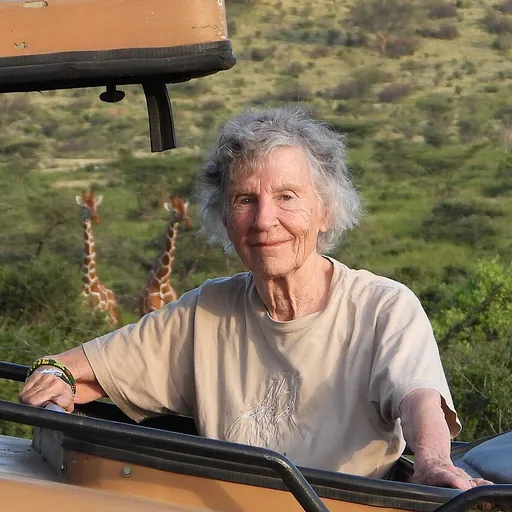
About Anne Innis Dagg
Lived 1933 – 2024 (aged 91). Anne Innis Dagg was a Canadian zoologist, writer, women's rights activist and university teacher, known for Gender bias and Giraffe.
Anne Christine Innis Dagg (25 January 1933 – 1 April 2024) was a Canadian zoologist, feminist, and author of numerous books. A pioneer in the study of animal behaviour in the wild, Dagg is credited with being the first person to study wild giraffes. Her impact on current understandings of giraffe biology and behaviour were the focus of the 2011 CBC radio documentary Wild Journey: The Anne Innis Story, the 2018 documentary film The Woman Who Loves Giraffes, and the 2021 children's book The Girl Who Loved Giraffes and Became the World's First Giraffologist.
In addition to her giraffe research, Dagg published extensively about camels, primates, and Canadian wildlife, and she raised concerns about the influence of sociobiology on how zoological research was shared with the general public. She also researched and wrote extensively about gender bias in academia, drawing attention to the detrimental impact that anti-nepotism rules can have on the academic careers of the wives of male faculty members and to sexist academic work environments that fail to support female researchers.
Early life and education Anne Christine Innis was born on 25 January 1933 in Toronto, Ontario. Her father, Harold Innis, was a professor of political economy at the University of Toronto and her mother, Mary Quayle Innis, was an author of short stories and books about history.
As a child, Dagg attended Bishop Strachan School.
Career Dagg published over 60 refereed scientific papers on such subjects as homosexuality, mammal behaviour, sociobiology, feminism, sexism at universities, and the rights of animals. She also wrote 20 books on related topics. Although best known for her research on the giraffe, Dagg studied other animals including camels, primates, and Canadian wildlife. She taught courses in mammalogy and wildlife management, among other topics, as an assistant professor with the Department of Zoology at the University of Guelph from 1968 to 1972. The remainder of her career was spent affiliated with the University of Waterloo's Integrated Studies program, later renamed Independent Studies. From 1986 to 1989, she served as the Academic Director of the program before transitioning to an academic advisor role. She was surprised to discover how little research had been done on smaller mammals and birds, in favour of research on big game species in Ontario and British Columbia such as the caribou. In 1972, she founded Otter Press in Waterloo, Ontario. The first publication was Matrix Optics by her husband Ian Dagg, followed in 1974 by her own book on Canadian wildlife, Mammals of Waterloo and South Wellington Counties, which was co-written by C. A. Campbell.
In 1975, Dagg was recognized by the National Museum of Natural Sciences as part of an exhibit dedicated to their achievements in the natural sciences. She was awarded the Batke Human Rights Award in 1984 by the K-W Status of Women in recognition of her work in the fields of social justice and gender equality. Dagg received a Lane Anderson Award in 2017 in recognition of her non-fiction children's book 5 Giraffes, alongside author Caroline Fox. She donated the $10,000 prize that accompanied the award to giraffe conservation efforts.
Despite demonstrated academic achievement, Dagg was denied tenure at the University of Guelph in 1972 due to concerns about her qualifications. She claimed she was told by the Dean that she was denied tenure, in part, because she lived outside of Guelph with her family and was not involved in the community. Pointing to a strong research record, support from the student body, and the barring of women from participating on campus committees, Dagg called her treatment during the tenure review process "demoralizing" and framed the future of women in academia as "bleak" given the type of discrimination they face. Her academic ability was similarly questioned at the University of Waterloo where it was suggested there was no point in pursuing a position because she had a family and a husband to support them. The documentary was heard by Alison Reid, who later directed the 2018 documentary The Woman Who Loves Giraffes, chronicling Dagg's life, career and her recognized impact on the study of giraffes. The film includes interviews with members of the tenure review committee that rejected Dagg's application. The chair of the committee, Keith Ronald, stood by the decision to deny Dagg tenure explaining that despite being a good teacher, Dagg's research program, which at the time included 20 peer-reviewed publications, "hadn't been fully developed".
On 27 December 2019, the office of Canadian Governor General Julie Payette announced that Dagg had been appointed a Member of the Order of Canada. She became invested in May 2022.
Giraffe field research
Dagg was referred to as "the Jane Goodall of giraffes" and was recognized as having made significant contributions to the study of giraffes. The trip was prompted by what she described in 1974 interview with the Toronto Star as a "tremendous urge to see giraffes roaming free, instead of being cooped up in zoos."
Ahead of the trip Dagg changed tactics by adjusting how her letters were signed. She contacted citrus farmer Alexander Matthew, who owned land near Kruger National Park in close proximity to roaming giraffes, to ask for permission to visit and study giraffes. Her request was granted based on the Matthew's assumption that the letter, signed A. Innis, was written by a man. She began writing to Matthew multiple times a week for several weeks asking for permission to return. He eventually agreed, allowing her to stay in his family's home in exchange for clerical services over the course of her stay. Her thesis work analyzed and compared the gaits of giraffes and other large mammals. Dagg's field research was eventually published in The Giraffe: Its Biology, Behavior and Ecology (1976). Co-authored with ecologist J. Bristol Foster, the book is recognized by researchers as the foundational text on giraffes.
Gender inequality in academia During her PhD studies, Dagg attempted to secure employment as a professor, but found that at the time universities were not inclined to hire women. According to Dagg, anti-nepotism rules, whether formal or unspoken, combined with a reluctance by universities to hire their own PhD students doubly hindered the wives of male faculty: "A wife often earns a Ph.D. from the local university where she is then unable to become a professor because of this opposition. Unlike many other women, she may not be free because of her marriage to seek a position at a university outside her locale, a dilemma which makes her career vulnerable to the local university's policies."
In 1974, Dagg filed a complaint with the Ontario Human Rights Commission against Wilfrid Laurier University. The complaint was in regards to the school's refusal to interview her for a position in their biology department despite 19 years experience, opting to instead hire a male professor who she claimed had less experience and fewer qualifications. Dagg requested a formal review of the complaint by Ontario's Ombudsman after the Commission found that her claims were "absolutely without foundation."
Dagg further explored the experiences of women in academia in the 1988 book MisEducation: Women & Canadian Universities, co-authored with Patricia J. Thompson. The authors pointed to a reliance on course material and textbooks reliant on gender-based stereotypes, male co-workers making sexist jokes, and lack of support or funding for women researchers as example of how conditions at Canadian universities had not changed much for women over time. In a Globe and Mail interview, Dagg, who at the time had published 10 books and more than 50 scholarly articles, said about the book that she hoped her lack of tenure would not cost her her job.
Personal life and death Dagg married Ian Ralph Dagg (1928–1993) in 1957. The ceremony took place at St. Pancras Town Hall in London, England. Together until his death, the couple had three children: Hugh, Ian and Mary.
Publications Books 192 pp. With J. Bristol Foster: xiii+210 pp. ix+324 pp. 192 pp. With Hilde Gauthier-Pilters: xii+208 pp. 125 pp.| 128 pp. With Patricia J. Thompson: 355 pp.
281 pp. ix+225 pp. viii+238 pp. With Lee E. Harding:
Articles
Don’t just read it —
keep it.
Full-length biographies made to live with: read them, listen on the way to work, watch them tonight.
- E-book
- Audio
- Video
Instant download · yours to keep · every purchase keeps this site free
Important facts
People in Anne Innis Dagg's life
Named in this biography and alive at the same time




Related people
Same field, nearest in time



Contemporaries
People whose lives overlapped Anne Innis Dagg's



Frequently asked questions
Who was Anne Innis Dagg?
Canadian zoologist
When was Anne Innis Dagg born?
Anne Innis Dagg was born on 25 January 1933 in Toronto.
When did Anne Innis Dagg die?
Anne Innis Dagg died on 1 April 2024 in Kitchener.
What was Anne Innis Dagg's occupation?
Anne Innis Dagg was a zoologist, writer, women's rights activist and university teacher.
What was Anne Innis Dagg known for?
Anne Innis Dagg was known for Gender bias and Giraffe.
What nationality was Anne Innis Dagg?
Anne Innis Dagg was Canadian.
Sources & further reading
Cite this page
APA: Biography.guide. (2026). Anne Innis Dagg. https://biography.guide/anne-innis-dagg/
MLA: "Anne Innis Dagg." Biography.guide, https://biography.guide/anne-innis-dagg/.
Chicago: "Anne Innis Dagg." Biography.guide. https://biography.guide/anne-innis-dagg/.
Data last updated: 2026-09-23 · Spot an error? Report a correction.
Portrait: Wikimedia Commons · author & licence
Page generated 2026-09-27 05:06 UTC