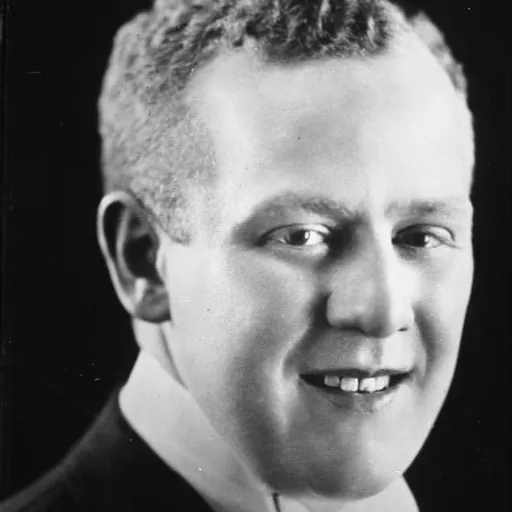
About Jack Hylton
Lived 1892 – 1965 (aged 72). Jack Hylton was a British bandleader, conductor, impresario, band leader, composer and pianist.
Jack Hylton (born John Greenhalgh Hilton; 2 July 1892 – 29 January 1965) was an English pianist, composer, band leader and impresario.
Hylton rose to prominence during the British dance band era, being referred as the "British King of Jazz" and "The Ambassador of British Dance Music" by the musical press, not only because of his popularity which extended throughout the world, but also for his use of unusually large ensembles for the time and his polished arrangements. He mostly retired from the music industry after 1940, becoming a successful theatrical businessman until his death.
Early life and career He was born John Greenhalgh Hilton in Great Lever near Bolton, Lancashire, the son of George Hilton, a cotton yarn twister. His father was an amateur singer at the local Labour Club and Hylton learned piano to accompany him on the stage. Hylton later sang to the customers when his father bought a pub (The Round Croft) in nearby Little Lever, becoming known as the "Singing Mill-Boy".
An ensemble consisting at times of more than 20 musicians, the Hylton orchestra quickly stood out from the rest. Unlike many other bandleaders who took up residences at nightclubs and ballrooms, Hylton often embarked on lengthy tours of England, which ultimately moulded the concept most Britons had of jazz.
The second half of the 1920s marked Hylton's highest point of prominence. After recovering from a near-fatal car accident – which took place on 20 January 1927, on way to the Gramophone Company studios in Hayes, Middlesex – he made the first in a string of "continental tours" that lasted until 1930. The orchestra's line-up also included some of the most skilled musicians of the time. "Regular" players included saxophonists Billy Ternent (who was also the band's main arranger and co-leader), Edward Owen (E.O.) "Poggy" Pogson and Noel "Chappie" d'Amato, trumpeter/cornetist Jack Jackson, trombonist Lew Davis, violinists Hugo Rignold and Harry Berly, pianist/arranger Peter Yorke, and (from 1928) singer Sam Browne. The orchestra was often augmented with members of other Hylton-controlled bands, especially for 12-inch "concert arrangements". According to the Daily Herald of 7 June 1930, between four and five million records sold in 1929 (out of 50 million sold overall) were made by Hylton, although three million has been suggested as likely a more accurate figure. Hylton also became a director and major shareholder of the new Decca record label, switching from His Master's Voice in late 1931. The following year, he was decorated by the French government, recorded with Paul Robeson, and made the first transatlantic entertainment broadcast with Paul Whiteman and his orchestra. In 1935, he appeared in his first feature film, the musical comedy She Shall Have Music, which starred June Clyde and Claude Dampier. Hylton began appearing on radio more frequently, starring in Radio Luxembourg's Rinso Radio Revue until 1939, when he appeared in the BBC's Band Waggon, as well as its 1940 film adaptation.
At this point in his career he became an impresario, discovering new stars and managing radio, film and theatre productions, from ballets to circuses. His productions dominated the London theatres with such productions as The Merry Widow, Kiss Me, Kate, and Kismet. They separated in 1929, but remained relatively close until Parkes's death in 1957, despite the formation of a short-lived "Mrs. Jack Hylton Band" in the mid-1930s. During the 1930s he had a long affair with model Frederika Kogler ("Fifi"), with whom he had two daughters: Jackie (b. 1932) and Georgina (b. 1938). He also had a son, Jack (b. 1947) by a later affair with the singer and actress Pat Taylor and a daughter, Angela (b. 1965) by an affair with Rosalina Neri.
He secondly married in Geneva in 1963, to Australian model and beauty queen Beverley Prowse (1932–2000).
Hylton was decorated by the French government on two occasions for his contribution to the entertainment industry. However, this equates to £4.6 million in 2018, when adjusted for inflation.
He is buried in the churchyard of St Catherine at Gosfield, Essex. His wife Beverley is buried beside him.
Legacy
Specialist dance band radio stations, such as Radio Dismuke and Swing Street Radio, continue to play his records. Hylton also features regularly on the Manx Radio programme Sweet & Swing, presented by Howard Caine.
His 1930 recording of "Happy Days Are Here Again" was used during the closing credits of episode four of Ken Burns's documentary series "The Roosevelts".
Hylton is portrayed by Ted Robbins in the 2011 television film Eric and Ernie.
Don’t just read it —
keep it.
Full-length biographies made to live with: read them, listen on the way to work, watch them tonight.
- E-book
- Audio
- Video
Instant download · yours to keep · every purchase keeps this site free
Important facts
People in Jack Hylton's life
Named in this biography and alive at the same time





Related people
Same field, nearest in time

Contemporaries
People whose lives overlapped Jack Hylton's

Frequently asked questions
Who was Jack Hylton?
British band leader and impresario (1892–1965)
When was Jack Hylton born?
Jack Hylton was born on 2 July 1892 in Bolton.
When did Jack Hylton die?
Jack Hylton died on 29 January 1965 in The London Clinic.
What was Jack Hylton's occupation?
Jack Hylton was a bandleader, conductor, impresario, band leader, composer and pianist.
What nationality was Jack Hylton?
Jack Hylton was British.
Sources & further reading
Cite this page
APA: Biography.guide. (2026). Jack Hylton. https://biography.guide/jack-hylton/
MLA: "Jack Hylton." Biography.guide, https://biography.guide/jack-hylton/.
Chicago: "Jack Hylton." Biography.guide. https://biography.guide/jack-hylton/.
Data last updated: 2026-09-21 · Spot an error? Report a correction.
Portrait: Wikimedia Commons · author & licence
Page generated 2026-09-27 04:58 UTC