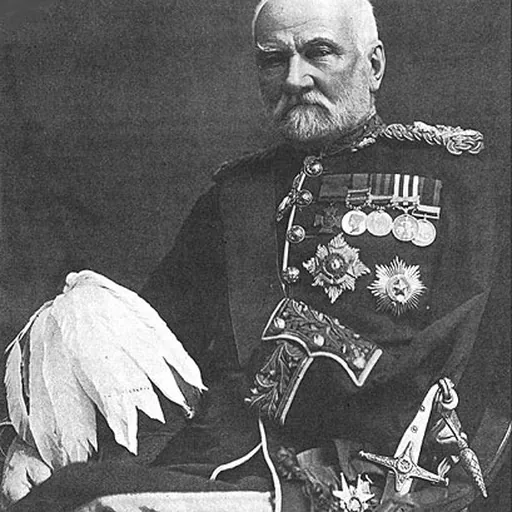
Sam Browne
British general, recipient of the Victoria Cross
About Sam Browne
Lived 1824 – 1901 (aged 76). Sam Browne was a British inventor, art collector and sam Browne belt.
General Sir Samuel James Browne, (3 October 1824 – 14 March 1901) was a British Indian Army cavalry officer, known best as the creator of the Sam Browne belt. He was a recipient of the Victoria Cross, the most prestigious award for gallantry in combat that can be awarded to British and Commonwealth forces.
Early life He was born in Barrackpore, India, the son of Dr. John Browne, a surgeon of the Bengal Medical Service and his wife Charlotte (née Swinton). Educated in England, Browne returned to India in 1840 and joined the 46th Bengal Native Infantry as an ensign. During the Second Anglo-Sikh War, he participated in actions at Ramnuggar, Sadulpur, Chillianwalla and Gujrat. In 1849 he was made a lieutenant and tasked with raising a cavalry force, to be designated the 2nd Punjab Irregular Cavalry and later incorporated into the regular force. From 1851 to 1863 he was adjutant and then commanding officer of this unit. Later (1904) the unit would be re-designated as the 22nd Sam Browne's Cavalry (Frontier Force) in his honour.
Indian Mutiny Browne commanded the 2nd Punjab in several engagements, and was decorated for action during the Bozdar Expedition of 1857, being promoted to captain.
Browne was awarded the Victoria Cross for actions on 31 August 1858 at Seerporah, Rohilkhand, Uttar Pradesh, India. His citation reads:
His Victoria Cross is displayed at the National Army Museum.
Sam Browne belt
Sometime after this incident he began to wear the accoutrement which now bears his name, as compensation for the difficulty his disability caused with wearing his officer's sword. A Sam Browne belt is a wide belt, usually leather, supported by a narrower strap passing diagonally over the right shoulder; the diagonal strap stabilizes the scabbard of a sword if worn. Later such a belt would be adopted by other officers who knew Browne in India, but it was not to become used commonly by the British Army until after his retirement. Browne's original "Sam Browne" belt is possessed presently by the National Army Museum in Chelsea.
Later career and retirement After the Indian Mutiny, Browne remained in the Indian Army and was promoted major-general in February 1870. and became a lieutenant-general on 1 October 1877.
During the Second Anglo-Afghan War in 1878–9, Browne commanded the Peshawar Valley Field Force. After entering Afghanistan via the Khyber Pass, and defeating the Afghan army at the battle of Ali Masjid on 21 November 1878, he occupied Jalalabad on 20 December. However, further advance towards Kabul in the new year was slowed by transport difficulties. After the end of the first phase of the war in May 1879, Browne's force returned to India. Although criticised by the viceroy Lord Lytton for the slow pace of his advance, and received the thanks of both Parliament and the government of India for his Afghan service. He retired from active service in 1884, was promoted general on 1 December 1888 and made a Knight Grand Cross of the Order of the Bath (GCB) in 1891.
In retirement Browne lived in Ryde on the Isle of Wight, England, and died there in 1901 at the age of 76. His remains were cremated but there is a memorial marker dedicated to Browne in the Ryde New Cemetery, as well as plaques at St Paul's Cathedral in London and Lahore Cathedral in Pakistan. His grave was restored in 2010.
Family
Browne married Lucy Sherwood, daughter of Richard Crosier Sherwood. She survived her husband, and died on 27 July 1911. Lieutenant-Colonel Alfred Percy Browne, (15 January 1868 – 16 October 1930), an officer in the Central India Horse; who married Winifred Marie (3 February 1899 – 5 august 1970) Violet Adriana Browne (d. London 17 March 1946)
Don’t just read it —
keep it.
Full-length biographies made to live with: read them, listen on the way to work, watch them tonight.
- E-book
- Audio
- Video
Instant download · yours to keep · every purchase keeps this site free
Important facts
People in Sam Browne's life
Named in this biography and alive at the same time



Related people
Same field, nearest in time


Contemporaries
People whose lives overlapped Sam Browne's




Frequently asked questions
Who was Sam Browne?
British general, recipient of the Victoria Cross (1824–1901)
When was Sam Browne born?
Sam Browne was born on 3 October 1824 in Barrackpore.
When did Sam Browne die?
Sam Browne died on 14 March 1901 in Ryde.
What was Sam Browne's occupation?
Sam Browne was an inventor, art collector and sam Browne belt.
What nationality was Sam Browne?
Sam Browne was British.
Sources & further reading
Cite this page
APA: Biography.guide. (2026). Sam Browne. https://biography.guide/sam-browne-inventor/
MLA: "Sam Browne." Biography.guide, https://biography.guide/sam-browne-inventor/.
Chicago: "Sam Browne." Biography.guide. https://biography.guide/sam-browne-inventor/.
Data last updated: 2026-09-20 · Spot an error? Report a correction.
Portrait: Wikimedia Commons · author & licence
Page generated 2026-09-27 04:58 UTC