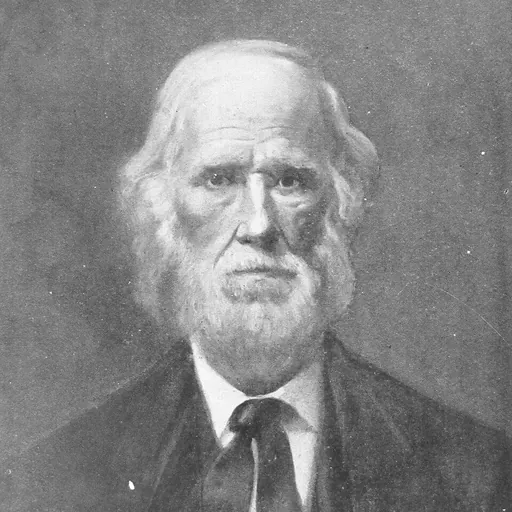
About J. G. M. Ramsey
Lived 1797 – 1884 (aged 87). J. G. M. Ramsey was an American historian, businessperson, physician and slavery in the United States.
James Gettys McGready Ramsey (March 25, 1797 – April 11, 1884) was an American historian, physician, planter, slave owner, and businessman, active primarily in East Tennessee during the nineteenth century. Ramsey is perhaps best known for his book, The Annals of Tennessee to the End of the Eighteenth Century, a seminal work documenting the state's frontier and early statehood periods. Ramsey was also a major advocate for development in East Tennessee, leading efforts to bring railroad access to the region, and helping to organize the region's first medical society.
As the son of a prominent Tennessee statesman, Ramsey encountered as a child many of the state's important early political figures, giving him a unique historical perspective on the state's early years. After his father's death, Ramsey began compiling a vast collection of historical documents related to the state's Watauga, Franklin, and Southwest Territory periods. After years of exchanging advice and notes with fellow historian Lyman Draper, Ramsey published the 700-plus page Annals in 1853. While the book has been praised for its attention to accuracy and factual detail, modern historians have criticized it for its lack of historical inquiry and its overemphasis on biography and warfare.
Francis Alexander had left Pennsylvania possessing only his horse, and both a surveying compass and chain during 1783 at age 19 after having been invited by his material uncle John Alexander to live with him on Big Limestone Creek at what was then Washington County, North Carolina (now Greene County, Tennessee) and within approximately one mile of the Martin Academy founded by the Rev. Samuel Doak.
Also during 1783, Ramsey's father helped James White explore what is now the Knoxville area, and later served in various capacities in the State of Franklin and Southwest Territory governments. Guests who frequented the Ramsey House during Ramsey's formative years included John Sevier and Willie Blount, and Knoxville founders James White and Charles McClung.
Business interests After his father's death in 1820, Ramsey succeeded him as president of the Knoxville Branch of the Bank of Tennessee. During the same period, he began building a large plantation at the confluence of the French Broad and Holston rivers, named "Mecklenburg" after his mother's native Mecklenburg County, North Carolina.
As early as 1825, Ramsey had proposed connecting Knoxville with the Atlantic Coast via railroad, which would have given the region's farmers better access to markets in Charleston. Over the years, Ramsey negotiated several hundred thousand dollars' worth of bonds, which funded the first railroads built in the region. Ramsey also championed improvements to the Tennessee River that would give Knoxville's river merchants year-round access to the Mississippi River. In 1828, the first steamboat to reach Knoxville, the Atlas, docked at Mecklenburg, prompting Ramsey to give a speech on the meaning of patriotism. Knoxville Whig newspaper editor and Methodist minister William "Parson" Brownlow, who had been at odds with Ramsey since the 1840s, sued on behalf of these depositors and won a civil judgement against Ramsey.
The Annals of Tennessee Ramsey began accumulating historical documents pertaining to the state's history during the 1830s. He began writing The Annals of Tennessee in 1840, but the project stalled as Ramsey struggled with a lack of information regarding certain periods, and attempted to address certain contradictions in his source documents. A major catalyst for Ramsey during this period was his friendship with historian Lyman Draper, who first visited Ramsey in October 1844. Draper, who was compiling documents for a history of the Trans-Allegheny region, helped Ramsey fill in a number of gaps, and provided him with technical advice.
The book is an invaluable account of many of the state's early historical events, especially considering that many of the documents on which it was based were destroyed during the Civil War. Modern historians, however, criticize Ramsey for focusing almost solely on battles and biographies of key figures, while ignoring economic and social factors that contributed significantly to the state's early settlement. The book has also been criticized for its unbalanced organization, providing a torrent of details on some events and scant details on other, equally important events.
During the secession crisis that followed Lincoln's election in November 1860, Ramsey grew increasingly frustrated with East Tennessee's refusal to align itself with the South. Ramsey suggested that most East Tennesseans were too "ignorant" to understand the secession issue, and accused Brownlow (who was pro-Union) of using the Whig to brainwash them.
The Civil War During the war, Ramsey served as a Confederate treasury agent, and two of his sons served in the Confederate Army. Ramsey himself spent the latter half of the war in various cities around the region, continuously fleeing the Union Army's advance.
Legacy During his lifetime, Ramsey helped establish the East Tennessee Medical Society, serving as its first president, as well as the East Tennessee Historical Society, serving as its first recording secretary.
While criticized by modern historians, the Annals of Tennessee remains an important source of factual information regarding the state's early settlement, and has been republished several times. In 1918, the East Tennessee Historical Society published a short pamphlet written by Ramsey that details the history of the Lebanon-in-the-Fork Presbyterian Church. In 1954, the Tennessee Historical Commission published an autobiography Ramsey had written to venerate his family's actions during the Civil War, along with some of his personal correspondence.
Don’t just read it —
keep it.
Full-length biographies made to live with: read them, listen on the way to work, watch them tonight.
- E-book
- Audio
- Video
Instant download · yours to keep · every purchase keeps this site free
Important facts
People in J. G. M. Ramsey's life
Named in this biography and alive at the same time



Related people
Same field, nearest in time



Contemporaries
People whose lives overlapped J. G. M. Ramsey's






Frequently asked questions
Who was J. G. M. Ramsey?
American historian (1797-1884)
When was J. G. M. Ramsey born?
J. G. M. Ramsey was born on 25 March 1797 in Knoxville.
When did J. G. M. Ramsey die?
J. G. M. Ramsey died on 11 April 1884 in Knoxville.
What was J. G. M. Ramsey's occupation?
J. G. M. Ramsey was a historian, businessperson, physician and slavery in the United States.
What nationality was J. G. M. Ramsey?
J. G. M. Ramsey was American.
Sources & further reading
Cite this page
APA: Biography.guide. (2026). J. G. M. Ramsey. https://biography.guide/j-g-m-ramsey/
MLA: "J. G. M. Ramsey." Biography.guide, https://biography.guide/j-g-m-ramsey/.
Chicago: "J. G. M. Ramsey." Biography.guide. https://biography.guide/j-g-m-ramsey/.
Data last updated: 2026-09-22 · Spot an error? Report a correction.
Portrait: Wikimedia Commons · author & licence
Page generated 2026-09-27 05:00 UTC