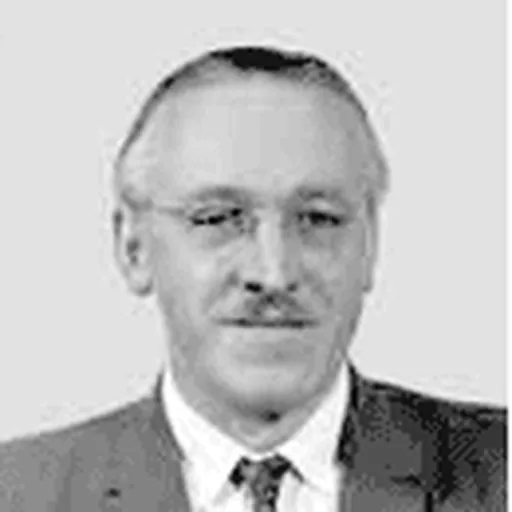
J. Carson Mark
Canadian-American mathematician
About J. Carson Mark
Lived 1913 – 1997 (aged 83). J. Carson Mark was a Canadian and American mathematician, physicist and university teacher, known for Nuclear weapon.
Jordan Carson Mark (July 6, 1913 – March 2, 1997) was a Canadian-American mathematician best known for his work on developing nuclear weapons for the United States at the Los Alamos National Laboratory. Mark joined the Manhattan Project in 1945, and continued to work at Los Alamos under the leadership of Norris Bradbury after World War II ended. He became the leader of the Theoretical Division at the laboratory in 1947, a position he held until 1973. He oversaw the development of new weapons, including the hydrogen bomb in the 1950s. On the hydrogen bomb project he was able to bring together experts like Edward Teller, Stanislaw Ulam and Marshall Holloway despite their personal differences.
In July and August 1958, and again the following year, Mark was a scientific adviser to the United States delegation at the Conference of Experts on Detection of Nuclear Explosions. He served on the United States Air Force's Scientific Advisory Board, and its Foreign Weapons Evaluation Group. After he retired from Los Alamos in 1973 he served on the Nuclear Regulatory Commission's Advisory Committee on Reactor Safeguards, and was a consultant for the Nuclear Control Institute.
Biography Jordan Carson Mark was born in Lindsay, Ontario, July 6, 1913. He had a brother, James, and five sisters, Margaret, Dorothy, Muriel, Frances and Tony. He received a Bachelor of Arts (BA) degree in mathematics and physics from the University of Western Ontario in 1935, and a Doctor of Philosophy (PhD) in mathematics from the University of Toronto in 1938, writing his thesis "On the Modular Representations of the Group GLH(3,P)" under the supervision of Richard Brauer.
Mark taught mathematics at the University of Manitoba, from 1938 until World War II, when he joined the Montreal Laboratory of the National Research Council of Canada in 1943. He came to the Los Alamos Laboratory in May 1945 as part of the British Mission to the Manhattan Project,
In 1947 the Los Alamos Laboratory, under the leadership of Norris Bradbury, was much smaller than it had been during the war, because most of the wartime staff had returned to their universities and laboratories, but it was still the center of American nuclear weapons development, and the Theoretical Division was for many years the center of the laboratory. The Laboratory made great strides in improving the weapons, making them easier to manufacture, stockpile and handle. The Operation Sandstone tests in 1948 demonstrated that uranium-235 could be used in implosion-type nuclear weapons.
Mark played a key role in the development of thermonuclear weapons in the early 1950s. A crash program to develop the hydrogen bomb was approved by President Harry S. Truman in January 1950 at Edward Teller's urging before the laboratory had a workable design. The Ivy Mike test was successful, obliterating an island in Enewetak Atoll in the Pacific on November 1, 1952. As most weapon research in the 1960s no longer involved the Theoretical Division, Mark branched out, sponsoring research into hydrodynamics, neutron physics and transport theory. He was committed to preventing nuclear weapons proliferation. He spoke at Pugwash Conferences, and wrote a paper dispelling the myth that reactor-grade plutonium could not be used for nuclear weapons.
Mark was member of the American Mathematical Society and the American Physical Society, and served on the United States Air Force's Scientific Advisory Board, and its Foreign Weapons Evaluation Group. After he retired from Los Alamos in 1973 he served on the Nuclear Regulatory Commission's Advisory Committee on Reactor Safeguards, and was a consultant for the Nuclear Control Institute. One of his last papers was on Iraq's nuclear weapons capability.
Mark died in Los Alamos, New Mexico, on March 2, 1997, from complications related to a fall. He was survived by his wife Kathleen, daughters, Joan, Elizabeth Mark and Mary, and sons, Thomas, Graham and Christopher, his brother, James and sister Dorothy .
Don’t just read it —
keep it.
Full-length biographies made to live with: read them, listen on the way to work, watch them tonight.
- E-book
- Audio
- Video
Instant download · yours to keep · every purchase keeps this site free
Important facts
People in J. Carson Mark's life
Named in this biography and alive at the same time


Related people
Same field, nearest in time


Contemporaries
People whose lives overlapped J. Carson Mark's





Frequently asked questions
Who was J. Carson Mark?
Canadian-American mathematician
When was J. Carson Mark born?
J. Carson Mark was born on 6 July 1913 in Lindsay.
When did J. Carson Mark die?
J. Carson Mark died on 2 March 1997 in Los Alamos.
What was J. Carson Mark's occupation?
J. Carson Mark was a mathematician, physicist and university teacher.
What was J. Carson Mark known for?
J. Carson Mark was known for Nuclear weapon.
What nationality was J. Carson Mark?
J. Carson Mark was Canadian and American.
Sources & further reading
Cite this page
APA: Biography.guide. (2026). J. Carson Mark. https://biography.guide/j-carson-mark/
MLA: "J. Carson Mark." Biography.guide, https://biography.guide/j-carson-mark/.
Chicago: "J. Carson Mark." Biography.guide. https://biography.guide/j-carson-mark/.
Data last updated: 2026-09-23 · Spot an error? Report a correction.
Portrait: Wikimedia Commons · author & licence
Page generated 2026-09-27 05:07 UTC