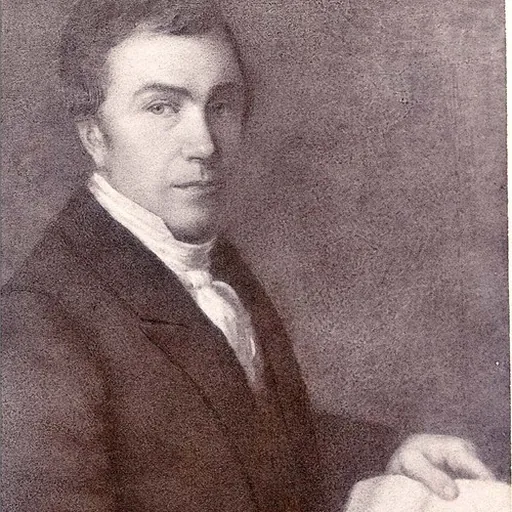
About Isaac McCoy
Lived 1784 – 1846 (aged 62). Isaac McCoy was a missionary, christian minister, writer and baptists.
Isaac McCoy (June 13, 1784 – June 21, 1846) was an American pioneer and Baptist missionary among the Native Americans in what became the states of Indiana, Michigan, Missouri, and Kansas.
He was an advocate of saving the dwindling tribes from decades of ongoing American abuse, by leading their charitable removal from the eastern United States into their own homesteading. He serially established successful tribal missions at the remote western American frontiers, hundreds of miles beyond any white settlements, repeatedly relocating westward due to encroachment and exploitation. He wrote books and made many trips to Washington, D.C. to solicit funds, create programs, and propose a permanent sovereign tribal colony within Indian Territory, which instead became the states of Kansas, Nebraska, and Oklahoma. He pioneered the areas that became Grand Rapids, Michigan and Kansas City, Missouri.
Early life McCoy was born in Uniontown, Pennsylvania, on June 13, 1784, to William and Elizabeth Royce McCoy. Five years later, the McCoy family rafted down the Ohio River to Kentucky, settling first near Louisville and in 1792 in Shelby County. When he was nine years old, he lost three fingers while chopping wood. When he was nineteen years old, he felt a call from God to go out and preach.
His father was a Baptist minister, sharing profound arguments with him about religion. His father, on theological principles shared by many of his congregation, was opposed to evangelizing. McCoy was inspired in childhood to become a missionary to Native Americans and determined on that work.
Marriage and family On October 6, 1803, Isaac McCoy married Christiana Polke (1778–1851), age 16, in Kentucky. She was a cousin of the future President James K. Polk. Christiana's family had been at Kincheloe's Station, Nelson County, Kentucky, when it was attacked. Her mother and four siblings were carried into captivity by the Shawnee, and Christiana was born after that time.
McCoy's wife, Christiana, died in Kansas City in 1851. A stream in Elkhart County, Indiana and a lake in Cass County, Michigan are named for her.
Westward migration Soon after their marriage, the young couple departed Kentucky for Vincennes, Indiana. Although he had no training and no formal education, McCoy became a part-time preacher. In 1808, the Silver Creek Baptist Church, the first Baptist Church in Indiana, granted McCoy a license "to preach the Gospel wherever God in His providence might cast his lot". The Silver Creek church was located near what became Sellersburg in Clark County. In 1809, McCoy became pastor of Maria Creek Church near Vincennes. In 1810, the Church ordained him as a minister. He was the town jailor at Vincennes.
Through illness and poverty, McCoy traveled widely, if unsuccessfully, on the frontier promoting the Baptist church. In 1817, the Baptist Board of Foreign Missions appointed him as a missionary
Missions in Indiana and Michigan McCoy founded his first "religious station" and school in October 1818 in what became Parke County, Indiana, on Big Raccoon Creek
Carey Mission often suffered a subsistence diet. McCoy once wrote, "Blessed be God, we have not yet suffered for lack of food; for parched corn is an excellent substitute for bread. [...] But, now having eaten our last grain of corn, we cannot avoid some anxiety about our next meal."
In 1829, his book was published, Remarks on the Practicability of Indian Reform, Embracing Their Colonization. It recounts a four-page, cited, historical summary of the essential justification of the European colonization of the continent since Jamestownand refutes each essential element. He laments the callous conquest of the native tribes, the disregard of their very concept of government, land rights, and freely chosen lifestyle. He compares this to a hypothetical conquest of the modern Washington, DC by Chinese invaders who could similarly see America as alien, uncivilized, and inferior.
In 1830 Congress passed the Indian Removal Act, which formally authorized the removal of eastern Indians to the West. For the next ten years, McCoy was engaged in surveying boundaries of reservations for more than twenty tribes who moved west to present-day Kansas. Often they comprised small remnants of formerly powerful peoples. McCoy had hoped to be one of the three commissioners appointed to oversee Indian Territory, but he was passed over and his dreams of becoming the government's chief representative to the Indian tribes were dashed.
In a letter , included in the Mormon publication The Joseph Smith Papers, Edward Partridge recalled the same incident, when the Mormons were disarmed at Independence: "Wednesday Nov 6th. The arms being taken from the Saints the mob now felt safe and were no longer militia. They formed themselves into companies and went forth on horseback armed to harass the saints and pick up all the arms they could find. Two of these companies were headed by Baptist priests. The Rev. Isaac McCoy headed one of about 60 or 70, the other's was about 30 or 40. They went through the different settlement of the Saints threatening them with death and destruction if they were not off immediately... The mobs whipped and shot at some and others they hunted, for as they said to kill them. Such mobs well lined with whiskey were acting worse than savages."
Although he was involved in numerous projects on behalf of what he perceived as the best interest of Indians, McCoy was nearly destitute during much of the 1830s, taking in boarders and working as bookkeeper in a neighboring store. He hoped to be appointed as the government overseer of Indians. He lobbied in Washington and on the frontier seeking, unsuccessfully, for U.S. government recognition of the Indian lands as an official U.S. Territory.
In 1840, McCoy wrote one of the earliest, most personally informed reports on the Midwestern Native American tribes, The History of Baptist Indian Missions. on June 21, 1846, aged 62, and was buried in Western Cemetery.
Assessment
McCoy was much more of a social reformer than a missionary, hardly being concerned in his later years with converting Indians to Christianity. He "attacked the system of law and custom by which Indians had been kept in bondage" and "his object was to free the Indians from those restraints". His solution was to move the Indians beyond where they could be corrupted and exploited by Whites. But the tide of westward expansion in the United States was too strong and his plans failed. His biographer said that the vision of this rude, untutored preacher and pioneer was "somewhat breathtaking". Periodical Account of Baptist Missions Within the Indian Territory For the Year Ending December 31, 1836 History of the American Baptist African and Haytien Missions For the Use of Sabbath Schools History of Baptist Indian Missions Remarks on the Practicability of Indian reform, embracing their colonization Annual Register of Indian Affairs (1855–1888)
Don’t just read it —
keep it.
Full-length biographies made to live with: read them, listen on the way to work, watch them tonight.
- E-book
- Audio
- Video
Instant download · yours to keep · every purchase keeps this site free
Important facts
People in Isaac McCoy's life
Named in this biography and alive at the same time
Related people
Same field, nearest in time


Contemporaries
People whose lives overlapped Isaac McCoy's




Frequently asked questions
Who was Isaac McCoy?
American city founder
When was Isaac McCoy born?
Isaac McCoy was born on 13 June 1784 in Uniontown.
When did Isaac McCoy die?
Isaac McCoy died on 21 June 1846 in Louisville, Kentucky.
What was Isaac McCoy's occupation?
Isaac McCoy was a missionary, christian minister, writer and baptists.
Sources & further reading
Cite this page
APA: Biography.guide. (2026). Isaac McCoy. https://biography.guide/isaac-mccoy/
MLA: "Isaac McCoy." Biography.guide, https://biography.guide/isaac-mccoy/.
Chicago: "Isaac McCoy." Biography.guide. https://biography.guide/isaac-mccoy/.
Data last updated: 2026-09-23 · Spot an error? Report a correction.
Portrait: Wikimedia Commons · author & licence
Page generated 2026-09-27 05:06 UTC