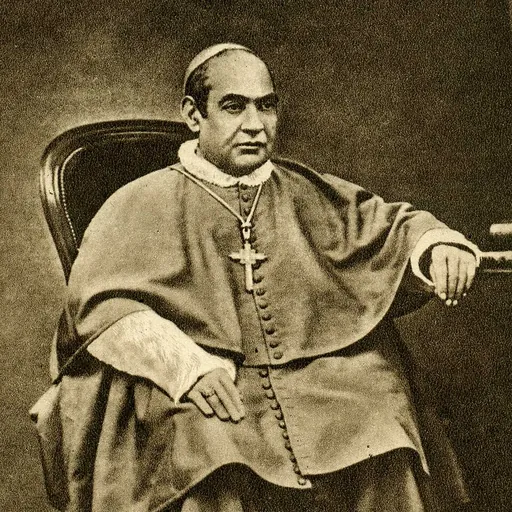
Anthony Mary Claret
Spanish Roman Catholic bishop, missionary and saint
About Anthony Mary Claret
Lived 1807 – 1870 (aged 62). Anthony Mary Claret was a Spanish missionary, catholic priest and catholic bishop.
Anthony Mary Claret, (born Antoni Maria Claret i Clarà; ; 23 December 1807 – 24 October 1870) was a Spanish Catholic prelate and missionary who served as Archbishop of Santiago de Cuba and was the confessor of Queen Isabella II. He founded the congregation of Missionary Sons of the Immaculate Heart of Mary, commonly called the Claretians.
In addition to the Claretians, which in the early 21st century had over 450 houses and 3100 members, with missions in five continents, Claret founded or drew up the rules of several communities of religious sisters. Claret is the patron saint of weavers.
Life Antoni Maria Claret i Clarà was born in Sallent, in the county of Bages in the Province of Barcelona, on 23 December 1807, the fifth of the eleven children of Juan and Josefa Claret. His father was a wool manufacturer. As a child he enjoyed pilgrimages to the nearby Shrine of Our Lady of Fussimanya.
Claret received an elementary education in his native village, and at the age of twelve became a weaver. At the age of eighteen, he went to Barcelona to specialize in his trade as a Jacquard loom programmer, and remained there until he was 20 years old. Meanwhile, he devoted his spare time to study and became proficient in Latin, French and engraving.
Frightened that his love of active time and design was causing him to become obsessed and burned out, and feeling a call to religious life, he left Barcelona. Although he initially wished to become a Carthusian monk, he entered the diocesan seminary at Vic in 1829, and was ordained on 13 June 1835, on the feast of St. Anthony of Padua. He received a benefice in his native parish, where he continued to study theology until 1839; but as missionary work strongly appealed to him, he proceeded to Rome. There he entered the Jesuit novitiate but had to leave due to ill health. He then returned to Spain and exercised his pastoral ministry in Viladrau and Girona, attracting notice through his efforts on behalf of the poor.
Recalled by his superiors to Vic, Claret was sent as Apostolic Missionary throughout Catalonia which had suffered from French invasions. He travelled from one mission to the next on foot. An eloquent preacher fluent in the Catalan language, he drew people from miles around. After a lengthy time in the pulpit, he would spend long hours in the confessional. In 1848, Claret's life was threatened by anti-clericalists and he was sent to the Canary Islands where he gave retreats for 15 months. His missions were so well attended that he often preached from an improvised pulpit in the plaza before the church.
Archbishop
Pope Pius IX, at the request of the Spanish crown (Queen-regnant Isabella II of Spain), appointed him Archbishop of Santiago de Cuba, in 1849. He was consecrated at Vic in October 1850. Before he embarked, he made three separate pilgrimages: to Our Lady of the Pillar, patroness of Spain; to the Virgin of Montserrat, patroness of Catalonia; and to Our Lady of Fussimanya, near his home village.
Claret was a charismatic preacher who could reportedly perform miracles. Among them were claims that his body would become transfigured while preaching or in prayer; that he would at times levitate up to six feet off the ground; that he stopped a series of earthquakes in Cuba by kneeling on the ground and placing his palms to the earth while uttering prayers; that he could calm storms by raising a hand to the sky and blessing the storm clouds; that he experienced apparitions of both Jesus and Mary; and that he seen walking on water. In addition, claims circulated that a supernatural light could be seen radiating from his body while he was saying Mass. Queen Isabella of Spain produced a written statement declaring that she had personally witnessed this phenomenon. thumb Photograph of Saint Anthony Mary Claret, In February 1857, Claret was recalled to Spain by Queen Isabella II, who made him her confessor. He obtained permission to resign his Cuban see and was appointed to the titular see of Trajanopolis. His influence was now directed solely to help the poor and to propagate learning; he lived frugally and took up his residence in an Italian hospice. For nine years he was rector of the Escorial monastic school, where he established a scientific laboratory, a museum of natural history, a library, college and schools of music and languages. In 1868, a new revolution dethroned the queen and sent her and her family into exile. Claret's life was also in danger, so he accompanied her to Paris.
Veneration Claret was declared venerable by Pope Leo XIII in 1899. His relics were transferred to the mission house at Vic in 1897, at which time his heart was found incorrupt. His grave is visited by many pilgrims.
Anthony Mary Claret was beatified in Rome by Pope Pius XI on 24 February 1934. He was canonized 16 years later by Pope Pius XII on 7 May 1950. Pope John XXIII included him in the General Roman Calendar in 1960, and fixed his feast on 23 October, where it remained for nine years until the 1969 revision of the calendar moved it to the day of his death, 24 October, which had been the feast of Saint Raphael the Archangel since 1921.
Anthony Mary Claret is the patron saint of weavers. Sevilla, and Valencia), Colombia (Cali), Dominican Republic (Santo Domingo), Peru (Trujillo, Huancayo, Arequipa and Lima), Argentina (Buenos Aires and Bahía Blanca), Venezuela (Caracas, Maracaibo and Mérida), Equatorial Guinea (Malabo), Chile (Temuco ), Costa Rica (Heredia ), the Philippines (Zamboanga City, Quezon City ), India (Ziro), and Bangalore.
In popular culture He is portrayed by Antonio Reyes in the 2022 film Slaves and Kings, produced by the Claretians and Stellarum Films, and directed by Pablo Moreno. The film is a re-release of the 2020 film Claret.
Don’t just read it —
keep it.
Full-length biographies made to live with: read them, listen on the way to work, watch them tonight.
- E-book
- Audio
- Video
Instant download · yours to keep · every purchase keeps this site free
Important facts
Related people
Same field, nearest in time




Contemporaries
People whose lives overlapped Anthony Mary Claret's




Frequently asked questions
Who was Anthony Mary Claret?
Spanish Roman Catholic bishop, missionary and saint (1807-1870)
When was Anthony Mary Claret born?
Anthony Mary Claret was born on 23 December 1807 in Sallent.
When did Anthony Mary Claret die?
Anthony Mary Claret died on 24 October 1870 in Fontfroide Abbey.
What was Anthony Mary Claret's occupation?
Anthony Mary Claret was a missionary, catholic priest and catholic bishop.
What nationality was Anthony Mary Claret?
Anthony Mary Claret was Spanish.
Sources & further reading
· Wikipedia: Anthony Mary Claret
· DBpedia: Anthony Mary Claret
Cite this page
APA: Biography.guide. (2026). Anthony Mary Claret. https://biography.guide/anthony-mary-claret/
MLA: "Anthony Mary Claret." Biography.guide, https://biography.guide/anthony-mary-claret/.
Chicago: "Anthony Mary Claret." Biography.guide. https://biography.guide/anthony-mary-claret/.
Data last updated: 2026-09-21 · Spot an error? Report a correction.
Portrait: Wikimedia Commons · author & licence
Page generated 2026-09-27 05:00 UTC