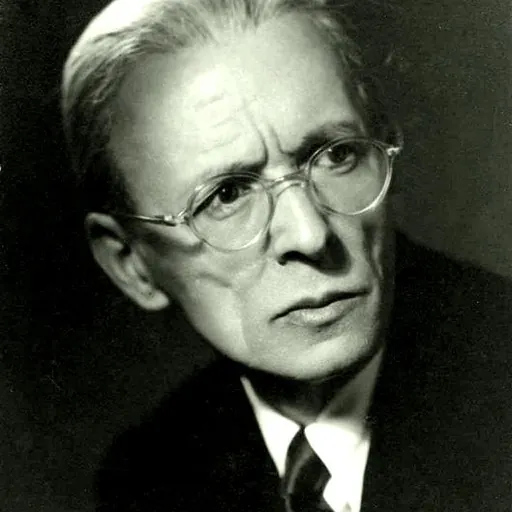
About Ildebrando Pizzetti
Lived 1880 – 1968 (aged 87). Ildebrando Pizzetti was an Italian composer, conductor, musicologist and critic.
Ildebrando Pizzetti (20 September 1880 – 13 February 1968) was an Italian composer of classical music, as well as a musicologist and a music critic.
Biography Pizzetti was born in Parma in 1880. He was part of the "Generation of 1880" along with Ottorino Respighi, Gian Francesco Malipiero, and Alfredo Casella. They were among the first Italian composers in some time whose primary contributions were not in opera. The instrumental and a cappella traditions had never died in Italian music and had produced, for instance, the string quartets of Antonio Scontrino (1850–1922) and the works of Respighi's teacher Giuseppe Martucci; but with the "Generation of 1880" these traditions became stronger.
Ildebrando Pizzetti was the son of Odoardo Pizzetti, a pianist and piano teacher who was his son's first teacher. At first Pizzetti seemed headed for a career as a playwright—he had written several plays, two of which had been produced—before he decided in 1895 on a music career and entered the Parma Conservatory. There he was taught from 1897 by Giovanni Tebaldini and gained the beginnings of his lifelong interest in the early music of Italy, reflected in his own music and his writings.
He taught at the Florence Conservatory (director from 1917 to 1923), directed the Milan Conservatory from 1923, and was Respighi's successor at the National Academy of St Cecilia in Rome from 1936 to 1958. His students included Mario Castelnuovo-Tedesco, Olga Rudge, Manoah Leide-Tedesco, Franco Donatoni and Amaury Veray. Also a music critic, he wrote several books on the music of Italy and of Greece and co-founded a musical journal. Pizzetti was an active supporter of fascism and signed the Manifesto of the Fascist Intellectuals in 1925.
A disciple of poet, playwright and revolutionary Gabriele d'Annunzio, Pizzetti wrote incidental music to his plays, and was highly influenced by d'Annunzio's dark neoclassic themes. One of Pizzetti's later operas, La figlia di Jorio, is a setting of d'Annunzio's 1904 eponymous play.
He was named to the Royal Academy of Italy in 1939. As noted by Franco Sciannameo, his relations with the Fascist government of the 1940s were often positive, sometimes mixed; he received at one point high awards, and the one symphony of his mature years was the product of a commission from their Japanese allies to celebrate the "XXVI Centennial of the foundation of the Japanese Empire" (Benjamin Britten's Sinfonia da Requiem was also commissioned for this event, though it was rejected on account of its finale; its original finale was rediscovered after Britten's death and only premiered then.). Pizzetti's Symphony in A was premiered as noted in the article, and recorded in 1940, and again by Naxos with his Harp Concerto (Naxos 8573613, 2017).
His Violin Concerto in A was premiered in 1944 by Gioconda de Vito; this seems to be the only 20th-century violin concerto she ever played.
Some of his works were published under the name "Ildebrando da Parma".
Selected works
Operas Sabina (1897) Il Cid (1903) Aeneas (1903) Mazeppa (1905, unfinished) Gigliola (1914, unfinished) Fedra (1915) Dèbora e Jaéle (1922) Suite from La Pisanelle (premiered 1919) 3 Sonetti del Petrarca Tre composizioni corali Other vocal works, e.g. Epithalamium (1939? 1940, played at a Library of Congress concert in April 1940 and again in 1977) Cello concerto in C minor (1933–34) Viola concerto (1955, unfinished) Canti della stagione alta : concerto for piano and orchestra (1930) Sinfonia del fuoco (from music for the silent film Cabiria) Rondo veneziano (1929) Concerto dell'Estate Tre Preludii sinfonici per L'Edipo Re di Sofocle (1903)
Chamber music Violin sonata in C minor (1900) String Quartet n.1 in A major (1906) Violin sonata in A (championed by Yehudi Menuhin) written 1918–9, pub. 1920 Cello sonata in F 1921, pub. 1922 Tre canti for cello and piano (1924) Piano sonata pub. 1942 Piano trio in G minor (1900) Piano trio in A (from 1925) Cantata: Filiae Jerusalem, Adjuro Vos (1966)
Film scores Cabiria (1914) (Pizzetti provided the 10-minute Sinfonia del Fuoco for the pivotal sacrifice scene of the film) The Ship (1921) The Betrothed (1941)
Don’t just read it —
keep it.
Full-length biographies made to live with: read them, listen on the way to work, watch them tonight.
- E-book
- Audio
- Video
Instant download · yours to keep · every purchase keeps this site free
Important facts
People in Ildebrando Pizzetti's life
Named in this biography and alive at the same time




Related people
Same field, nearest in time

Contemporaries
People whose lives overlapped Ildebrando Pizzetti's




Frequently asked questions
Who was Ildebrando Pizzetti?
Italian composer (1880-1968)
When was Ildebrando Pizzetti born?
Ildebrando Pizzetti was born on 20 September 1880 in Parma.
When did Ildebrando Pizzetti die?
Ildebrando Pizzetti died on 13 February 1968 in Rome.
What was Ildebrando Pizzetti's occupation?
Ildebrando Pizzetti was a composer, conductor, musicologist and critic.
What nationality was Ildebrando Pizzetti?
Ildebrando Pizzetti was Italian.
Sources & further reading
· Wikipedia: Ildebrando Pizzetti
· DBpedia: Ildebrando Pizzetti
Cite this page
APA: Biography.guide. (2026). Ildebrando Pizzetti. https://biography.guide/ildebrando-pizzetti/
MLA: "Ildebrando Pizzetti." Biography.guide, https://biography.guide/ildebrando-pizzetti/.
Chicago: "Ildebrando Pizzetti." Biography.guide. https://biography.guide/ildebrando-pizzetti/.
Data last updated: 2026-09-23 · Spot an error? Report a correction.
Portrait: Wikimedia Commons · author & licence
Page generated 2026-09-27 05:07 UTC