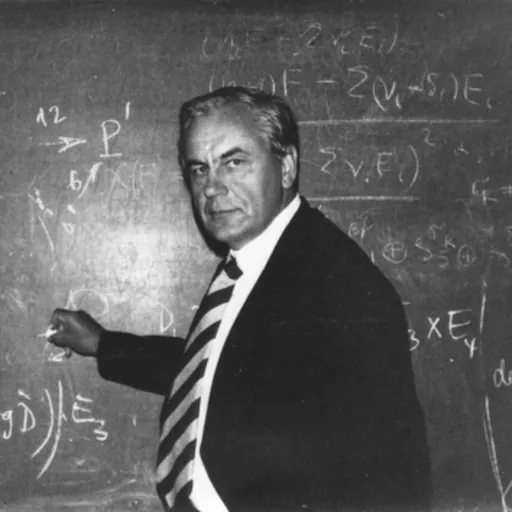
Igor Shafarevich
Soviet and Russian mathematician
About Igor Shafarevich
Lived 1923 – 2017 (aged 93). Igor Shafarevich was a Russian mathematician, human rights defender, university teacher and dissident, known for Golod–Shafarevich theorem, Grothendieck–Ogg–Shafarevich formula and Néron–Ogg–Shafarevich criterion.
Soviet politics Shafarevich came into conflict with the Soviet authorities in the early 1950s but was protected by Ivan Petrovsky, the Rector of Moscow University. He belonged to a group of Pochvennichestvo-influenced dissidents who endorsed the Eastern Orthodox tradition. Shafarevich published a book, The Socialist Phenomenon (French edition 1975, English edition 1980), which was cited by Aleksandr Solzhenitsyn in his 1978 address to Harvard University.
In the 1970s, Shafarevich, with Valery Chalidze, Grigori Podyapolski and Andrei Tverdokhlebov, became one of Andrei Sakharov's human rights investigators and so was dismissed from Moscow University. Shafarevich opposed political interference in universities.
The Socialist Phenomenon Shafarevich's book The Socialist Phenomenon, which was published in the US by Harper & Row in 1980, analyzed numerous examples of socialism from ancient times to various medieval heresies and a variety of modern thinkers and socialist states. From those examples, he claimed that all the basic principles of socialist ideology derive from the urge to suppress individualism. The Socialist Phenomenon consists of three major parts:
Chiliastic Socialism: Identifies socialist ideas amongst the ancient Greeks, especially Plato, in numerous medieval heretic groups such as the Cathars, Brethren of the Free Spirit, Taborites, Anabaptists, in various religious groups during the English Civil War, in modern writers such as Thomas More, Tommaso Campanella and numerous Enlightenment writers in 18th-century France. State Socialism: Describes the socialism of the Incas, the Jesuit state in Paraguay, Mesopotamia, Egypt and China. Analysis: Identifies three persistent abolition themes in socialism: the abolition of private property, the abolition of the family, and the abolition of religion (mainly but not exclusively Christianity).
Shafarevich argued that ancient socialism (such as Mesopotamia and Egypt) was not ideological, as an ideology socialism was a reaction to the emergence of individualism in the Axial Age. He compared Thomas More's (Utopia) and Tommaso Campanella's (City of the Sun) visions with what is known about the Inca Empire and concluded that there are striking similarities. He claimed that we become persons through our relationship with God and argued that socialism is essentially nihilistic and is unconsciously motivated by a death instinct. He concluded that we have the choice of pursuing death or life.
Religious views Shafarevich adhered to Russian Orthodox Christianity and incorporated the neo-Platonic views of Eastern Orthodoxy into his understanding of the relation of mathematics and religion.
In his talk to the Göttingen Academy of Sciences upon receiving a prize, Shafarevich presented his view of the relationship between mathematics and religion. He noted the multiple discoveries in mathematics, such as that of non-Euclidean geometry, to suggest that pure mathematics reflects an objective reality, not a set of conventional definitions or a formalism. He claimed that the growth of mathematics itself is not directed or organic. To have a unity and direction, mathematics needs a goal. It can be practical applications or God as the source for the direction of development. Shafarevich opted for the latter, as pure mathematics is not in itself driven by practical applications.
Russian politics
On 21 December 1991 he took part in the first congress of the Russian All-People's Union, headed by Sergei Baburin. In October 1992, he became a member of the founding committee of the National Salvation Front. In 1993, he was an unsuccessful candidate for the State Duma with Mikhail Astafyev's Constitutional Democratic Party - Party of Popular Freedom.
Shafarevich was a member of the editorial board of the magazine Nash Sovremennik and in 1991–1992 of the editorial board of Den of Alexander Prokhanov, which was banned in October 1993 following the 1993 Russian constitutional crisis and later reopened under the title Zavtra. In 1994, he joined the "All-Russian National Right Wing Centre", led by Mikhail Astafyev.
Accusations of antisemitism Shafarevich's essay Russophobia was expanded into his book Three Thousand-Year-Old Mystery (Трехтысячелетняя загадка) and resulted in accusations of antisemitism. He completed the Russophobia essay in 1982 and it was initially circulated as samizdat. In the Soviet Union, it was first officially published in 1989. At the same time, Shafarevich condemned the methods that were used to screen out applicants of Jewish origin when entering prestigious Moscow universities in the 1970s and early 1980s.
In Russophobia, he argued in the essay that great nations experience periods in their history of reformist elitist groups ('small nations') having values that differ fundamentally from the values of the majority of the people but gaining the upper hand in the society. In Shafarevich's opinion, the role of such a 'small nation' in Russia was played by a small group of intelligentsiya, dominated by Jews, "who were full of hatred against traditional Russian way of life and played an active role in the terrorist regimes of Vladimir Lenin and Joseph Stalin".
Its publication led to a request by the United States National Academy of Sciences (NAS) to Shafarevich to resign his membership, because the NAS charter prohibited stripping an existing membership. In an open letter to the NAS, Shafarevich explained that Russophobia is not antisemitic. Shafarevich also noted that since NAS enlisted him without his request or knowledge, delisting him was its internal matter. Nevertheless, when the United States invaded Iraq, Shafarevich faxed his resignation.
Accusations of antisemitism continued and involved Shafarevich's other publications. Semyon Reznik targets the Russophobia essay for factual inaccuracies: Shafarevich misassigned Jewish ethnicity to a number of non-Jews involved in the execution of Nicholas II, repeated the false assertion of graffiti in Yiddish at the murder site and suggested that Shafarevich's phrase "Nicholas II was shot specifically as the Tsar, and this ritual act drew a line under an epoch in Russian history" – is read by some as a blood libel. (An accusation which ignores the remainder of Shafarevich's sentence: "so it can only be compared with the execution of Charles I in England or of Louis XVI in France".) Aron Katsenelinboigen wrote that Shafarevish's work "lives up to the best traditions of antisemitic propaganda".
Later, Shafarevich expanded on his views in his book Three Thousand-Year-Old Mystery in which he further claimed that Jews effectively marginalise and exclude non-Jews in all types of intellectual endeavors. The work was published in Russian in 2002; an introductory section explains the relationship with the Russophobia essay, explaining that the essay developed from an appendix to an intended work of wider scope, which he started writing in samizdat.
In 2005, Shafarevich was amongst the signatories of the Letter of 5000.
The issue of Shafarevich's alleged antisemitism has been the subject of a 2009 doctoral thesis at the University of Helsinki, which was later turned into a book
Publications
Shafarevich, Igor (1975), "Socialism in Our Past and Future." In From under the Rubble, with Solzhenitsyn, Alexander; Agursky, Mikhail; Barabanov, Evgeny; Borisov, Vadim; Korsakov, F. Collins: Harvill Press [Regnery Pub. 1989].
Shafarevich, Igor (1981), "On Certain Tendencies in the Development of Mathematics", The Mathematical Intelligencer, Vol. 3, Number 4, pp. 182–184. Nikulin, V. V.; Shafarevich, Igor (1987), Geometries and Groups, Berlin; Springer-Verlag,
Kostrikin, A. I.; Shafarevich, Igor (1991), Noncommutative Rings, Identities, Berlin: Springer-Verlag, Parshin, A. N.; Shafarevich, Igor (1995), Number Theory: Fundamental Problems, Ideas, and Theories, Berlin: Springer, Arslanov, M. M.; Parshin, A. N.; Shafarevich, Igor (1996), Algebra and Analysis, Berlin: Walter de Gruyter, Shafarevich, Igor (2003), Discourses on Algebra, Berlin: Springer, Shafarevich, Igor (2005), Basic Notions of Algebra, Berlin: Springer, Shafarevich, Igor (2013), Basic Algebraic Geometry 1: Varieties in Projective Space (3rd edition), translated by Reid, Miles, Berlin, Springer-Verlag, Shafarevich, Igor (2013), Basic Algebraic Geometry 2: Schemes and Complex Manifolds (3rd edition), translated by Reid, Miles, Berlin, Springer-Verlag, Shafarevich, Igor; Remizov, Alexey (2013), Linear Algebra and Geometry, Berlin, Springer-Verlag, Shafarevich, Igor (2015), Collected mathematical papers, Reprint of the 1989 edition, Springer Collect. Works Math., Springer, Heidelberg, x+769 pp.
Don’t just read it —
keep it.
Full-length biographies made to live with: read them, listen on the way to work, watch them tonight.
- E-book
- Audio
- Video
Instant download · yours to keep · every purchase keeps this site free
Important facts
People in Igor Shafarevich's life
Named in this biography and alive at the same time


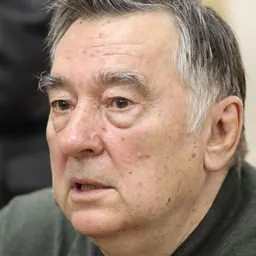

Related people
Same field, nearest in time
Contemporaries
People whose lives overlapped Igor Shafarevich's

Frequently asked questions
Who was Igor Shafarevich?
Soviet and Russian mathematician (1923-2017)
When was Igor Shafarevich born?
Igor Shafarevich was born on 3 June 1923 in Zhytomyr.
When did Igor Shafarevich die?
Igor Shafarevich died on 19 February 2017 in Moscow.
What was Igor Shafarevich's occupation?
Igor Shafarevich was a mathematician, human rights defender, university teacher and dissident.
What was Igor Shafarevich known for?
Igor Shafarevich was known for Golod–Shafarevich theorem, Grothendieck–Ogg–Shafarevich formula, Néron–Ogg–Shafarevich criterion, Shafarevich's theorem on solvable Galois groups and Shafarevich–Weil theorem.
What nationality was Igor Shafarevich?
Igor Shafarevich was Russian.
Sources & further reading
Cite this page
APA: Biography.guide. (2026). Igor Shafarevich. https://biography.guide/igor-shafarevich/
MLA: "Igor Shafarevich." Biography.guide, https://biography.guide/igor-shafarevich/.
Chicago: "Igor Shafarevich." Biography.guide. https://biography.guide/igor-shafarevich/.
Data last updated: 2026-09-20 · Spot an error? Report a correction.
Page generated 2026-09-27 05:09 UTC