
About Huo Yanwei
Lived 872 – 928 (aged 55–56). Huo Yanwei was a politician.
Huo Yanwei (872–928 ), known as Li Shaozhen from 924 to 926, courtesy name Zizhong , formally Duke Zhongwu of Jin , was a general of the Chinese Five Dynasties and Ten Kingdoms period Later Liang and Later Tang states.
Background Huo Yanwei was born in 872, during the reign of Emperor Yizong of Tang. He was from Quzhou (曲周, in modern Handan, Hebei), but his birth name is lost to history. When he was 13 (i.e., in 885), He became a soldier under Huo Cun, and Huo Cun, favoring him for his good disposition and good looks, adopted him as a son. During this early stage of Huo Yanwei's career — either while serving under his father Huo Cun or under Zhu Quanzhong — Huo Yanwei suffered an arrow wound in one of his eyes while in battle and became blind in that eye.
During Later Liang In 908, by which time Zhu Quanzhong had seized the Tang throne, ending Tang and starting Later Liang as its Emperor Taizu, Huo Yanwei was serving as a commander of the police for the eastern capital Kaifeng and a commander of the emperor's guards. That year, he was made one of the two commanders of the elite Longxiang Army . In 909, he was made one of the commanders of Tianwu Army , and then as a grand general of the guards.
In 913, another son of Emperor Taizu's, Zhu Youzhen the Prince of Jun, rose against Zhu Yougui along with Emperor Taizu's nephew Yuan Xiangxian, and Zhu Yougui committed suicide, allowing Zhu Youzhen (who changed his name to Zhu Zhen shortly after) to take the throne. (Huo's biographies in the History of the Five Dynasties and the New History of the Five Dynasties, however, attributed this to Huo's releasing Qi soldiers that he captured to gain Qi's goodwill.)
In 923 — shortly after Jin's prince Li Cunxu declared himself emperor of a new Later Tang (as Emperor Zhuangzong) — the new Later Liang commander of the army against Later Tang, Duan Ning, made a plan for a four-prong assault on Later Tang. As part of Duan's plan, Huo was supposed to head toward Zhen Prefecture (鎮州, in modern Shijiazhuang, Hebei). However, before Duan could actually launch the attack, Emperor Zhuangzong crossed the Yellow River, bypassing Duan's main army (which Duan had intended to command to confront him), and headed directly for Daliang (i.e., Kaifeng), which Zhu Zhen had made capital (after Emperor Taizu and Zhu Yougui had both had their capital at Luoyang), It was said that because of this opportunity to serve under Li Siyuan, and because Li Siyuan liked Huo's personality, they became friends.
Li Siyuan pondered his next step. He considered returning to Chengde Circuit (成德, headquartered at Zhen Prefecture), which he was the military governor of, and then submitting a report to Emperor Zhuangzong begging forgiveness for the defeat. Li Shaozhen and Li Siyuan's strategist An Chonghui advised against it — pointing out that another general, Li Shaorong, who had also retreated in light of Li Siyuan's army's mutiny, would then use this opportunity to accuse Li Siyuan of rebelling himself. Rather, they advised heading south toward Luoyang (which Emperor Zhuangzong had made capital) to see if he could explain the situation personally to Emperor Zhuangzong. Li Siyuan accepted their suggestion. Meanwhile, the eunuch monitor of the Wuning army at Wuning's capital Xu Prefecture , believing that Li Siyuan and Li Shaozhen had both rebelled, wanted to slaughter Li Shaozhen's family and close associates, but the acting military governor Chunyu Yan acted first, killing the eunuch monitor, to avoid this.
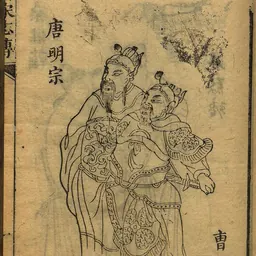
Meanwhile, while the situation was still calming down in Luoyang, Li Shaozhen was in charge of many of the key decisions. Despising Duan Ning (whose name Emperor Zhuangzong had changed to Li Shaoqin) and another former Later Liang general, Li Shaochong (李紹沖, né Wen Tao , he arrested Li Shaoqin and Li Shaochong, intending to put them to death. An, however, questioned him on it, pointing out that Li Shaoqin's and Li Shaochong's crimes occurred during Later Liang and that, in effect, Li Shaozhen was carrying out personal vendettas. Li Shaoqin and Li Shaochong were subsequently stripped of their imperially-bestowed names, but (at that point) allowed to live. Emperor Mingzong mourned him, posthumously created him the Duke of Jin, and gave him the posthumous name of Zhongwu ("faithful and martial"). Later, during the reign of Emperor Taizu of Song, when the Song emperor built a temple dedicated to Later Tang's Emperor Mingzong, Huo was one of the officials enshrined at Emperor Mingzong's temple.
Notes and references
History of the Five Dynasties, vol. 64. New History of the Five Dynasties, vol. 46. Zizhi Tongjian, vols. 268, 269, 271, 272, 273, 274, 275, 276.
Don’t just read it —
keep it.
Full-length biographies made to live with: read them, listen on the way to work, watch them tonight.
- E-book
- Audio
- Video
Instant download · yours to keep · every purchase keeps this site free
Important facts
People in Huo Yanwei's life
Named in this biography and alive at the same time





Related people
Same field, nearest in time


Contemporaries
People whose lives overlapped Huo Yanwei's


Frequently asked questions
Who was Huo Yanwei?
general
When was Huo Yanwei born?
Huo Yanwei was born in 872.
When did Huo Yanwei die?
Huo Yanwei died in 928.
What was Huo Yanwei's occupation?
Huo Yanwei was a politician.
Sources & further reading
Cite this page
APA: Biography.guide. (2026). Huo Yanwei. https://biography.guide/huo-yanwei/
MLA: "Huo Yanwei." Biography.guide, https://biography.guide/huo-yanwei/.
Chicago: "Huo Yanwei." Biography.guide. https://biography.guide/huo-yanwei/.
Data last updated: 2026-09-20 · Spot an error? Report a correction.
Page generated 2026-09-27 05:17 UTC