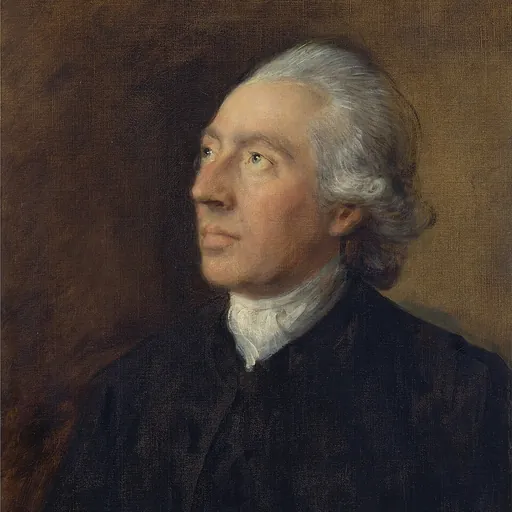
About Humphrey Gainsborough
Lived 1718 – 1776 (aged 57–58). Humphrey Gainsborough was a British civil engineer, cleric, engineer and parson.
Humphrey Gainsborough (1718 – 23 August 1776) was an English non-conformist minister, engineer, and inventor.
Humphrey Gainsborough was pastor to the Independent Church in Henley-on-Thames, England. He was the brother of the artist Thomas Gainsborough. He invented the drill plough (1766), winning a prize of £60 from the Royal Society for his efforts. He also invented the tide mill (1761), which allowed a mill wheel to rotate in either direction, winning a £50 prize from the Society for the Encouragement of Arts in London. In addition, he designed a self-ventilating fish wagon (1762).
Gainsborough designed Conway's Bridge, built in 1763 at Park Place close to Henley, an interesting rustic arched stone structure that still carries traffic on the road between Wargrave and Henley today. In 1768, he improved the slope on the road up the steep White Hill to the east of Henley, straightening it in the process.
James Watt perhaps included some of – and at least built on – Gainsborough's ideas on his steam engine. Watt had been working independently on improvements to the Newcomen "atmospheric engine" and subsequently patented these in 1769. Gainsborough is thus probably less well-known than he might have been.
The lock, weir and footbridge at Marsh Lock, just upstream from Henley on the River Thames, were designed by Gainsborough, together with other early locks from Sonning to Maidenhead (1772–73).
A blue plaque in Gainsborough's honour can be found in the town of Henley itself on the gates of the Manse, the house where he lived next to the Christ Church United Reformed Church. Inside he designed an early security chain and plate on one of the outside doors, allowing the door to be partially opened, that is still there now. Similar designs are used on many people's front doors today.
Epitaph Philip Thicknesse wrote in The Gentleman's Magazine in 1785:
Don’t just read it —
keep it.
Full-length biographies made to live with: read them, listen on the way to work, watch them tonight.
- E-book
- Audio
- Video
Instant download · yours to keep · every purchase keeps this site free
Important facts
People in Humphrey Gainsborough's life
Named in this biography and alive at the same time



Related people
Same field, nearest in time


Contemporaries
People whose lives overlapped Humphrey Gainsborough's



Frequently asked questions
Who was Humphrey Gainsborough?
British engineer and minister; (1718-1776)
When was Humphrey Gainsborough born?
Humphrey Gainsborough was born in 1718 in England.
When did Humphrey Gainsborough die?
Humphrey Gainsborough died on 23 August 1776 in England.
What was Humphrey Gainsborough's occupation?
Humphrey Gainsborough was a civil engineer, cleric, engineer and parson.
What nationality was Humphrey Gainsborough?
Humphrey Gainsborough was British.
Sources & further reading
· Wikipedia: Humphrey Gainsborough
· DBpedia: Humphrey Gainsborough
Cite this page
APA: Biography.guide. (2026). Humphrey Gainsborough. https://biography.guide/humphrey-gainsborough/
MLA: "Humphrey Gainsborough." Biography.guide, https://biography.guide/humphrey-gainsborough/.
Chicago: "Humphrey Gainsborough." Biography.guide. https://biography.guide/humphrey-gainsborough/.
Data last updated: 2026-09-21 · Spot an error? Report a correction.
Portrait: Wikimedia Commons · author & licence
Page generated 2026-09-27 04:59 UTC