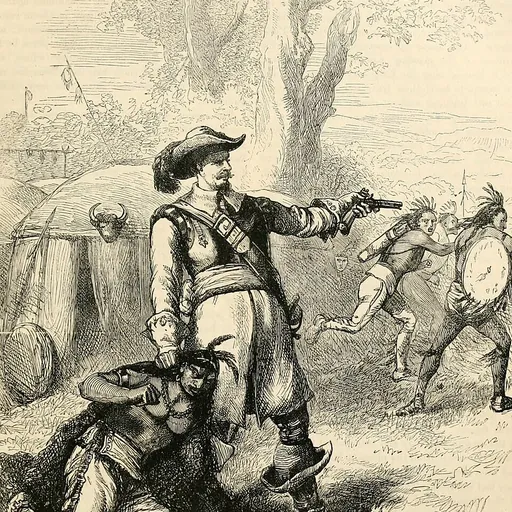
About Humphrey Atherton
Lived 1608 – 1661 (aged 52–53). Humphrey Atherton was an American military officer.
Major-General Humphrey Atherton (c. 1607 – September 16, 1661), an early settler of Dorchester, Massachusetts, held the highest military rank in colonial New England. He first appeared in the records of Dorchester on March 18, 1637 and made freeman May 2, 1638. in 1654, and remained as such until his death." He was a member of the Ancient and Honorable Artillery Company of Massachusetts and held the ranks of lieutenant and captain for several years before rising to the rank of major-general. He also organized the first militia in Massachusetts.
It is unclear where and when Atherton was born. It is presumed he came from Lancashire, England. He was active in the governance of the colony, taking part in the acquisition of Native American lands, and the apprehension and convictions of heretics. His accidental death was seen by the Quakers as a punishment from God for his persecution of them, an idea repeated in a play by Henry Wadsworth Longfellow. He was one of the most successful land speculators in the New England colonies. He and his wife, Mary, had a number of children and several New England families have traced their ancestry to them. He is interred at Dorchester North Burying Ground, one of the oldest cemeteries in New England.
Origin and emigration
Humphrey Atherton's date and place of birth are uncertain. It has been presumed by some that he was born in Lancashire, England, because the name Atherton is prominent there. On the other hand, Charles Samuel Hall in Hall Ancestry, pointed out that when Atherton was made freeman and was granted property in 1638, "he must at that time reached his majority." but there is no record of this. The identity of his wife is disputed. Some sources say Mary Kennion. or treasurer,
Atherton was a member of the Ancient and Honorable Artillery Company and he organized the first trained band (militia) in Dorchester. As Major-General in the Suffolk County Militia, he was the senior military officer in New England. Hibbins was later fictionalized in Nathaniel Hawthorne's The Scarlet Letter. In that book she was depicted as the sister of Governor Bellingham.
Atherton was involved in the persecution of Quakers The Quakers understood this comment to be an insulting boast.
The Quaker “Mary Dyer led to execution on Boston Common, June 1, 1660. Sketch by unknown 19th century artist
The Quaker “Mary Dyer being led to the gallows in Boston, June 1, 1660. Painted in 1905 by Howard Pyle (1853-1911)
There was the case of Wenlock Christison, a Quaker who had repeatedly returned to Massachusetts despite banishment, whose trial in May, 1661 put an end to the execution of Quakers. He was sentenced to death, but the law was changed soon after, and he was not executed. He was the last Quaker to be sentenced to death in Massachusetts. The Quakers believed that during an altercation between the accused and Atherton at the trial, Christison prophesied the outcome of his trial as well as the circumstances of Atherton's untimely death. Quaker writer George Bishop wrote, "Yea, Wenlock Christison, though they did not put him to death, yet they sentenced him to die, so that their cruel purposes were nevertheless. I cannot forbear to mention what he spoke, being so prophetical, not only as to the judgment of God coming on Major-general Adderton, but as to their putting any more Quakers to death after they had passed sentence on him." Henry Wadsworth Longfellow recreated the Christison trial in his play John Endicott which included the damnation of Atherton by the accused. The United Colonies obtained Narragansett lands within the boundaries of Rhode Island by putting in motion a series of events that began with their promise of aid to the Mohegan Sachem, Uncas, whom they had supported during the Pequot War, if he declared war against the Narragansett Sachem, Miantinomo. During the ensuing war, Miantinomo was captured and brought to the commissioners of the Four United Colonies at Hartford. "After obtaining him as a captive, they could find no excuse for putting him to death; and, to avoid the responsibility, they referred his case for decision to a convention of ministers in Boston; [sic] Winthrop states, 'Miantinomo was killed near Hartford by a blow on the back of his head with a hatchet.' " He held that position until his death. "Though a terror to warlike Indians, yet he was the trusted friend of all who were well disposed, helping on their education and Christianizing, and guarding their rights, so that he had immense personal influence with them, and was a successful treaty-maker".
Appointment as Major General In 1656, he was appointed Major-General, becoming the Chief Military Officer in New England, replacing Robert Sedgwick. He was the fifth holder of this rank. His predecessors were Thomas Dudley, John Endicott, Edward Gibbons and Robert Sedgwick.
Land speculation Humphrey Atherton was a successful land speculator. The land he owned in Dorchester included a large portion of South Boston. He also owned a share in what became Milton, Massachusetts. The General Court awarded to him for his public service, but because some of it impeded the town on Hadley, Massachusetts, he was given a new grant that had an additional . Since he had represented Springfield in the General Court, he probably owned land in Springfield as well. When he died, his estate was worth 900 pounds, not including much of his land.
Atherton "played a key role in fighting and removing Indians from land he later owned." In 1659, he and some friends, including Connecticut Governor, John Winthrop, Jr., made some purchases of land from Native Americans on the western side of Narragansett Bay for which Rhode Island had claimed. The group, referred to as the Atherton Trading Company, circumvented Rhode Island's law by acquiring the land when the Natives defaulted on a loan. He was traveling through Boston Common, on his way home after drilling his troops when his mount collided with a cow.
Longfellow repeated this sentiment in his account of Atherton's death in the final scene of John Endicott. In the scene Governor Endicott, while speaking to Richard Bellingham, asks if it is true that Humphrey Atherton is dead. Bellingham confirms that he is and adds, "His horse took fright, and threw him to the ground, so that his brains were dashed about the street." Endicott responds, "I am not superstitions, Bellingham, and yet I tremble lest it may have been a judgment on him."
Increase, also a mariner, died at sea, aged 31, on the Friezland, whilst in the service of the Guiney Company. Hope Atherton, was minister of Hadley, Massachusetts and married Sarah Hollister. Consider, married Ann Anable. Watching, married Elizabeth Rigbee.
They had six daughters, Elizabeth Catherine “Isabel” married Timothy Mather, followed by Nathaniel Wales Jr. and then William Weekes. Margaret married James Trowbridge. Mary married William Billings and then Joseph Weeks. Rest married Obadiah Swift. Thankful married Thomas Bird of Dorchester. Patience, married Isaac Humphrey. The History of the Dorchester Pope Family: 1634–1888, In the National Genealogical Society Quarterly, Volume 60, some of Humphrey Atherton's descendants are included in the Belcher Genealogy. In the same volume, Samuel Atherton's ancestry was traced to Humphrey Atherton. William B. Task claimed descent from Atherton in the 1899 New England Historical Genealogical Register.
Atherton continued to be revered by his community after his death. Thirty years later and Thomas Maule was arrested on charges of slanderous publication about the manner of his untimely death, and was imprisoned for twelve months and his pamphlets were ordered to be burnt.
Joshua Atherton journaled the Atherton family origins in the 18th century.
Don’t just read it —
keep it.
Full-length biographies made to live with: read them, listen on the way to work, watch them tonight.
- E-book
- Audio
- Video
Instant download · yours to keep · every purchase keeps this site free
Important facts
People in Humphrey Atherton's life
Named in this biography and alive at the same time

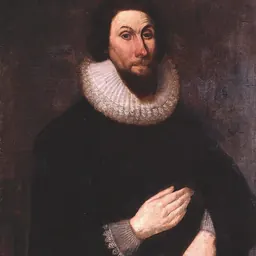



Related people
Same field, nearest in time
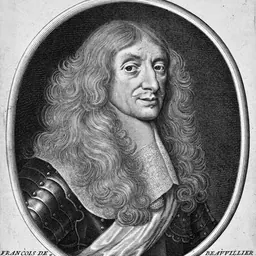
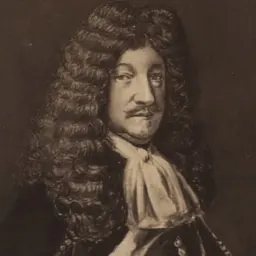


Contemporaries
People whose lives overlapped Humphrey Atherton's




Frequently asked questions
Who was Humphrey Atherton?
Military leader in Colonial America
When was Humphrey Atherton born?
Humphrey Atherton was born in 1608 in Lancashire.
When did Humphrey Atherton die?
Humphrey Atherton died on 16 September 1661 in Boston.
What was Humphrey Atherton's occupation?
Humphrey Atherton was a military officer.
What nationality was Humphrey Atherton?
Humphrey Atherton was American.
Sources & further reading
· Wikipedia: Humphrey Atherton
Cite this page
APA: Biography.guide. (2026). Humphrey Atherton. https://biography.guide/humphrey-atherton/
MLA: "Humphrey Atherton." Biography.guide, https://biography.guide/humphrey-atherton/.
Chicago: "Humphrey Atherton." Biography.guide. https://biography.guide/humphrey-atherton/.
Data last updated: 2026-09-22 · Spot an error? Report a correction.
Portrait: Wikimedia Commons · author & licence
Page generated 2026-09-27 05:02 UTC