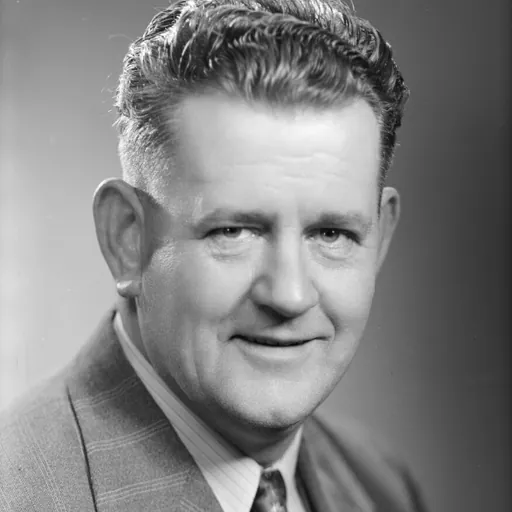
About Hugh Watt
Lived 1912 – 1980 (aged 67). Hugh Watt was a New Zealand politician and diplomat.
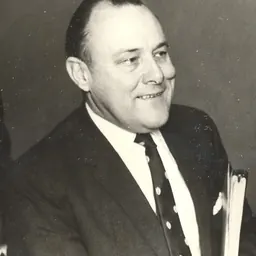
Hugh Watt (19 March 1912 – 4 February 1980) was a New Zealand politician who was a Labour member of Parliament and the acting prime minister of New Zealand between 31 August and 6 September 1974, following the death of Prime Minister Norman Kirk. He had been the fifth deputy prime minister of New Zealand since 8 December 1972. Watt later served as high commissioner to the United Kingdom.
Biography Early life Watt was born in Perth, Western Australia, in 1912. His father, William Watt, was a mining engineer, and his family emigrated to New Zealand in 1914, when he was two years old, settling in Auckland. His father lost an arm in Australia and moved back to New Zealand to take up a position as a watchman at the Auckland Harbour Board. Watt attended Remuera Primary School, where his headmaster was Sir Leslie Munro's father.
Watt attended Seddon Memorial Technical College, where he studied engineering and also played senior grade rugby for the Tech Old Boys' club. He became an apprentice engineer and joined the Engineers' Union, of which he was a member for 16 years. He enjoyed his union membership but never aspired to hold any office within it. He established his own engineering business in 1947. He was director of the business, Hugh Watt & Coy Ltd, which operated in both engineering operations and sheet metal working. He continued to run the business (even while a minister) until 1969, when he accepted a doctor's advice to lessen his workload.
Watt was married twice: first to Alice Merry Fowke from 1935 to 1965, when they divorced; and then to Irene Frances Ray from 1968. He had two sons and two daughters with his first wife. Watt was Australian-born, like Labour Party founders such as Harry Holland, Michael Joseph Savage, Bob Semple, and Paddy Webb, and later MPs such as Mabel Howard and Jerry Skinner. He was born on the same street where Australian Prime Minister John Curtin, of whom Watt was a great admirer, once lived. He was then successful in winning the parliamentary seat of in a after the death of Arthur Osborne, and held it until 1975.
Second Labour Government
Watt was first appointed as a minister in the Second Labour Government led by Walter Nash; he was Minister of Works from 1957 to 1960, and additionally, Minister of Electricity from 1958 until 1960. He resigned from the Auckland Harbour Board in December 1957 after his appointment to the cabinet. As Minister of Works, he quickly became known for both his vitality and his genial style of inspecting infrastructure sites. During the Second Labour Government, he oversaw one of the most constructive and positive periods of public development New Zealand had seen. He started construction on the Benmore Dam and ensured that when it was completed it was £12 million under the original estimates.
When Labour was in opposition, several previous ministers had either died or retired and Watt soon found himself as one of the party's most experienced MPs. He stood for the position of Deputy Leader in 1962 following the death of Jerry Skinner but was defeated by Fred Hackett. Following Hackett's own death in 1963 he stood again and was this time elected, narrowly ahead of Norman Kirk. At 11 years, 4 months and 12 days Watt is Labour's longest-serving deputy leader, first under Arnold Nordmeyer and then under Kirk. He was the Shadow Minister of Works and Electricity while Labour was in opposition.
During this period Watt suffered several health scares. In 1962 he had an operation in Auckland Hospital for an undisclosed illness. Later, in 1967 he had his appendix removed and in 1969 he suffered a heart attack. Later that same year he was admitted to hospital yet again with both influenza and inflammation round the heart. Although Watt was initially seen as the front-runner, the Minister of Finance and former party president Bill Rowling soon appeared to have more momentum than Watt. The party's National Executive and the Federation of Labour preferred Watt to Rowling and made their support known. Ultimately, on 6 September, Rowling was elected by the caucus to replace Kirk as Labour Party Leader and Prime Minister at the leadership election. After losing the leadership ballot Watt decided to retire as deputy leader. Though disappointed, Watt took the defeat graciously and fought back tears informing reporters he had been defeated, later admitting that losing the leadership vote was "the greatest, most tragic disappointment of my life, it knocked me tremendously". In June 1975, Watt was asked if he was about to resign as an MP. He stated that:
Upon arriving in London he encountered low staff morale due to a recent workplace restructuring. Watt made it a priority to boost confidence with employees by going out of his way to engage with people in person, gather groups to make decisions collectively and by attending all the staff training sessions himself. He was also shocked at how high a workload the post of high commissioner had, finding himself doing almost the same amount of work as he was when he was a minister. He also worked to advocate for New Zealand's trade interests in Britain, which were severely impacted by Britain's joining the European Communities (EC). During the British referendum (held to gauge support for continued EC membership) Watt was invited to speak at about 100 different gatherings during this period. When discussing the topic with Londoners he found there was still much demand for New Zealand products particularly lamb and butter.
Following the election of the Third National Government Watt was pressured to resign by new Prime Minister Robert Muldoon, it was widely speculated that his recall was purely for political reasons. His most important diplomatic task while in London was relaying to Wellington the seriousness of New Zealand's 1976 rugby tour of South Africa and its potential impact on New Zealand's participation in the upcoming Olympic Games in Montreal. His confidential cables cautioned that the All Black tour was perceived abroad as giving tacit support to the apartheid regime in South Africa.
He served only fifteen months of his three-year contract and as part of a well publicised deal he relinquished the role of High Commissioner in exchange for the role of Commissioner of the Accident Compensation Corporation (ACC) in Wellington. He was replaced by Douglas Carter (a recently retired National MP) which served to strengthen the public perception that his removal was politically motivated. Upon his return to New Zealand over 300 people attended a function supporting Watt after his treatment by the new government. His health began to decline rapidly soon after his retirement and he was admitted to Auckland's Green Lane Hospital in October 1979 for surgery to drain a fluid buildup around his lungs. In December 1979 he was made a life member of the Labour Party with party president Jim Anderton visiting Watt in hospital to bestow him with the award.
Watt died on 4 February 1980 in Green Lane Hospital after a long illness, aged 67 years. He was survived by his wife, ex-wife and four children.
Honours and commemorations Hugh Watt Drive, a road running along the Onehunga waterfront in Auckland, was named to commemorate Watt. The Labour Party purchased a property on Grey Street in Onehunga which became the headquarters of the local Labour Party and named Hugh Watt Hall in his honour. The hall was managed by the Onehunga Labour Society which was later renamed the Hugh Watt Society also in his honour.
Don’t just read it —
keep it.
Full-length biographies made to live with: read them, listen on the way to work, watch them tonight.
- E-book
- Audio
- Video
Instant download · yours to keep · every purchase keeps this site free
Important facts
People in Hugh Watt's life
Named in this biography and alive at the same time



Related people
Same field, nearest in time





Contemporaries
People whose lives overlapped Hugh Watt's





Frequently asked questions
Who was Hugh Watt?
New Zealand politician (1912–1980)
When was Hugh Watt born?
Hugh Watt was born on 19 March 1912 in Perth.
When did Hugh Watt die?
Hugh Watt died on 4 February 1980 in Auckland.
What was Hugh Watt's occupation?
Hugh Watt was a politician and diplomat.
What nationality was Hugh Watt?
Hugh Watt was New Zealand.
Sources & further reading
Cite this page
APA: Biography.guide. (2026). Hugh Watt. https://biography.guide/hugh-watt/
MLA: "Hugh Watt." Biography.guide, https://biography.guide/hugh-watt/.
Chicago: "Hugh Watt." Biography.guide. https://biography.guide/hugh-watt/.
Data last updated: 2026-09-22 · Spot an error? Report a correction.
Portrait: Wikimedia Commons · author & licence
Page generated 2026-09-27 05:02 UTC