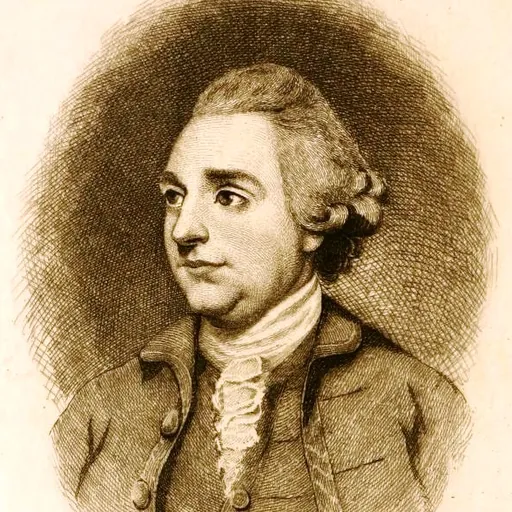
About Hugh Waddell
Lived 1734 – 1773 (aged 38–39). Hugh Waddell was a politician.
General Hugh Waddell ( – 9 April 1773) was an Irish-born military officer, merchant, planter and politician who served in the French and Indian War. Waddell commanded provincial troops in Rowan County, North Carolina and the Ohio River Valley during the French and Indian War and Anglo-Cherokee War, along with supervising the construction of Fort Dobbs near the settlement of the Fourth Creek Congregation. His career was well-served by close connections to several provincial governors of North Carolina.
Early life Waddell was born in Lisburn, County Down, Ireland, to Hugh and Isabella Brown Waddell who were of Ulster Protestant origin, although the exact date of his birth is unknown. As a family friend to the aristocrat Arthur Dobbs of County Antrim, who had just been appointed as Governor of North Carolina, Waddell was sent to the colonies in 1753 or 1754, and enlisted in the service of the acting governor, Matthew Rowan, as a lieutenant.
French and Indian War alt=A map of the northwest branch of the Cape Fear river depicting the location of the home of "Col. Waddell" In 1754, Waddell was sent to Virginia under the command of Colonel James Innes, who was commander-in-chief of all colonial forces then in Virginia under the authority of the governor of that state, Robert Dinwiddie. After being promoted to captain, Waddell returned to North Carolina in late 1754. In the summer of 1755, he was given command of a company of 50 Provincial Soldiers sent to the frontier to defend the colony from attacks by French-allied Native Americans. He and his men began constructing Fort Dobbs in about December of 1755, near what is now Statesville, North Carolina. In February, 1756, Waddell joined two Virginia delegates and a Mohawk Indian to serve as a "Commissioner of Peace" to the Cherokee and Catawba tribes. Waddell was the sole representative of North Carolina in these negotiations, which secured the temporary cooperation of those tribes against the French and their native allies.
In 1758, Waddell promoted to major and sent to Pennsylvania with 300 men to assist with Brigadier-general John Forbes' campaign against Fort Duquesne. Waddell's men arrived without uniforms or weapons. They were initially used for road construction, but by August, his men began to be trained by Cherokee and Catawba allies. Eventually, part of Waddell's corps were dressing like their Native allies, and active in scouting the French positions. Sgt John Rogers was credited with capturing the only French-allied Native warrior taken in the whole campaign.
On 12 November 1758, Forbes ordered Colonel George Washington to command a force of Virginian and Carolinian troops to assault Fort Duquesne. Over the course of four days, Waddell and his troops fought off advanced groups of native French-allied warriors. By 24 November 1758, Waddell and his scouting force arrived to find that Fort Duquesne had been destroyed by the fleeing French soldiers, who had decided to abandon the fort in the face of the Forbes Expedition's methodical attack. After the conclusion of the Forbes Expedition, returned to North Carolina and was rewarded with a Colonel's Commission. Despite his prior allegiances to Governors Dobbs and Tryon, Waddell was passed over for an appointment to North Carolina's Governor's Council, the primary advisory body to the colonial Governor. During this time, Waddell assisted in the establishment of a Sons of Liberty organization based around the Wilmington area, and participated in protests against the Stamp Act of 1765. Waddell died after a prolonged battle with an illness on 9 April 1773, in Castle Hayne, North Carolina where he is buried.
General Waddell was an ancestor of James Iredell Waddell, a Confederate captain during the Civil War, as well as Alfred Moore Waddell, a United States Congressman from North Carolina who wrote and published a biography of Waddell in 1890. In his biography, Alfred Waddell noted that Waddell had served longer in the military service of the crown than any other officer of the province, and as such was its most prominent soldier.
Notes and references
Don’t just read it —
keep it.
Full-length biographies made to live with: read them, listen on the way to work, watch them tonight.
- E-book
- Audio
- Video
Instant download · yours to keep · every purchase keeps this site free
Important facts
People in Hugh Waddell's life
Named in this biography and alive at the same time

Related people
Same field, nearest in time



Contemporaries
People whose lives overlapped Hugh Waddell's






Frequently asked questions
Who was Hugh Waddell?
American militia general
When was Hugh Waddell born?
Hugh Waddell was born in 1734 in Lisburn.
When did Hugh Waddell die?
Hugh Waddell died on 9 April 1773 in Castle Hayne.
What was Hugh Waddell's occupation?
Hugh Waddell was a politician.
Sources & further reading
· DBpedia: Hugh Waddell (general)
Cite this page
APA: Biography.guide. (2026). Hugh Waddell. https://biography.guide/hugh-waddell-politician/
MLA: "Hugh Waddell." Biography.guide, https://biography.guide/hugh-waddell-politician/.
Chicago: "Hugh Waddell." Biography.guide. https://biography.guide/hugh-waddell-politician/.
Data last updated: 2026-09-20 · Spot an error? Report a correction.
Page generated 2026-09-27 05:10 UTC