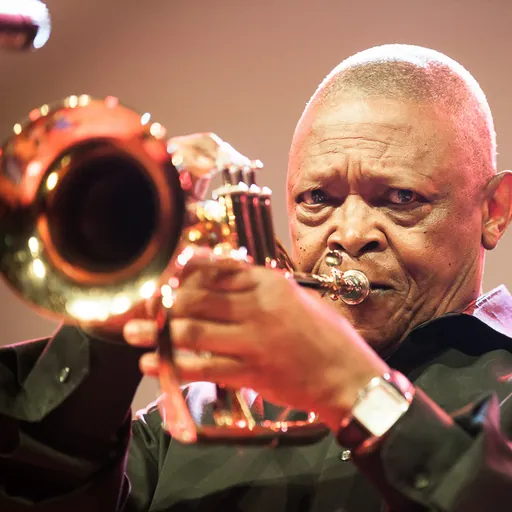
About Hugh Masekela
Lived 1939 – 2018 (aged 78). Hugh Masekela was a South African trumpeter, composer, jazz musician, recording artist and political activist.
Hugh Ramapolo Masekela (4 April 1939 – 23 January 2018) was a South African trumpeter, flugelhornist, cornetist, singer and composer who was described as "the father of South African jazz". Masekela was known for his jazz compositions and for writing well-known anti-apartheid songs such as "Soweto Blues" and "Bring Him Back Home". He also had a number-one US pop hit in 1968 with the song "Grazing in the Grass", which was later covered by various other artists.
Early life Hugh Ramapolo Masekela was born in Witbank (now called Emalahleni), South Africa, to Thomas Selema Masekela, who was a health inspector and sculptor; and his wife, Pauline Bowers Masekela, a social worker. His younger sister Barbara Masekela is a poet, educator and ANC activist. As a child, he began singing and playing piano and was largely raised by his grandmother, who ran an illegal bar for miners. the anti-apartheid chaplain at St. Peter's Secondary School now known as St. Martin's School (Rosettenville).
Huddleston asked the leader of the then Johannesburg "Native" Municipal Brass Band, Uncle Sauda, to teach Masekela the rudiments of trumpet playing. Masekela quickly mastered the instrument. Soon, some of his schoolmates also became interested in playing instruments, leading to the formation of the Huddleston Jazz Band, South Africa's first youth orchestra.
From 1954, Masekela played music that closely reflected his life experience. The agony, conflict, and exploitation faced by South Africa during the 1950s and 1960s inspired and influenced him to make music and also spread political change. In his music he portrayed the struggles and sorrows, as well as the joys and passions of his country. His music protested about apartheid, slavery, government; the hardships individuals were living. Masekela reached a large population that also felt oppressed due to the country's situation.
Following a Manhattan Brothers tour of South Africa in 1958, Masekela joined the orchestra of the musical King Kong, written by Todd Matshikiza. King Kong was South Africa's first blockbuster theatrical success, touring the country for a sold-out year with Miriam Makeba and the Manhattan Brothers' Nathan Mdledle in the lead. The musical later went to London's West End for two years.
Career
At the end of 1959, Dollar Brand (later known as Abdullah Ibrahim), Kippie Moeketsi, Makhaya Ntshoko, Jonas Gwangwa, Johnny Gertze and Hugh formed the Jazz Epistles, the first African jazz group to record an LP. They performed to record-breaking audiences in Johannesburg and Cape Town from late 1959 to early 1960.
Following the 21 March 1960 Sharpeville massacre, during which 69 protesters were shot dead in Sharpeville, and the South African government banned gatherings of ten or more people, and the increased brutality of the Apartheid state, Masekela left the country. He was helped by Huddleston and international friends such as Yehudi Menuhin and John Dankworth, who got him admitted into London's Guildhall School of Music in 1960. During that period, Masekela visited the United States, where he was befriended by Harry Belafonte. After securing a scholarship in London, In 1964, Makeba and Masekela were married, divorcing two years later. He also appeared at the Monterey Pop Festival in 1967, and was featured in the film Monterey Pop by D. A. Pennebaker and mentioned in the song Monterey by Eric Burdon & the Animals. In 1974, Masekela and Stewart Levine organised the Zaire 74 music festival in Kinshasa set around the Rumble in the Jungle boxing match.
He played primarily in jazz ensembles, with guest appearances on recordings by the Byrds ("So You Want to Be a Rock 'n' Roll Star" and "Lady Friend") (the latter being denied by David Crosby) and Paul Simon ("Further to Fly"). In 1984, Masekela released the album Techno Bush; from that album, a single entitled "Don't Go Lose It Baby" peaked at number two for two weeks on the dance charts. In 1987, he had a hit single with "Bring Him Back Home". The song became enormously popular, and turned into an unofficial anthem of the anti-apartheid movement and an anthem for the movement to free Nelson Mandela.
A renewed interest in his African roots led Masekela to collaborate with West and Central African musicians, and then to reconnect with Southern African players when he set up with the help of Jive Records a mobile studio in Botswana, just over the South African border, from 1980 to 1984. Here he re-absorbed and re-used mbaqanga strains, a style he continued to use following his return to South Africa in the early 1990s.
In 1985, Masekela founded the Botswana International School of Music (BISM), which held its first workshop in Gaborone that year. The event continues as the annual Botswana Music Camp, giving local musicians of all ages and from all backgrounds the opportunity to play and perform together. Masekela taught the jazz course at the first workshop, and performed at the final concert.
Also in the 1980s, Masekela toured with Paul Simon in support of Simon's album Graceland, which featured other South African artists such as Ladysmith Black Mambazo, Miriam Makeba, Ray Phiri, and other elements of the band Kalahari, which was co-founded by guitarist Banjo Mosele and which backed Masekela in the 1980s. As well as recording with Kalahari, he also collaborated in the musical development for the Broadway play Sarafina!, which premiered in 1988.
In 2003, he was featured in the documentary film Amandla!: A Revolution in Four-Part Harmony. In 2004, he released his autobiography, Still Grazing: The Musical Journey of Hugh Masekela, co-authored with journalist D. Michael Cheers, which detailed Masekela's struggles against apartheid in his homeland, as well as his personal struggles with alcoholism from the late 1970s to the 1990s. In this period, he migrated, in his personal recording career, to mbaqanga, jazz/funk, and the blending of South African sounds, through two albums he recorded with Herb Alpert, and solo recordings, Techno-Bush (recorded in his studio in Botswana), Tomorrow (featuring the anthem "Bring Him Back Home"), Uptownship (a lush-sounding ode to American R&B), Beatin' Aroun de Bush, Sixty, Time, and Revival. His song "Soweto Blues", sung by his former wife, Miriam Makeba, is a blues/jazz piece that mourns the carnage of the Soweto riots in 1976. He also provided interpretations of songs by Jorge Ben, Antônio Carlos Jobim, Caiphus Semenya, Jonas Gwangwa, Dorothy Masuka, and Fela Kuti.
In 2006 Masekela was described by Michael A. Gomez, professor of history and Middle Eastern and Islamic studies at New York University as "the father of African jazz."
In 2009, Masekela released the album Phola (meaning "to get well, to heal"), his second recording for 4 Quarters Entertainment/Times Square Records. It includes some songs he wrote in the 1980s but never completed, as well as a reinterpretation of "The Joke of Life (Brinca de Vivre)", which he recorded in the mid-1980s. From October 2007, he was a board member of the Woyome Foundation for Africa.
In 2010, Masekela was featured, with his son Selema Masekela, in a series of videos on ESPN. The series, called Umlando – Through My Father's Eyes, was aired in 10 parts during ESPN's coverage of the FIFA World Cup in South Africa. The series focused on Hugh's and Selema's travels through South Africa. Hugh brought his son to the places he grew up. It was Selema's first trip to his father's homeland.
On 3 December 2013, Masekela guested with the Dave Matthews Band in Johannesburg. He joined Rashawn Ross on trumpet for "Proudest Monkey" and "Grazing in the Grass".
In 2016, at Emperors Palace, Johannesburg, Masekela and Abdullah Ibrahim performed together for the first time in 60 years, reuniting the Jazz Epistles in commemoration of the 40th anniversary of the historic 16 June 1976 youth demonstrations.
Social initiatives Masekela was involved in several social initiatives, and served as a director on the board of the Lunchbox Fund, a non-profit organization that provides a daily meal to students of township schools in Soweto.
Personal life and death From 1964 to 1966 Masekela was married to singer and activist Miriam Makeba. He had subsequent marriages to Chris Calloway (daughter of Cab Calloway), Jabu Mbatha, and Elinam Cofie. He was the father of American television host Selema Masekela.
Masekela died in Johannesburg on the early morning of 23 January 2018 from prostate cancer, aged 78.
Awards and honours Masekela was honoured with a Google Doodle on 4 April 2019, which would have been his 80th birthday. The Doodle depicts Masekela, dressed in colourful shirt, playing a flugelhorn in front of a banner.
In 2026, a new nightclub called "Hugh's" dedicated to Masekela's memory opened in Johannesburg, set up in collaboration with the Hugh Masekela Heritage Foundation.
Grammy history Masekela was nominated for a Grammy Award three times, including a nomination for Best World Music Album for his 2012 album Jabulani, one for Best Musical Cast Show Album for Sarafina! The Music Of Liberation (1989) and one for Best Contemporary Pop Performance for the song "Grazing in the Grass" (1968).
+ Hugh Masekela Grammy Awards history Year Category Title Genre Label Result 1968 Best Contemporary Pop Performance – Instrumental Grazing in the Grass Pop Uni 1989 Best Musical Cast Show Album Sarafina! The Music Of Liberation Musical Sonet 2012 Best World Music Album Jabulani World Music Listen 2
Honours 1998: Nominated for Broadway's Tony Award for Best Score (Musical), with music and lyrics collaborator Mbongeni Ngema, for Sarafina! 2002: BBC Radio Jazz Awards: International Award of the Year 2003: Order for Meritorious Service in silver 2005: Channel O Music Video Awards: Lifetime Achievement Award 2007: Ghana Music Awards:African Music Legend award 2010: Order of Ikhamanga in gold: South African National Orders Ceremony, 27 April 2010 2015: Rhodes University: Doctor of Music (honoris causa) 2016: MTV Africa Music Awards (MAMAs): Legend Award
Discography Albums
Chart singles
"| "Puffin' On Down the Track" 71 - 43 1969 "Riot" 55 21 55 1978 "Skokiaan"with Herb Alpert - 87 - 1984 "Don't Go Lose It Baby" - 67 -
Autobiography With D. Michael Cheers (2004). Still Grazing: The Musical Journey of Hugh Masekela, Crown,
Don’t just read it —
keep it.
Full-length biographies made to live with: read them, listen on the way to work, watch them tonight.
- E-book
- Audio
- Video
Instant download · yours to keep · every purchase keeps this site free
Important facts
Family & relationships
People in Hugh Masekela's life
Named in this biography and alive at the same time



Related people
Same field, nearest in time

Contemporaries
People whose lives overlapped Hugh Masekela's



Frequently asked questions
Who was Hugh Masekela?
South African jazz trumpeter
When was Hugh Masekela born?
Hugh Masekela was born on 4 April 1939 in Witbank.
When did Hugh Masekela die?
Hugh Masekela died on 23 January 2018 in Johannesburg.
What was Hugh Masekela's occupation?
Hugh Masekela was a trumpeter, composer, jazz musician, recording artist and political activist.
What nationality was Hugh Masekela?
Hugh Masekela was South African.
Sources & further reading
Cite this page
APA: Biography.guide. (2026). Hugh Masekela. https://biography.guide/hugh-masekela/
MLA: "Hugh Masekela." Biography.guide, https://biography.guide/hugh-masekela/.
Chicago: "Hugh Masekela." Biography.guide. https://biography.guide/hugh-masekela/.
Data last updated: 2026-09-22 · Spot an error? Report a correction.
Portrait: Wikimedia Commons · author & licence
Page generated 2026-09-27 04:58 UTC