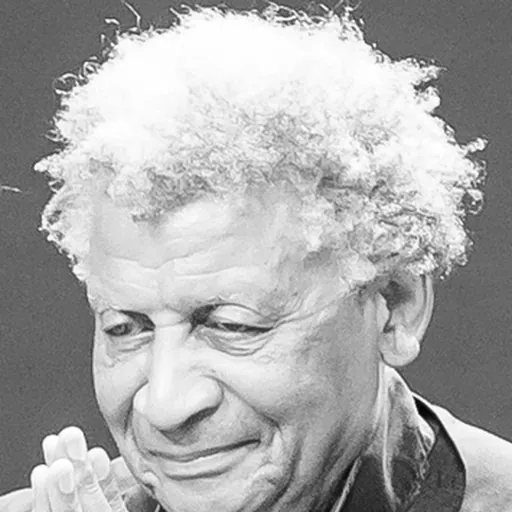
About Abdullah Ibrahim
Lived 1934 – 2026 (aged 91). Abdullah Ibrahim was a South African jazz musician, composer, pianist, saxophonist, recording artist and musician.
Abdullah Ibrahim (born Adolph Johannes Brand; 9 October 1934 – 15 June 2026), previously known as Dollar Brand, was a South African pianist and composer. His music reflects many of the musical influences of his childhood in the multicultural port areas of Cape Town, ranging from traditional African songs to the gospel of the AME Church and Ragas, to more modern jazz and other Western styles. Ibrahim is considered the leading figure in the subgenre of Cape jazz. Within jazz, his music particularly reflects the influence of Thelonious Monk and Duke Ellington. He is known especially for "Mannenberg", a jazz piece that became an anti-apartheid anthem.
During the apartheid era in the 1960s, Ibrahim moved to New York City and, apart from a brief return to South Africa in the 1970s, remained in exile until the early 1990s. Over the decades, he toured the world extensively, appearing at major venues either as a solo artist or playing with other renowned musicians, including Max Roach, Carlos Ward, and Randy Weston, as well as collaborating with classical orchestras in Europe. and was baptized Adolph Johannes Brand. He attended Trafalgar High School in Cape Town's District Six, and began piano lessons at the age of seven, making his professional debut at 15. He was of mixed-race heritage, making him a Coloured person according to the apartheid system. His mother played piano in a church, the musical style of which would remain an influence on him; in addition, he learned to play several genres of music during his youth in Cape Town, including marabi, mbaqanga, and American jazz. He became well known in jazz circles in Cape Town and Johannesburg. bassist Johnny Gertze and drummer Makaya Ntshoko; in January 1960, the six musicians went into the Gallo studio and recorded the first full-length jazz LP by Black South African musicians, Jazz Epistle Verse One, with 500 copies being produced. Although the group avoided explicitly political activity, the apartheid government was suspicious of it and other jazz groups, and targeted them heavily during the increase in state repression following the Sharpeville massacre in March 1960, and eventually, the Jazz Epistles broke up.
Ibrahim and Benjamin married and moved to New York in 1965 In 1967, a Rockefeller Foundation grant enabled Ibrahim to study at the Juilliard School of Music in New York. The track was recorded in one take during a period of collective improvisation. The piece was inspired by the Cape Flats township where many of those forcibly removed from District Six were sent.
The recordings made with Jansen and Coetzee, including "Mannenberg" (renamed "Capetown Fringe" for its United States release), "Black Lightning"; "African Herbs"; and "Soweto Is Where It Is At" – sounds that mirrored and spoke of the defiance in the streets and townships of South Africa – gave impetus to the genre of music known as "Cape Jazz." Saxophonist and flautist Carlos Ward was Ibrahim's sideman in duets during the early 1980s. A few years after the release of "Mannenberg" (released on Brand's 1974 album Mannenberg ~ 'Is Where It's Happening), South African police fired upon protesting children during the Soweto Uprising that began on 16 June 1976; this event led Ibrahim and Benjamin to publicly express support for the African National Congress, which was still banned at the time, and to help organize an illegal benefit concert.
Soon afterwards returning to the United States and settling in New York, Ibrahim and Sathima founded the record company Ekapa (meaning "Cape Town" in Xhosa) in 1981.
Starting in 1983, Ibrahim led a group called Ekaya (which translates as "home"), as well as various trios, occasional big bands, and other special projects. Ibrahim returned to South Africa after Nelson Mandela convinced him to return in a 1990 meeting in Germany.
On 25 November 1989, he made an extended appearance in the British Channel 4 television discussion series After Dark alongside Zoë Wicomb, Donald Woods, Shula Marks, and others. Ibrahim also took part in the 2002 documentary Amandla!: A Revolution in Four-Part Harmony, where he and others recalled the days of apartheid; the film's subtitle derives from observations made by Ibrahim.
Ibrahim is the subject of the documentaries A Brother with Perfect Timing (1987) and A Struggle for Love (2005, directed by Ciro Cappellari).
Post-apartheid Ibrahim worked as a solo performer, typically in unbroken concerts which echoed the unstoppable impetus of the old marabi performers, classical impressionists and snatches of his musical idols – Duke Ellington, Thelonious Monk and Fats Waller. Ibrahim also performed frequently with trios and quartets and larger orchestral units. Returning to South Africa in the early 1990s, he was feted with symphony orchestra performances, one of which was in honour of Nelson Mandela's 1994 inauguration as president.
In 1997, Ibrahim collaborated on a tour with drummer Max Roach, and the following year undertook a world tour with the Munich Radio Philharmonic Orchestra.
In 1999, Ibrahim founded the M7 academy for South African musicians in Cape Town
Ibrahim continued to perform internationally, mainly in Europe, and with occasional shows in North America. Reviewing his 2008 concert at London's Barbican Centre – a "monumental" show with the BBC Big Band, featuring vocalists Ian Shaw and Cleveland Watkiss – John Fordham of The Guardian referred to "[Ibrahim's] elder-statesman status as the African Duke Ellington and Thelonious Monk combined (and his role as an educator and political campaigner)". He released the solo piano album Senzo, named after his father, in 2008. In 2019, with his group Ekaya, he released The Balance,
Reviewing Ibrahim's July 2023 appearance with bassist Noah Jackson and flautist Cleave Guyton at the Barbican Centre in London, Kevin Le Gendre wrote: "Ibrahim's enduring love of the founding fathers of modern jazz is made clear from the outset as the trio starts with rhapsodic versions of two timeless anthems, Ellington's "In A Sentimental Mood" and Coltrane's "Giant Steps", while later on we are treated to a spirited take (on) Monk's 'Skippy'. But in the interim it is Ibrahim's originals that take pride of place, showing how, since the '60s, he has been creating standards of his own that vividly capture the poised dignity of African culture and customs."
His final album, 3, was released in 2024.
In 2009, for his solo piano album Senzo he received the "Best Male Artist" award at the 15th Annual MTN South African Music Awards.
In 2009, the University of the Witwatersrand, Johannesburg, conferred on Ibrahim an Honorary Doctorate of Music. Also in 2009, he was awarded South Africa's national honour the Order of Ikhamanga (Silver), "For his excellent contribution to the arts, putting South Africa on the international map and his fight against racism and apartheid."
In July 2017, Ibrahim was honoured with the German Jazz Trophy.
In July 2018, the National Endowment for the Arts (NEA) announced Abdullah Ibrahim as one of four recipients of the NEA Jazz Masters Fellowships, to be celebrated in a concert on 15 April 2019 at the John F. Kennedy Center for the Performing Arts in Washington, DC. Awarded in recognition of lifetime achievement, the honour is bestowed on individuals who have made significant contributions to the art form, the other 2019 recipients being Bob Dorough, Maria Schneider, and Stanley Crouch.
"Mannenberg" was played at Zohran Mamdani's inauguration as mayor of New York City in 2026.
Personal life and death With his wife, the jazz singer Sathima Bea Benjamin, Ibrahim was father to New York underground rapper Jean Grae (Tsidi), and a son, Tsakwe, an artist.
Ibrahim died in Prien am Chiemsee, Bavaria, Germany, on 15 June 2026, at the age of 91, after a short illness. His partner Dr Marina Umari said in tribute to him: "Abdullah passed away peacefully with South Africa and its people in his heart. His love for his country never wavered, no matter where in the world he found himself."
Discography An asterisk (*) indicates that the year is that of release.
Sources:
As leader/co-leader
Compilations
As sideman
Don’t just read it —
keep it.
Full-length biographies made to live with: read them, listen on the way to work, watch them tonight.
- E-book
- Audio
- Video
Instant download · yours to keep · every purchase keeps this site free
Important facts
People in Abdullah Ibrahim's life
Named in this biography and alive at the same time







Related people
Same field, nearest in time



Contemporaries
People whose lives overlapped Abdullah Ibrahim's


Frequently asked questions
Who was Abdullah Ibrahim?
South African pianist and composer (1934–2026)
When was Abdullah Ibrahim born?
Abdullah Ibrahim was born on 9 October 1934 in Cape Town.
When did Abdullah Ibrahim die?
Abdullah Ibrahim died on 15 June 2026 in Prien am Chiemsee.
What was Abdullah Ibrahim's occupation?
Abdullah Ibrahim was a jazz musician, composer, pianist, saxophonist, recording artist and musician.
What nationality was Abdullah Ibrahim?
Abdullah Ibrahim was South African.
Sources & further reading
Cite this page
APA: Biography.guide. (2026). Abdullah Ibrahim. https://biography.guide/abdullah-ibrahim/
MLA: "Abdullah Ibrahim." Biography.guide, https://biography.guide/abdullah-ibrahim/.
Chicago: "Abdullah Ibrahim." Biography.guide. https://biography.guide/abdullah-ibrahim/.
Data last updated: 2026-09-24 · Spot an error? Report a correction.
Portrait: Wikimedia Commons · author & licence
Page generated 2026-09-27 05:08 UTC