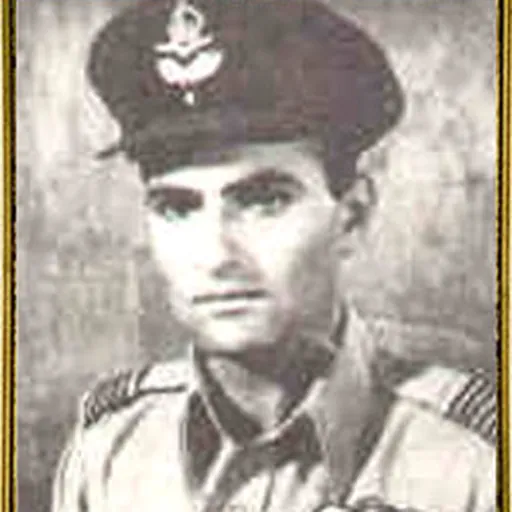
Hrushikesh Moolgavkar
Recipient of Maha Vir Chakra
About Hrushikesh Moolgavkar
Lived 1920 – 2015 (aged 94–95). Hrushikesh Moolgavkar was an Indian.
Air Chief Marshal Hrushikesh Moolgavkar, PVSM, MVC (15 August 1920 – 9 April 2015) was a former Indian Air officer in the Indian Air Force. He served as the 9th Chief of the Air Staff of the Indian Air Force from 1 February 1976 to 31 August 1978.
Early life and education Moolgavkar was born on 14 August 1920 to Chandraseniya Kayastha Prabhu family in Bombay. He attended the St. Mary's School, Mumbai and the St. Xavier's College, Mumbai. Moving to the United Kingdom for higher education, he attended the Malvern College. He was studying there when World War II broke out.
Military career Early career Moolgavkar was commissioned into the Indian Air Force as an acting Pilot Officer on 30 November 1940. He joined the No. 1 Squadron IAF, commanded by Squadron Leader Karun Krishna Majumdar, at Peshawar. He flew the Hawker Hart and the Westland Lysander aircraft. In early 1942, the squadron moved to Burma where he saw active service. In May 1942, he was promoted to the rank of Flying Officer. After the operations in Burma, he came back with the squadron to Secunderabad where Squadron Leader Subroto Mukerjee took command. The squadron then moved to Trichy and to RAF Station Kohat.
On 1 April 1944, Moolgavkar was promoted to the acting rank of Flight Lieutenant and transferred to No. 4 Squadron IAF, commanded by Squadron Leader Geoffrey Sharp of the Royal Air Force, at Chittagong. He flew the Supermarine Spitfire in escort fighter role in supply dropping missions. In January 1945, while on a sortie, the engine of his Spitfire failed. He crash landed on a beach and was stuck upside-down. Luckily, a couple of British Commandos spotted the plane and rescued him.
In January 1947, Moolgavkar was promoted to the acting rank of Squadron Leader and took command of No. 6 Squadron RIAF at Kohat. After a short stint, he took command of No. 10 Squadron at Kanpur. The squadron was equipped with the Hawker Tempest II. After completing the staff course, he took command of No. 1 Operational Wing at Srinagar from Wing Commander Minoo Merwan Engineer. The citation for the Maha Vir Chakra reads as follows:
Post-war career After the war, in March 1950, he commanded a detachment of de Havilland Vampire aircraft, which were recently received by the IAF. He led the detachment touring South India and in flying demonstrations in Bombay, Poona, Bangalore and Madras. In October 1950, he moved to Air headquarters as Deputy Director Operations. He was promoted to the acting rank of Group Captain and appointed Director of Operations at Air HQ in May 1952. He became the first IAF officer to serve in this appointment, since the previous officers were from the RAF.
In October 1954, he was a part of a team of three, consisting of Air Commodore (later Air Chief Marshal) Pratap Chandra Lal and Flight Lieutenant (later Air Commodore) Roshan Lal Suri, which went to Europe to select new aircraft for the IAF. The team rejected the Supermarine Swift, and chose the Folland Gnat, a decision which would hold India and the IAF in good stead during the Indo-Pakistani War of 1965. During this tour, he became among the first Indians to break the sound barrier.
Air rank
Moolgavkar was promoted to the acting rank of Air Commodore and returned to India. He subsequently took over as the Senior Air Staff Officer (SASO) of the Operational Command. In October 1962, the Hawker Siddeley HS 748 arrived in India for a tour of demonstration flights. Moolgavkar led the team for this tour. He moved to Air HQ in June 1963, where he served as the Air Officer-in-Charge Policy and Plans. He was promoted substantive Air Commodore on 1 April 1964. He served in this appointment for a year-and-a-half before moving to the Maintenance Command at Nagpur. He served as the Senior Air & Administration Staff Officer (SAASO) of the Command. He was promoted substantive Air Marshal in June 1972. In April, he took over as the Commodore Commandant of the squadron that he had commanded in the past - No. 10 Squadron.
Chief of Air Staff In January 1976, the Government of India appointed Moolgavkar to be the next Chief of the Air Staff (CAS), succeeding Air Chief Marshal Om Prakash Mehra. He was promoted to the rank of Air Chief Marshal took over as the 9th CAS on 31 January. Soon after taking over as Chief, Moolgavkar and the Chief of the Naval Staff Admiral Jal Cursetji discussed about the handing over of the maritime reconnaissance role from the Indian Air Force to the Indian Navy. In accordance with this, the Lockheed L-1049 Super Constellation aircraft of the No. 6 Squadron IAF were transferred to the Navy. On 8 October 1976, the INAS 312 was commissioned at Goa.
Dates of rank
Personal life and death The Moolgavkars had two children - a son Dr. Prakash and a daughter Jyoti. Jyoti later wrote the biography of the former CAS titled Leading from the Cockpit: A Fighter Pilot’s Story. The book was published and released in 2010.
Don’t just read it —
keep it.
Full-length biographies made to live with: read them, listen on the way to work, watch them tonight.
- E-book
- Audio
- Video
Instant download · yours to keep · every purchase keeps this site free
Important facts
People in Hrushikesh Moolgavkar's life
Named in this biography and alive at the same time



Contemporaries
People whose lives overlapped Hrushikesh Moolgavkar's






Frequently asked questions
Who was Hrushikesh Moolgavkar?
Recipient of Maha Vir Chakra
When was Hrushikesh Moolgavkar born?
Hrushikesh Moolgavkar was born in 1920 in Mumbai.
When did Hrushikesh Moolgavkar die?
Hrushikesh Moolgavkar died on 9 April 2015 in Pune.
What nationality was Hrushikesh Moolgavkar?
Hrushikesh Moolgavkar was Indian.
Sources & further reading
· Wikipedia: Hrushikesh Moolgavkar
· DBpedia: Hrushikesh Moolgavkar
Cite this page
APA: Biography.guide. (2026). Hrushikesh Moolgavkar. https://biography.guide/hrushikesh-moolgavkar/
MLA: "Hrushikesh Moolgavkar." Biography.guide, https://biography.guide/hrushikesh-moolgavkar/.
Chicago: "Hrushikesh Moolgavkar." Biography.guide. https://biography.guide/hrushikesh-moolgavkar/.
Data last updated: 2026-09-20 · Spot an error? Report a correction.
Page generated 2026-09-27 05:10 UTC