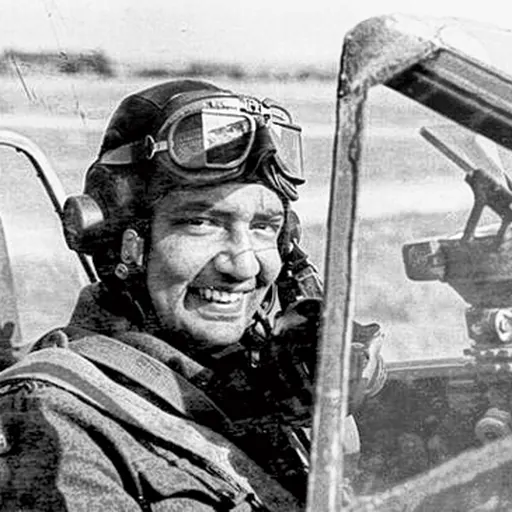
About Karun Krishna Majumdar
Lived 1913 – 1945 (aged 31). Karun Krishna Majumdar was a military officer.
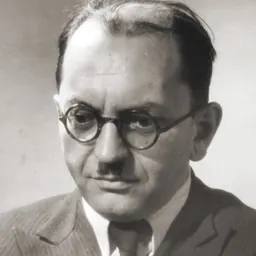
Wing Commander Karun Krishna 'Jumbo' Majumdar, DFC & bar (6 September 1913 – 17 February 1945) was an officer in the Indian Air Force. He was the first Indian to reach the rank of wing commander.
Early life Majumdar was born in Kolkata in a Brahmin family on 6 September 1913. His maternal grandfather was Womesh Chunder Bonnerjee, the first president of the Indian National Congress.
He and his elder brother, Jai Krishna Majumdar, had taken entrance exams together, with Jai opting for Sandhurst, while Karun opted for Cranwell. His brother was commissioned into the 16th Light Cavalry in 1933 and was a pilot as well. He would later be killed in a training flight crash in October 1942. Majumdar first flew Westland Wapiti and then Hawker Hart. Soon he was promoted to flight commander of the 'C' Flight of No. 1 Squadron. In June 1941, Majumdar was promoted to squadron leader and took charge of No. 1 Squadron in Miramshah. In August 1941, No. 1 Squadron was upgraded with Westland Lysanders and training commenced in Drigh Road.
World War II
In 1942, the Imperial Japanese forces occupied Burma. No. 1 Squadron of the Royal Indian Air Force was posted to Burma, and Majumdar reached Taungoo with his squadron on 31 January 1942. On the very next day, the Imperial Japanese Army Air Force based in Mae Hong Son in Thailand bombed Taungoo, inflicting considerable damage. However, No. 1 Squadron, which had taken the precaution of dispersing and hiding their Lysanders, was unharmed.
Majumdar immediately planned retaliatory action, even though the Westland Lysander was an army co-operation aircraft not meant to serve either as a fighter or as a bomber. Slinging two 250-pound bombs on the stub wings of a Lysander, he set off solo on 2 February 1942 towards the Japanese airbase at Mae Hong Son. The New Zealanders of No. 67 Squadron of Royal Air Force send two Buffalo aircraft as escort. Majumdar took considerable risk in flying low and dropping bombs accurately on target, destroying the enemy hangar, aircraft and airfield. On the next day, Majumdar led the entire squadron in a bombing mission and destroyed the aircraft, wireless installations and the buildings. Until they were withdrawn from Burma in March–April 1942, No. 1 Squadron played a stellar role supporting the army, for which they were commended by General Archibald Wavell. On one occasion Majumdar was forced down in the Shan jungles due to engine failure and managed to return to Lashio after a harrowing journey through dense forests. Majumdar was awarded the Distinguished Flying Cross, gazetted in the London Gazette of 10 November 1942. In order to serve in an operational squadron, he voluntarily relinquished his acting rank of wing commander and reverted to squadron leader. After converting to North American Mustang aircraft at 41 OTU (Operational Training Unit), Majumdar joined No. 268 Squadron RAF, a photo-reconnaissance squadron, at RAF Gatwick in early June 1944. 268 squadron was then commanded by Squadron Leader Albert S. Mann, DFC, an old acquaintance of Majumdar from Burma.
In his first operational flight on 10 June 1944, he made a reconnaissance of the Seine River and carried out ground-strafing of enemy targets. His operational tour ended on 20 September. During this period of 100 days, Majumdar flew 65 sorties in Mustangs and Hawker Typhoons - he preferred the former to the latter, writing in his diary that "She is no lady like the Mustang, but is pretty hot stuff." He successfully completed two low-level photo-reconnaissance missions, one of the bridges over the Seine ("I went through an absolute hail of flak to get photographs of the rail bridge on the Seine at Rouen", he wrote), and another of the Falaise Gap in Normandy. His Falaise photographs were later used by Field Marshal Bernard Montgomery in the Battle of the Falaise Pocket. On one occasion he got shot up and force-landed in enemy territory, but was luckily rescued. The Bar to his DFC was gazetted on 23 January 1945, the citation specifically mentioning the Seine missions. Thus he became the most highly decorated Indian pilot of World War II.
Because of his superb piloting skills and indomitable spirit, Life magazine featured him in its issue of 15 May 1944 among twelve of the world's most outstanding airmen. His portrait was painted by the artist William Dring, Royal Academy.
Death On the afternoon of 17 February 1945, Majumdar took part in a flying display at Walton, near Lahore in a Hawker Hurricane. The aircraft he chose had a history of snags and malfunctions, and he was warned by Flying Officer Harjinder Singh. During a dive in the aerobatic routine, the aircraft developed a problem and crashed headlong into the ground. Majumdar died instantly. He was 31.
The following epitaph appears on the marble headstone of his grave at Lahore:
"Go, passers-by / And do if you can as he did / A Man's part / In defence of liberty."
Don’t just read it —
keep it.
Full-length biographies made to live with: read them, listen on the way to work, watch them tonight.
- E-book
- Audio
- Video
Instant download · yours to keep · every purchase keeps this site free
Important facts
People in Karun Krishna Majumdar's life
Named in this biography and alive at the same time


Related people
Same field, nearest in time




Contemporaries
People whose lives overlapped Karun Krishna Majumdar's



Frequently asked questions
Who was Karun Krishna Majumdar?
Royal Indian Air Force officer
When was Karun Krishna Majumdar born?
Karun Krishna Majumdar was born on 6 September 1913 in Kolkata.
When did Karun Krishna Majumdar die?
Karun Krishna Majumdar died on 17 February 1945 in Faisalabad.
What was Karun Krishna Majumdar's occupation?
Karun Krishna Majumdar was a military officer.
Sources & further reading
· Wikipedia: Karun Krishna Majumdar
· DBpedia: Karun Krishna Majumdar
Cite this page
APA: Biography.guide. (2026). Karun Krishna Majumdar. https://biography.guide/karun-krishna-majumdar/
MLA: "Karun Krishna Majumdar." Biography.guide, https://biography.guide/karun-krishna-majumdar/.
Chicago: "Karun Krishna Majumdar." Biography.guide. https://biography.guide/karun-krishna-majumdar/.
Data last updated: 2026-09-22 · Spot an error? Report a correction.
Portrait: Wikimedia Commons · author & licence
Page generated 2026-09-27 05:03 UTC