
About Subroto Mukerjee
Lived 1911 – 1960 (aged 49). Subroto Mukerjee was an Indian flying ace.
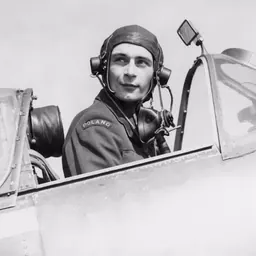
Subroto Mukerjee (Bengali: সুব্রত মুখোপাধ্যায়) (5 March 1911 – 8 November 1960) was an Indian military officer who was the first Indian Commander-in-Chief (C-in-C) of the Indian Air Force. He was awarded several honours during the course of a three-decade-long career, ended by his untimely demise in 1960. Mukerjee has been called the "Father of the Indian Air Force."
Born in a Bengali family of repute, he was educated both in India and in the United Kingdom. He joined the Royal Air Force and later was one of the first recruits of the Indian Air Force (IAF) in 1933. He flew with the No. 1 Squadron IAF from 1933 to 1941. He saw extensive action in the North-West Frontier Province during this stint and was mentioned in dispatches. He attended the Staff College, Quetta in 1941 before returning to command No. 1 Squadron in 1942. He commanded the RAF Station Kohat from 1943 to 1944 before moving to Air HQ as director of flying training. He was awarded the OBE in 1945.
Following the Partition of India, he was appointed Deputy Air Commander, Royal Indian Air Force. After completing the higher command course at the Imperial Defence College, he was appointed Commander-in-Chief of the IAF in 1954. He oversaw the transformation of IAF into an all-jet force. From 1955, he also served as the Chairman of the Chiefs of Staff Committee. He died while on a visit to Tokyo in 1960. His accidental death came as a shock to the Air Force and the nation and he was cremated with full military honours in New Delhi.
He had many firsts to his credit: the first Indian to command a flight, in 1938, the first Indian to command a squadron, in 1939, the first to command a station, in 1943, and finally, the first Indian to command the Service itself, in 1954.
Early life and education Mukerjee was born in Calcutta on 5 March 1911 in a well-known Bengali Brahmo family. His father was Satish Chandra Mukherjee of the Indian Civil Service, and his mother, Charulata Mukherjee, was a social worker. His paternal grandfather, Nibaran Chandra Mukherjee, pioneered several social and educational reforms in India and was a member of the Brahmo Samaj. His maternal grandfather Prasanna Kumar Roy of the Indian Education Service, was the first Indian Principal of Presidency College, Kolkata. His maternal grandmother, Sarala Roy, was an educationist and social worker who founded the Gokhale Memorial Girls' School.
Mukerjee was educated at Nainital Diocesan Boys' High School later known as Sherwood College, Nainital, at Loreto Convent in Calcutta, at Howrah Zilla School, and also at a school in Hampstead in England. He completed his secondary education at Birbhum Zilla School in 1927. He then attended Presidency College, Calcutta for year, before studying at the University of Cambridge.
With the Indian Air Force Act being passed by the Central Legislative Assembly, the IAF was established on 8 October 1932 as an auxiliary force of the Royal Air Force. Mukerjee was commissioned as a pilot officer. After completing their training at Cranwell, the Indian pilots received further training at the Army Cooperation School at Old Sarum Airfield in Wiltshire. Mukerjee served with the No. 16 Squadron RAF for about a year before returning to India.
Though widely regarded as the first Indian officer in the Indian Air Force, Subroto Mukerjee was in fact the second Indian to be commissioned. The first was Harish Chander Sircar, who was dismissed from service in 1935.
In 1936, a rebellion erupted in North-West Frontier Province (NWFP), led by the Pukhtoon tribes. The Indian Air Force were forced to play a major role in containing the rebellion due to the harsh terrain of the region. Mukerjee was awarded the India General Service Medal with the clasps 'North West Frontier 1936–37', and 'North West Frontier 1937–39'. He took command of the No. 1 Squadron on 16 March 1939, the first Indian officer to command a squadron. In June 1939, under Mukerjee, the squadron converted to Hawker Hart aircraft with a few Hawker Audax aircraft in its inventory. He led the squadron into action at Miramshah in NWFP.
World War II At the outbreak of World War II, Coastal Defence Flights (CDFs) of the Indian Air Force Volunteer Reserve (IAFVR) were formed. Mukerjee was the senior Indian commissioned officer in the IAF. He was promoted to the acting rank of squadron leader on 25 August 1939. On 7 August 1940, he observed a beleaguered army picket, with the troops indicating that they were running out of ammunition. Mukerjee and his gunner removed ammunition from the rear cockpit-mounted Lewis machine gun and stuffed it into pairs of socks. The ammunition was dropped to the troops in a low pass under concentrated fire. The picket held out until another aircraft air-dropped a large cache of ammunition.
In June 1941, Mukerjee handed over command of No. 1 Squadron to Squadron Leader Karun Krishna Majumdar. He was selected to attend the Staff College, Quetta. Due to the war, the staff course was reduced to a duration of six months. By this time, No. 1 Squadron had moved to Secunderabad and was re-equipped with the Westland Lysander. In March 1942, Mukerjee took command of the squadron for the second time.
In December 1942, Mukerjee was mentioned in dispatches for his distinguished service during the operations in the NWFP. He commanded RAF Station Kohat from 28 August 1943 to December 1944, becoming the first Indian officer to command an airbase. During this time, the British Indian Army officer and author Major Francis Yeats-Brown praised the professionalism and the efficiency of the IAF, based on his experience at the Kohat airbase.
After handing over command to Aspy Engineer, Mukerjee subsequently moved to Air Headquarters, having been appointed director of flying training. In June 1945, he was awarded the Order of the British Empire (OBE). As the most senior Indian officer in the Royal Indian Air Force (RIAF), on 15 May 1947, Mukerjee was promoted to the acting rank of air commodore and became the first Indian air officer. He was appointed the Deputy Assistant to the Air Officer-in-charge Administration at Air headquarters.
Post-independence On 15 August 1947, with the Partition of India, a new Air Headquarters of the Dominion of India was formed. Mukerjee was appointed the Senior Air Staff Officer (SASO), in addition to being appointed Deputy Air Commander, RIAF. The assets of the Indian Air Force (like other branches of the military) had to be divided between the dominions of India and Pakistan. Mukerjee led the air force part of this committee.
After the outbreak of the Indo-Pakistani War of 1947, Mukerjee was promoted to the acting rank of air vice marshal on 15 November 1947. In the Poonch sector, the road link was under threat of being cut off. An air bridge had to be established to provide supplies to the besieged troops. The first aircraft to land at Poonch Airport was piloted by Air Commodore Mehar Singh, Air Officer Commanding No. 1 Operational Group, with Mukerjee as a passenger. The airstrip was surrounded by streams on three sides and had a steep approach. Against heavy odds, he landed a Douglas with a load of three tons, against a normal rated load of one ton. The landing was done without any landing aids, the airstrip being lit with the help of oil lamps. On 15 March 1948, Mukerjee took over as the officiating Chief of the Air Staff and Air Marshal Commanding RIAF when Air Marshal Sir Thomas Elmhirst left to the United Kingdom on deputation. He remained in command of the RIAF for about a year.
In September 1948, India initiated a police action against Hyderabad State. Mukerjee controlled and aided air operations in aid of the troops during the annexation of Hyderabad. In September 1952, he was selected to attend the Imperial Defence College. He attended the course during 1953, along with Captain Ram Dass Katari, the senior Indian naval officer at that time. After completing the year-long course, he returned to India in early 1954. His military service at the Air Headquarters from 1944, and having served as the SASO and Deputy Commander-in-Chief under the first three Chiefs of Independent India, fully qualified him for the top post.
Commander-in-Chief On 1 April 1954, Mukerjee took over as the Commander-in-Chief of the Indian Air Force, with the rank of air marshal. When the Change in Designation Act, 1955, was passed, the title of "Commander-in-Chief" was replaced by Chief of the Air Staff (CAS). Thus Mukerjee became the first Indian Commander-in-Chief as well as Chief of Air Staff of the Indian Air Force.
On 22 July 1955, with the retirement of the Chief of the Naval Staff Admiral Sir Charles Pizey, Mukerjee took over as the Chairman of the Chiefs of Staff Committee. He is the longest-serving such chairman in history, having served for more than five years, until his untimely death in 1960.
During his tenure, the aircraft of the IAF were replaced with transonic jet fighters and bombers. It witnessed all-round expansion and modernisation. In August 1958, Mukerjee was given a second tenure for a period of four years, starting 1 October 1958.
Awards and decorations
Indian Independence Medal(1948)Order of the British Empire (1945)India General Service Medal (1939)1939-1945 Star (1945)War Medal 1939-1945 (1945; with MID oak leaf)India Service Medal (1945)King George VI Coronation Medal (1937)
Sources:
Dates of rank Insignia !! Rank !! Component !! Date of rank
1 April 1954 (acting) She was subsequently appointed the Governor of Gujarat. She was the first woman governor of both states.
Death In November 1960, Air India inaugurated its service to Tokyo, Japan. Mukerjee and Air Commodore (later ACM) Pratap Chandra Lal, then General Manager of the Indian Airlines Corporation were passengers on this flight. After landing in Tokyo, on 8 November 1960, Mukerjee was having a meal in a restaurant with a friend, an Indian Navy officer. A piece of food became lodged in his windpipe, causing him to choke. Mukerjee died before a doctor could be called for. The next day, his body was flown to Palam Airport, New Delhi.
Mukerjee was cremated with full military honours. From Palam Airport, a hearse carried him to Air House. On 11 November, numerous visitors offered their respects. As his body was leaving Air House, a 15-gun salute, at one minute interval, was fired. His body was carried on a gun carriage to the Nigambodh Ghat, with servicemen lining the whole route. He was paid a final tribute with a flypast of forty-nine aircraft, one for each of his forty-nine years. The death came as a shock to the nation and to the Indian Air Force. A black-bordered extraordinary edition of The Gazette of India was issued on 9 November. The Indian Government received tributes from around the world, conveyed by the ambassadors and military attachés in New Delhi.
Legacy ACM Pratap Chandra Lal considered Mukerjee the foremost pioneer of military aviation in India. He was a much-loved figure in the Air Force. Aspy Engineer, a close associate of Mukerjee, assumed the role of CAS from 1 December 1960. He issued a Special Order of the Day paying tribute to Mukerjee and called him the "Father of the Indian Air Force".
Mukerjee, an eminent football lover and a regular member of Mohun Bagan, had conceived the idea of an inter-school all-India football tournament. This was implemented after his death. The Subroto Cup Football Tournament still helps find talented players from Indian schools. In July 1949, the RIAF introduced the Mukerjee Trophy for the 'Airmen's Mess and Dining Competition', in order for units to further improve messing conditions and amenities of airmen.
Subroto Park in the Delhi Cantonment is named after Mukerjee. The Air Force School, the headquarters of the Western Air Command, and the Army Hospital (Research & Referral) are all located here. The Centre for Air Power Studies organises the Subroto Mukerjee International Seminar annually.
Don’t just read it —
keep it.
Full-length biographies made to live with: read them, listen on the way to work, watch them tonight.
- E-book
- Audio
- Video
Instant download · yours to keep · every purchase keeps this site free
Important facts
People in Subroto Mukerjee's life
Named in this biography and alive at the same time




Related people
Same field, nearest in time

Contemporaries
People whose lives overlapped Subroto Mukerjee's






Frequently asked questions
Who was Subroto Mukerjee?
First Chief of the Air Staff of India
When was Subroto Mukerjee born?
Subroto Mukerjee was born on 5 March 1911 in Kolkata.
When did Subroto Mukerjee die?
Subroto Mukerjee died on 8 November 1960 in Tokyo.
What was Subroto Mukerjee's occupation?
Subroto Mukerjee was a flying ace.
What nationality was Subroto Mukerjee?
Subroto Mukerjee was Indian.
Sources & further reading
Cite this page
APA: Biography.guide. (2026). Subroto Mukerjee. https://biography.guide/subroto-mukerjee/
MLA: "Subroto Mukerjee." Biography.guide, https://biography.guide/subroto-mukerjee/.
Chicago: "Subroto Mukerjee." Biography.guide. https://biography.guide/subroto-mukerjee/.
Data last updated: 2026-09-25 · Spot an error? Report a correction.
Page generated 2026-09-27 05:12 UTC