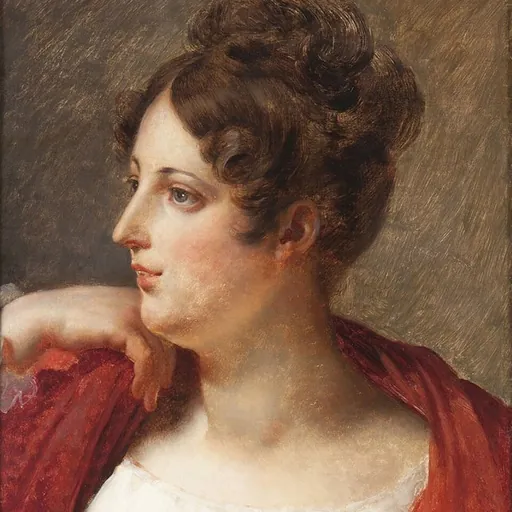
About Hortense Allart
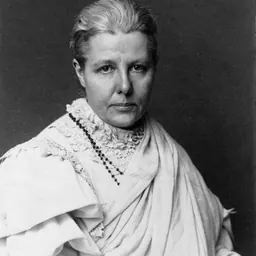
Lived 1801 – 1879 (aged 77). Hortense Allart was a French and Italian essayist, writer, novelist and women's rights activist.
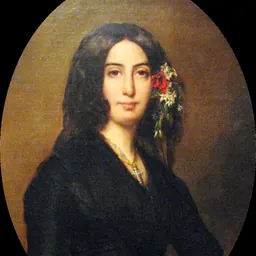
Hortense Allart de Méritens (; pseudonym Prudence de Saman L'Esbatx; 7 September 1801 – 28 February 1879 ) was an Italian-French feminist writer and essayist. Her novels, based on her adventures, did not have much success, except for Les enchantements de Prudence, Avec George Sand ("The Enchantment of Prudence, with George Sand"), which had a succès de scandale.
Early years and education Allart was born in Milan in 1801. Her French father was Nicolas-Jean-Gabriel Allart and her French mother was the writer Marie-Françoise Gay who had translated the works of the English gothic author Ann Radcliffe. Her maternal aunt was the writer Sophie Gay and her cousin was Delphine de Girardin. In 1817, her father died.
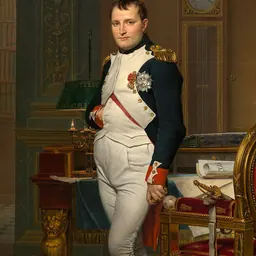
Career Allart was an enthusiastic supporter of the vanquished Napoleon and in 1819, she wrote to Henri Gatien Bertrand and volunteered to travel to Saint Helena to nurse the ex-emperor who was ill. Bertrand later offered her a job as a governess and commented that he thought that Napoleon would have fallen in love with her if she had been successful in travelling to be his nurse. Within a few weeks, he proceeded to Paris, and Allart followed him there, taking an apartment in the Rue d’Enfer. In 1843, she married the French aristocrat Napoléon Louis Frédéric Corneille de Méritens de Malvézie but she left him the following year. lived several miles outside Paris with her books which she called her "true lovers". She did not recommend that women should abandon men, in fact in her novel Settimia her heroine enjoys her male lovers but is not defined by them but by her lack of interdependence, her intellectual maturity and her children. This was the life that Allart lived, surviving without having to rely on a supportive family. She argued that women needed political reform of their lot and if this meant that women needed to abandon the two-parent family then this would be acceptable. Allart foresaw a world where society was not democratic or organised by men, but a meritocratic society run by women and men of higher abilities than the general population. She professed herself a Protestant, and had a kind of religiosity, however hazy; Allart was loyal, generous and true to her lovers, who usually became her friends.
Allart recorded her adventures in her books, veiling them only slightly as fiction. Her novel Jerome (1829), for example, is a thinly disguised account of her experiences with Sampayo, whom she portrayed in the book as a celibate Roman prelate. With the exception of Les enchantements de Prudence, Avec George Sand (1873), which had a succès de scandale, none of her novels had much success.
Allart died in Montlhéry in 1879 and is buried in the cemetery at Bourg-la-Reine.
Selected works
Essai sur la religion intérieure, Paris, 1824 Lettres sur les ouvrages de Madame de Staël, Paris, Bossange, 1824 Gertrude, Paris, Dupont, 1828 Jerome ou Le jeune prélat, 1829 Sextus, ou le Romain des Maremmes; suivi d'Essais détachés sur l'Italie, Heideloff et Campe, 1832 L'indienne, C. Vimont, 1833 Settimia, Bruxelles, A. Wahlen, 1836 La femme et la démocratie de nos temps, Paris, Delaunay et Pinard, 1836 Histoire de la république de Florence, Paris, Delloye, 1843 Études diverses, Volumes 1 2 & 3, Renault, 1850–1851 Novum organum ou sainteté philosophique, Paris, Garnier frères, 1857 Essai sur l’histoire politique depuis l'invasion des barbares jusqu’en 1848, 1857 Clémence, impr. de E. Dépée (Sceaux), 1865 Les enchantements de Prudence, Avec George Sand, Paris, Michel Lévy frères, 1873 Les nouveaux enchantements, Paris, C. Lévy, 1873 Derniers enchantements, Paris, M. Lévy, 1874 Lettres inédites à Sainte-Beuve (1841–1848) avec une introduction des notes, Éd. Léon Séché, Paris, Société du Mercure de France, 1908 Lettere inedite a Gino Capponi, Genova, Tolozzi, 1961 Mémoires de H.L.B. Henry Lytton Bulwer, Houston : University of Houston, 1960–1969 Nouvelles lettres à Sainte-Beuve, 1832–1864; les lettres de la collection Lovenjoul, Genève, Librairie Droz, 1965 Source: Uffenbeck, L. A. (1957), The life and writings of Hortense Allart, University of Wisconsin
Don’t just read it —
keep it.
Full-length biographies made to live with: read them, listen on the way to work, watch them tonight.
- E-book
- Audio
- Video
Instant download · yours to keep · every purchase keeps this site free
Important facts
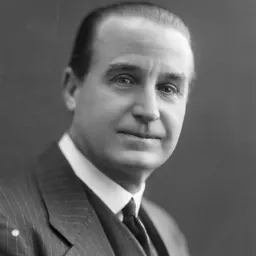
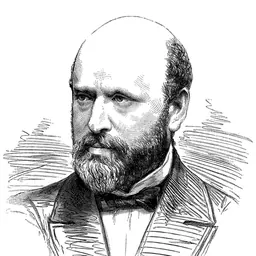
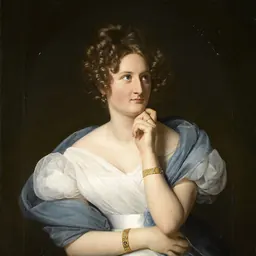
People in Hortense Allart's life
Named in this biography and alive at the same time


Related people
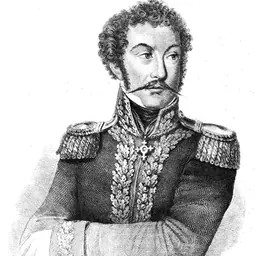
Same field, nearest in time



Contemporaries
People whose lives overlapped Hortense Allart's





Frequently asked questions
Who was Hortense Allart?
French-Italian writer and feminist
When was Hortense Allart born?
Hortense Allart was born on 7 September 1801 in Milan.
When did Hortense Allart die?
Hortense Allart died on 28 February 1879 in Montlhéry.
What was Hortense Allart's occupation?
Hortense Allart was an essayist, writer, novelist and women's rights activist.
What nationality was Hortense Allart?
Hortense Allart was French and Italian.
Sources & further reading
Cite this page
APA: Biography.guide. (2026). Hortense Allart. https://biography.guide/hortense-allart/
MLA: "Hortense Allart." Biography.guide, https://biography.guide/hortense-allart/.
Chicago: "Hortense Allart." Biography.guide. https://biography.guide/hortense-allart/.
Data last updated: 2026-09-23 · Spot an error? Report a correction.
Portrait: Wikimedia Commons · author & licence
Page generated 2026-09-27 05:06 UTC