About Horatio B. Hackett
Lived 1880 – 1941 (aged 61). Horatio B. Hackett was an American american football player and architect.
Horatio Balch Hackett Jr. (May 8, 1880 – September 8, 1941) was a leading American architect and construction executive, a college football player and official, a decorated combat veteran of World War I, and Assistant Administrator of the Public Works Administration during the presidency of Franklin D. Roosevelt.
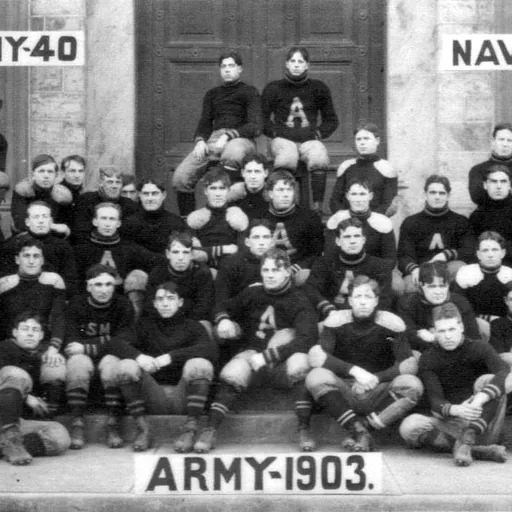
Early life Hackett was born in Philadelphia, where he attended the William Penn Charter School. He was the son of Pennsylvania State Senator Horatio Balch Hackett, who served as a captain in the 81st Pennsylvania Volunteers during the Civil War, – Hackett (quarterback), front row, center
Hackett attended the United States Military Academy at West Point, New York, arriving on June 27, 1900, distinguishing himself by making the varsity football team in his plebe year. Eventually becoming the starting quarterback, his field generalship was credited with making the difference in many Army victories. and (later in life) "Rash", he competed in five sports at the academy. He was elected captain of the baseball team and was a standout in hockey and track. Along with some of his classmates, he introduced basketball at the academy. He was awarded eight letters for athletics, which was the maximum allowed at the time of his graduation in 1904.
Football official
Hackett was a prominent figure in college football for most of his adult life. He served as a member of football's rules committee and had officiated Big Ten Conference football games for the better part of 30 years when he decided to retire just before the 1935 season. "I never missed a game, and was never late for a game," he told the Detroit Free Press. "I looked at that resignation letter a long time before I signed it, but I figured I had better quit ... This will be the first fall in 31 years, except when I was in France during the World War, that I haven't spent every Saturday afternoon and Thanksgiving Day on a football field." watched St. Louis University crush Iowa 39–0 – and Hackett witnessed what he characterized as the "perfection" achieved by the offense of "Blue and White" coach Eddie Cochems and the unequaled passing of Bradbury Robinson, the sport's first triple-threat man.
He was quoted the next day in Ed Wray's St. Louis Globe-Democrat article, which was reprinted in other newspapers across the country, including The Washington Post: "It was the most perfect exhibition ... of the new rules ... that I have seen all season and much better than that of Yale and Harvard. St. Louis' style of pass differs entirely from that in use in the east. ... The St. Louis university players shoot the ball hard and accurately to the man who is to receive it ... The fast throw by St. Louis enables the receiving player to dodge the opposing players, and it struck me as being all but perfect."
Hackett was amazed at what he had seen, telling a sportswriter, "Whew, that chap (Robinson) is a wonder! He beats anything I ever saw. He looks as though 40 yards is dead for him, and he's got accuracy with it."
Architect and businessman After serving two years as a lieutenant in the Army, Hackett began his business career in 1908. He moved to Chicago, where he became architectural superintendent of D.H. Burnham & Company before joining Embree Iron Company as its general superintendent.
Decorated war veteran
When the United States entered World War I, he returned to active duty, serving in France as a Lieutenant Colonel and later a Colonel in the 124th field artillery, 33rd division of the American Expeditionary Forces. he suffered wounds that almost claimed his life. In his war diary, "The Cannoneers Have Hairy Ears," Robert J. Casey, who served under Hackett as a captain and later became an award-winning columnist for the Chicago Daily News, described the severity of Hackett's injuries and his long and difficult recovery:
The Colonel was almost dead from loss of blood when he reached a dressing station, but was pulled through by a remarkable constitution, plus a miracle. He was taken to a Paris hospital where strips of his shin bone were grafted onto his jaw. For two years his jaws were wired together and he lived on liquids and pastes administered through a hole provided by the extraction of four of his front teeth. He recovered completely.
Hours before Hackett was wounded, Casey, who earned three citations for bravery himself,
Hackett was awarded the Distinguished Service Medal with Silver Star and the order of the Purple Heart. He contributed to the final designs for both Illinois' Memorial Stadium at Urbana/Champaign and Soldier Field. He remained with Holabird & Root until 1934, when he responded once more to the call of public service.
Franklin D. Roosevelt administration Hackett again interrupted his business career when his government was in need of his skills – this time those related to building and construction rather than the battlefield.
Although raised a Republican,
Final years in Chicago In September 1937, he became vice president of the Chicago contracting firm of Coath and Goss, Inc., as well as vice president of the Chicago Venetian Blind Company. a pioneer in the construction of skyscrapers in the United States.
He resigned from Thompson-Starrett in January 1941 to become a part owner and president of Materials Service Corporation, a large producer of sand and gravel and owner of numerous stone quarries in the Chicago area.
In late August 1941, Hackett was admitted to Henrotin Hospital in Chicago suffering from pneumonia, complicated by a stroke. He died at that hospital several days later at age 61.
Don’t just read it —
keep it.
Full-length biographies made to live with: read them, listen on the way to work, watch them tonight.
- E-book
- Audio
- Video
Instant download · yours to keep · every purchase keeps this site free
Important facts
People in Horatio B. Hackett's life
Named in this biography and alive at the same time



Related people
Same field, nearest in time


Contemporaries
People whose lives overlapped Horatio B. Hackett's






Frequently asked questions
Who was Horatio B. Hackett?
American football player (1880-1941)
When was Horatio B. Hackett born?
Horatio B. Hackett was born on 8 May 1880 in Philadelphia.
When did Horatio B. Hackett die?
Horatio B. Hackett died on 8 September 1941 in Chicago.
What was Horatio B. Hackett's occupation?
Horatio B. Hackett was an american football player and architect.
What nationality was Horatio B. Hackett?
Horatio B. Hackett was American.
Sources & further reading
· Wikipedia: Horatio B. Hackett
Cite this page
APA: Biography.guide. (2026). Horatio B. Hackett. https://biography.guide/horatio-b-hackett/
MLA: "Horatio B. Hackett." Biography.guide, https://biography.guide/horatio-b-hackett/.
Chicago: "Horatio B. Hackett." Biography.guide. https://biography.guide/horatio-b-hackett/.
Data last updated: 2026-09-22 · Spot an error? Report a correction.
Portrait: Wikimedia Commons · author & licence
Page generated 2026-09-27 05:00 UTC