
About Hirokichi Nadao
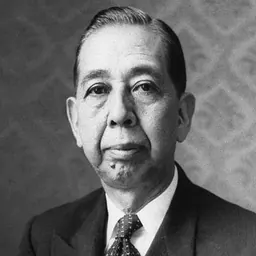
Lived 1899 – 1994 (aged 94). Hirokichi Nadao was a Japanese politician.
Hirokichi Nadao (; 21 December 1899 – 22 January 1994) was a Japanese politician. Throughout his career, he served as Minister of Education multiple times, Speaker of the House of Representatives, Minister of Health and Welfare, and Governor of Oita Prefecture.
Nadao was known for his hawkish attitudes. He held an aggressive stance towards Nikkyoso, the teachers' union of Japan, and unions in general (represented by Sōhyō). He was also one of the main people behind Prime Minister Eisaku Satō's foreign policy. In the mid-1970s, he was regarded as one of the most powerful men in Japan.
Career
Nadao was born in Hiroshima Prefecture in 1899. He graduated with a degree in jurisprudence from Tokyo Imperial University and joined the Home Ministry, rising to the position of Vice Minister pre-war. During the war, he served as Governor of Oita Prefecture.
After the war, Nadao became one of the main people who pushed through the 1954 Police Law (as Minister of Health and Welfare at the time). He was also a member of the "Taiwan faction" of Japanese politics, influencing the foreign policy of Prime Minister Eisaku Satō. He served as the chairman of the Diet Members' Talkfest on Japan-China Relations, visiting Taipei with a delegation to meet with Chiang Kai-Shek in 1959 (the first time any Japanese politician had done so since the cutting of ties with Taipei). In March 1973, Nadao created the LDP Members' Talkfest on Japan-China Relations.
As Education Minister, Nadao was one of the chairmen of the Education System Research Council. Under the premiership of Prime Minister Nobusuke Kishi, Nadao was hawkish towards the teachers' union, Nikkyoso, and the general council for trade unions, Sōhyō, arguing that teachers should not argue for better wages because they should teach based on their conviction and duty to their noble profession. His stand against Nikkyoso was what he was known for within the Ministry of Education, and lumped him in with other members of the "education-public peace" or "law and order" clique, or Bunkyo-chian zoku.
Nadao was also responsible for policies pushing national identity through education. In 1968, he voiced his support for teaching children about the Emperor of Japan, his descent from the sun goddess Amaterasu, and the formation of the Japanese monarchy. He also called for an reevaluation of the 6-3-3-4 system (6 years of primary school, 3 years of junior secondary school, 3 years of senior secondary school, and 4 years of university).
After having served as Minister of Education multiple times, Nadao became a main member of the Education Committee of the LDP. In 1976, Nadao was named as one of the most powerful men in Japanese politics.
Don’t just read it —
keep it.
Full-length biographies made to live with: read them, listen on the way to work, watch them tonight.
- E-book
- Audio
- Video
Instant download · yours to keep · every purchase keeps this site free
Important facts
People in Hirokichi Nadao's life
Named in this biography and alive at the same time

Related people
Same field, nearest in time






Contemporaries
People whose lives overlapped Hirokichi Nadao's

Frequently asked questions
Who was Hirokichi Nadao?
Japanese politician (1899-1994)
When was Hirokichi Nadao born?
Hirokichi Nadao was born on 21 December 1899 in Etajima.
When did Hirokichi Nadao die?
Hirokichi Nadao died on 22 January 1994 in Setagaya.
What was Hirokichi Nadao's occupation?
Hirokichi Nadao was a politician.
What nationality was Hirokichi Nadao?
Hirokichi Nadao was Japanese.
Sources & further reading
Cite this page
APA: Biography.guide. (2026). Hirokichi Nadao. https://biography.guide/hirokichi-nadao/
MLA: "Hirokichi Nadao." Biography.guide, https://biography.guide/hirokichi-nadao/.
Chicago: "Hirokichi Nadao." Biography.guide. https://biography.guide/hirokichi-nadao/.
Data last updated: 2026-09-27 · Spot an error? Report a correction.
Page generated 2026-09-27 05:17 UTC